
We read your photo as:
Define the following terms: Population density (ii) Natality (iii) Mortality (iv) Age distribution Construct an age pyramid for a growing population.
ScanSolve AI Answer
This answer stops before the end.
It was cut off when it was first written. Ask ScanSolve this question again for the full working.
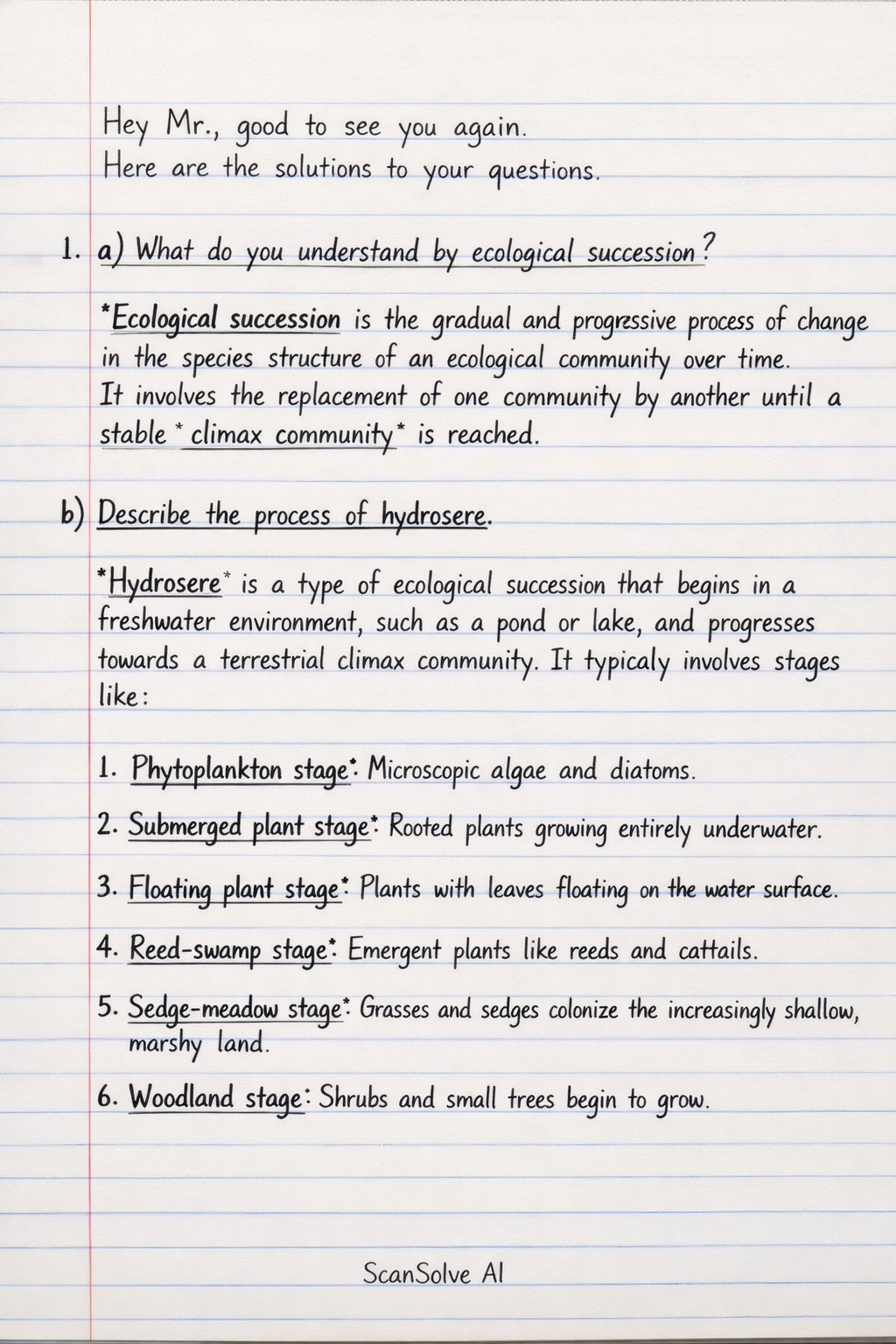
Here are the solutions to your questions.
1. a) What do you understand by ecological succession?
Ecological succession is the gradual and progressive process of change in the species structure of an ecological community over time. It involves the replacement of one community by another until a stable climax community is reached.
b) Describe the process of hydrosere.
Hydrosere is a type of ecological succession that begins in a freshwater environment, such as a pond or lake, and progresses towards a terrestrial climax community. It typically involves stages like:
- Phytoplankton stage: Microscopic algae and diatoms.
- Submerged plant stage: Rooted plants growing entirely underwater.
- Floating plant stage: Plants with leaves floating on the water surface.
- Reed-swamp stage: Emergent plants like reeds and cattails.
- Sedge-meadow stage: Grasses and sedges colonize the increasingly shallow, marshy land.
- Woodland stage: Shrubs and small trees begin to grow.
- Climax forest stage: A stable forest community develops. Each stage modifies the environment, making it suitable for the next.
c) Differentiate between primary and secondary succession.
- Primary succession occurs in an area that is initially devoid of life and soil, such as newly formed volcanic rock or bare sand dunes. It starts with pioneer species colonizing a barren substrate.
- Secondary succession occurs in an area where a pre-existing community has been disturbed or removed (e.g., by fire or logging), but the soil remains intact. It typically proceeds much faster than primary succession due to the presence of existing soil and seeds.
2. a) Discuss the structural features of phloem tissue.
Phloem tissue is responsible for the translocation of sugars and other organic nutrients in plants. Its main structural components include:
- Sieve tube elements: Elongated, living cells arranged end-to-end to form sieve tubes. They lack a nucleus at maturity but contain cytoplasm and have porous end walls called sieve plates for sap flow.
- Companion cells: Specialized parenchyma cells adjacent to sieve tube elements. They are metabolically active, containing a nucleus and numerous organelles, and provide metabolic support to the sieve tube elements.
- Phloem parenchyma: Storage cells for starch, fats, and other organic substances.
- Phloem fibers: Sclerenchymatous cells that provide structural support.
**b) How does translocation of food occur in a monocot such as the
Still stuck on this one?
Ask a follow-up, and the answer starts from this question.
More Biology Questions
Handwritten Step-by-Step Solution
Get this as a handwritten image on WhatsApp — like a tutor wrote it for you.
Try on WhatsApp