
We read your photo as:
Describe the general structure of an amino acid and provide examples of amino acids with hydroxyl, sulfur-containing, aromatic, and basic side chains, including their structures.
ScanSolve AI Answer
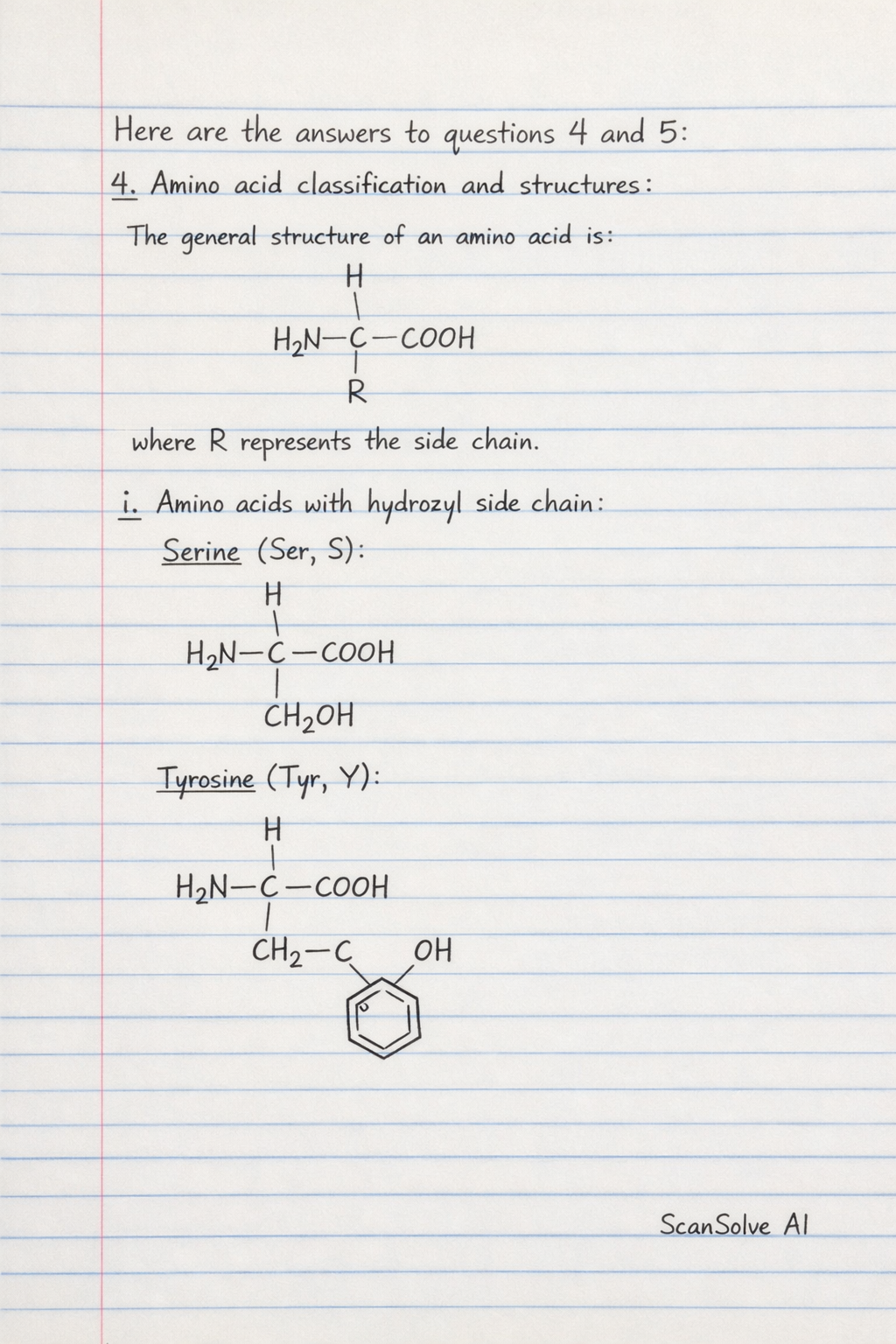
Here are the answers to questions 4 and 5:
4. Amino acid classification and structures:
The general structure of an amino acid is:
where R represents the side chain.
-
i. Amino acids with hydroxyl side chain:
- Serine (Ser, S):
- Tyrosine (Tyr, Y):
-
ii. Amino acids with sulfur-containing side chains:
- Methionine (Met, M):
-
iii. Aromatic amino acids:
- Tyrosine (Tyr, Y): (Structure shown above)
-
iv. Basic amino acids:
- Lysine (Lys, K):
-
v. Acidic amino acids:
- Aspartate (Asp, D):
-
vi. Essential amino acids from the list:
- Valine
- Leucine
- Methionine
- Lysine
5. (a) i. Outline the characteristics of a peptide bond
- A peptide bond is an amide linkage formed by a dehydration reaction between the carboxyl group of one amino acid and the amino group of another amino acid.
- It exhibits partial double-bond character due to resonance between the carbonyl oxygen and the amide nitrogen, making it rigid and planar.
- This partial double-bond character restricts rotation around the bond, but allows rotation around the and bonds.
- The atoms involved in the peptide bond () lie in a single plane.
- The peptide bond is uncharged, but the carbonyl oxygen can act as a hydrogen bond acceptor and the amide hydrogen as a hydrogen bond donor, which are crucial for protein secondary structures.
5. (a) ii. Define Isoelectric point (pI)
The isoelectric point () is the specific pH at which an amino acid, peptide, or protein has no net electrical charge. At this pH, the molecule exists predominantly as a zwitterion, meaning it has an equal number of positive and negative charges, and therefore, its overall charge is zero. At its pI, the molecule will not migrate in an electric field.
Still stuck on this one?
Ask a follow-up, and the answer starts from this question.
More Biology Questions
Handwritten Step-by-Step Solution
Get this as a handwritten image on WhatsApp — like a tutor wrote it for you.
Try on WhatsApp