
We read your photo as:
What are Genetically Modified Organisms (GMOs) and DNA profiling? Include their definitions, processes, and examples.
ScanSolve AI Answer
Step-by-step solution
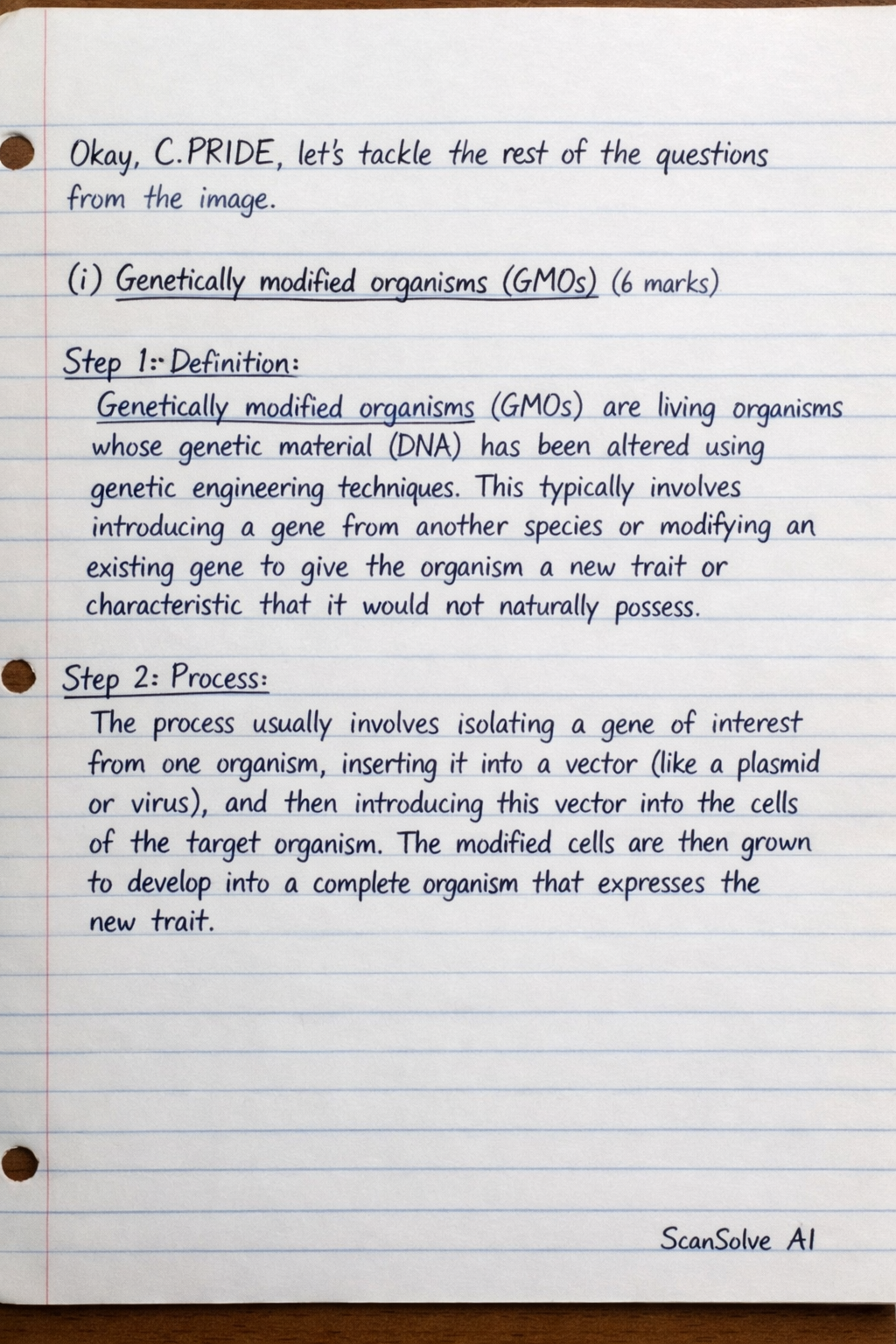
9 stepsOkay, C.PRIDE, let's tackle the rest of the questions from the image.
Part i· 3 steps
Genetically modified organisms (GMOs) (6 marks)
Definition
Genetically modified organisms (GMOs) are living organisms whose genetic material (DNA) has been altered using genetic engineering techniques. This typically involves introducing a gene from another species or modifying an existing gene to give the organism a new trait or characteristic that it would not naturally possess.
Process
The process usually involves isolating a gene of interest from one organism, inserting it into a vector (like a plasmid or virus), and then introducing this vector into the cells of the target organism. The modified cells are then grown to develop into a complete organism that expresses the new trait.
Examples and Purpose
GMOs are commonly created in agriculture to enhance crop characteristics, such as increasing yield, improving resistance to pests (e.g., Bt corn producing its own insecticide) or herbicides (e.g., Roundup Ready soybeans), or enhancing nutritional value (e.g., Golden Rice with increased Vitamin A). They are also used in research and for producing pharmaceuticals.
Part ii· 3 steps
DNA profiling (6 marks)
Definition
DNA profiling, also known as DNA fingerprinting, is a forensic technique used to identify individuals based on unique patterns in their DNA. It analyzes specific regions of DNA that vary greatly among individuals, creating a unique genetic "fingerprint."
Principle
The technique relies on analyzing short tandem repeats (STRs) or variable number tandem repeats (VNTRs), which are short sequences of DNA that are repeated multiple times in a row. The number of repeats at specific locations (loci) on chromosomes varies significantly between individuals. DNA is extracted, amplified using PCR, and then the lengths of these repeated segments are measured and compared, often using gel electrophoresis or capillary electrophoresis.
Applications
DNA profiling has numerous applications, including forensic investigations (identifying suspects or victims at crime scenes), paternity testing, identifying human remains, establishing familial relationships, and studying population genetics.
Part b· 3 steps
Describe the main stages involved in penicillin production (6 marks)
Fermentation
Penicillin is produced through fermentation using the fungus Penicillium chrysogenum. The fungus is grown in large bioreactors (fermenters) containing a nutrient-rich liquid medium, including a carbon source (like glucose or lactose), nitrogen source, and other essential minerals. The conditions, such as temperature, pH, and aeration, are carefully controlled to optimize the growth of the fungus and the production of penicillin.
Extraction
Once the fermentation process is complete and maximum penicillin has been produced, the penicillin needs to be separated from the fungal biomass and the fermentation broth. This is typically achieved by filtering the broth to remove the fungal mycelium. The penicillin, which is soluble in the broth, is then extracted from the aqueous solution into an organic solvent (e.g., amyl acetate) by adjusting the pH.
Purification and Formulation
The penicillin-containing organic solvent is then treated to purify the antibiotic. This often involves further solvent extraction steps, crystallization, and washing to remove impurities. The purified penicillin is then converted into a stable salt form (e.g., penicillin G potassium) and formulated into various dosage forms, such as tablets, capsules, or injectable solutions, ready for medical use.
Part c
Give the advantages and disadvantages of genetic engineering (8 marks)
Advantages of Genetic Engineering:
- Increased Crop Yield and Quality: Genetic engineering can introduce traits like pest resistance (e.g., Bt crops), herbicide tolerance (e.g., Roundup Ready crops), and disease resistance, leading to higher yields and reduced crop losses. It can also improve nutritional content (e.g., Golden Rice).
- Medical Applications: It allows for the production of therapeutic proteins like insulin, human growth hormone, and vaccines in large quantities. Gene therapy holds promise for treating genetic diseases by correcting defective genes.
- Environmental Benefits: Genetically modified crops can reduce the need for chemical pesticides and herbicides, potentially benefiting the environment. Bioengineered microorganisms can be used for bioremediation to clean up pollutants.
- Enhanced Livestock: Genetic engineering can improve animal health, growth rates, and resistance to diseases in livestock, leading to more efficient food production.
Disadvantages of Genetic Engineering:
- Ethical Concerns: There are ethical debates surrounding the manipulation of life forms, particularly regarding human gene editing and the potential for "designer babies." Concerns also exist about animal welfare in genetically modified livestock.
- Environmental Risks: There are concerns about the potential for genetically modified organisms (GMOs) to cross-pollinate with wild relatives, leading to the transfer of engineered genes (e.g., herbicide resistance) to weeds, creating "superweeds." There are also worries about the impact on biodiversity and non-target organisms.
- Unforeseen Health Effects: While regulatory bodies deem current GMOs safe, some critics raise concerns about potential long-term health effects of consuming genetically modified foods, such as allergic reactions or the creation of new toxins, though scientific consensus generally supports their safety.
- Economic and Social Issues: The dominance of a few large corporations in the GMO seed market can lead to monopolies, increased costs for farmers, and reduced seed diversity. There are also concerns about intellectual property rights over genetically modified organisms.
Still stuck on this one?
Ask a follow-up, and the answer starts from this question.
More Biology Questions
Handwritten Step-by-Step Solution
Get this as a handwritten image on WhatsApp — like a tutor wrote it for you.
Try on WhatsApp