

This biology question covers important biological concepts and processes. The step-by-step explanation below helps you understand the underlying mechanisms and reasoning.
ScanSolve AI Answer
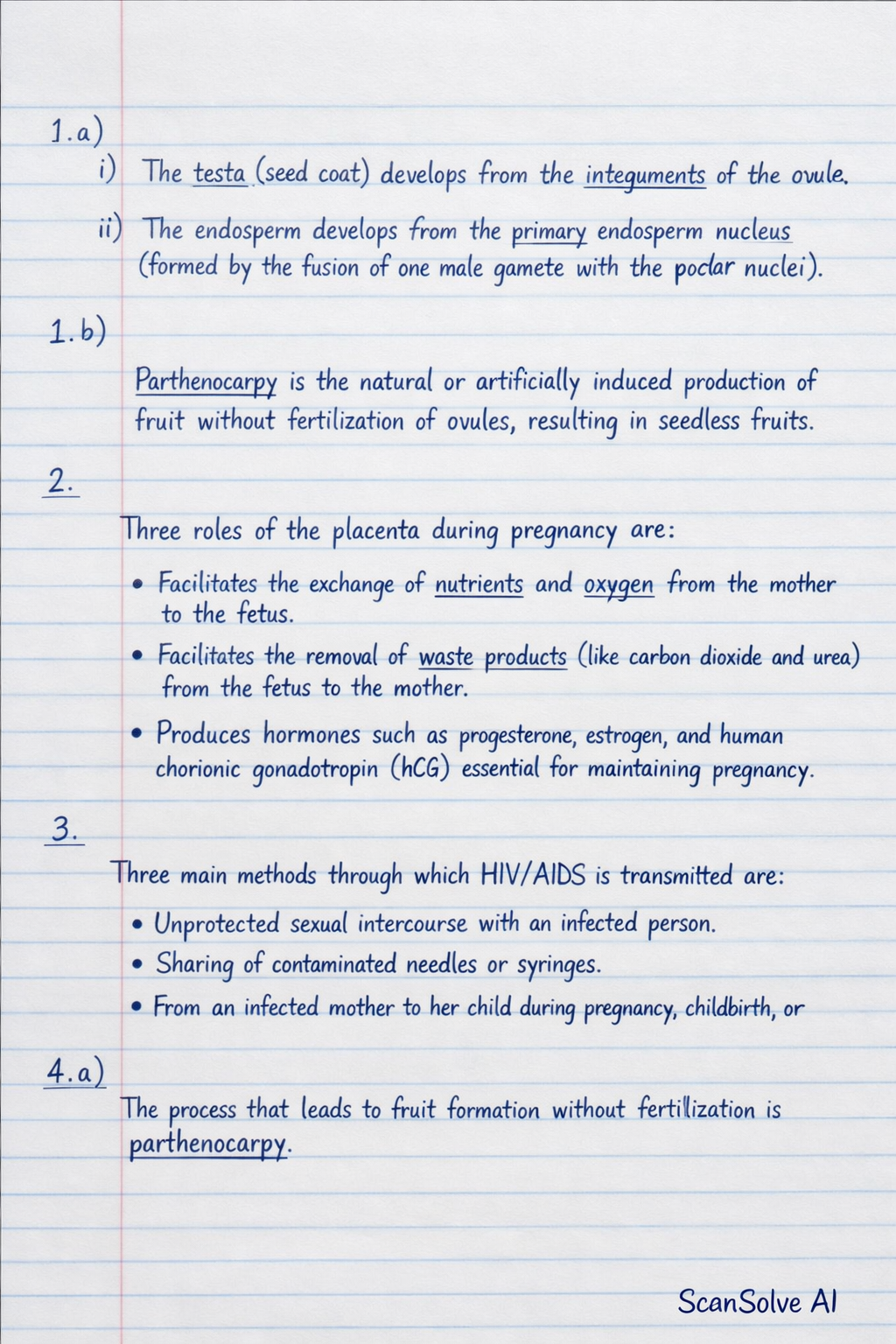
1. a) i) The testa (seed coat) develops from the integuments of the ovule. ii) The endosperm develops from the primary endosperm nucleus (formed by the fusion of one male gamete with the two polar nuclei). 1. b) Parthenocarpy is the natural or artificially induced production of fruit without fertilization of ovules, resulting in seedless fruits. 2. Three roles of the placenta during pregnancy are: • Facilitates the exchange of nutrients and oxygen from the mother to the fetus. • Facilitates the removal of waste products (like carbon dioxide and urea) from the fetus to the mother. • Produces hormones such as progesterone, estrogen, and human chorionic gonadotropin (hCG) essential for maintaining pregnancy. 3. Three main methods through which HIV/AIDS is transmitted are: • Unprotected sexual intercourse with an infected person. • Sharing of contaminated needles or syringes. • From an infected mother to her child during pregnancy, childbirth, or breastfeeding. 4. a) The process that leads to fruit formation without fertilization is parthenocarpy. 4. b) The hormone that causes leaf, flower, and fruit abscission is abscisic acid (ABA) or ethylene. 4. c) The role of ecdysone hormone in insects is to regulate molting (ecdysis) and metamorphosis. 5. The roles of the oviduct (fallopian tube) in the female reproductive system are: • It is the site where fertilization typically occurs. • It provides a pathway for the egg to travel from the ovary to the uterus. • Its ciliated lining helps to propel the egg towards the uterus. 6. a) X: Antipodal cells Y: Egg cell 6. b) Cross-pollination is more advantageous to a plant species than self-pollination because it leads to greater genetic variation in the offspring. This increased variation enhances the species' ability to adapt to changing environmental conditions and improves its chances of survival and evolution. 7. a) The part labeled T is a chromatid. 7. b) (i) The biological importance of a chromatid is that it is one of the two identical halves of a duplicated chromosome, ensuring that during cell division, each daughter cell receives a complete and identical set of genetic material. Send me the next one 📸