
We read your photo as:
Identify and describe the function/purpose of the following specimens: A - Dry hide of sheep, B - Hoof of a sheep, C - Ear of a sheep, D - Tail of a sheep, E - Pepper plant showing leaf curl disease,
Biology
ScanSolve AI Answer
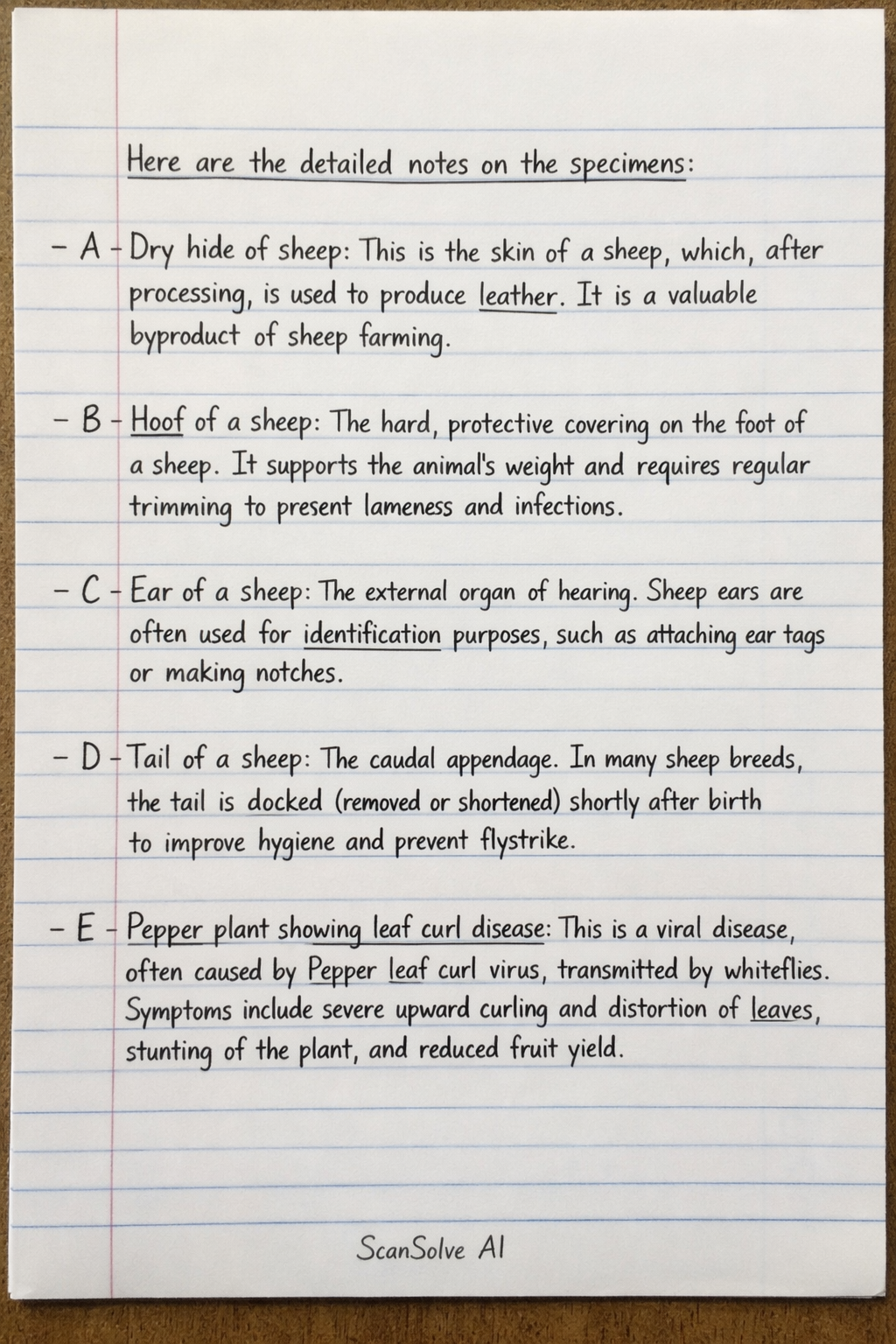
Here are the detailed notes on the specimens:
- A - Dry hide of sheep: This is the skin of a sheep, which, after processing, is used to produce leather. It is a valuable byproduct of sheep farming.
- B - Hoof of a sheep: The hard, protective covering on the foot of a sheep. It supports the animal's weight and requires regular trimming to prevent lameness and infections.
- C - Ear of a sheep: The external organ of hearing. Sheep ears are often used for identification purposes, such as attaching ear tags or making notches.
- D - Tail of a sheep: The caudal appendage. In many sheep breeds, the tail is docked (removed or shortened) shortly after birth to improve hygiene and prevent flystrike.
- E - Pepper plant showing leaf curl disease: This is a viral disease, often caused by Pepper leaf curl virus, transmitted by whiteflies. Symptoms include severe upward curling and distortion of leaves, stunting of the plant, and reduced fruit yield.
- F - Cassava plant showing mosaic disease: A widespread viral disease, primarily Cassava mosaic virus, transmitted by whiteflies. It causes characteristic yellow and green mottling on leaves, leaf distortion, and significant reduction in tuber yield.
- G - Cassava starch: A carbohydrate extracted from cassava tubers. It is widely used as a thickener in food products, and in industrial applications like textiles, paper, and adhesives.
- H - Mouldy maize grain: Maize grain contaminated by various fungi (moulds). This indicates poor storage conditions and can lead to the production of mycotoxins (e.g., aflatoxins), which are harmful to humans and livestock.
- J - Maize grain: The edible kernel of the maize (corn) plant. It is a major staple food crop globally and a primary source of animal feed, rich in carbohydrates.
- K - Onion bulb showing color rot: This typically refers to a fungal disease, such as anthracnose or other storage rots. Symptoms include discolored, sunken lesions on the bulb, leading to softening and decay, often occurring during storage.
- M - Sweet potato: A starchy, sweet-tasting root vegetable (storage root). It is a significant food crop, rich in carbohydrates, dietary fiber, and vitamins, particularly vitamin A.
- N - Folic acid: Also known as vitamin B9, it is essential for cell division and growth. In agriculture, it is often supplemented in animal feed to support reproductive health and overall growth.
- P - Cassava tuber: The large, starchy underground storage root of the cassava plant. It is a vital staple food in tropical regions but requires proper processing (e.g., peeling, grating, cooking) to remove toxic cyanogenic compounds.
- Q - Yam tuber: The starchy, edible underground stem (tuber) of the yam plant. It is a major staple food crop, especially in West Africa, providing a significant source of carbohydrates.
Was this helpful?
Still stuck on this one?
Ask a follow-up, and the answer starts from this question.
Got a different question?Ask your own question
More Biology Questions
QIdentify specimens A, B, and C from the livestock practical exam.QIdentify specimens D, E, and F from an image (not provided) and answer the following: a) State four…QMention three uses of each of specimens A, B and C in animal husbandry.QIdentify all the items listed under "Livestock farming" in the image, and specifically identify…Q2026 WAEC BIOLOGY PRACTICAL Specimen A: Bean weevil Specimen B: Bean seeds (with holes) Specimen C…
Handwritten Step-by-Step Solution
Get this as a handwritten image on WhatsApp — like a tutor wrote it for you.
Try on WhatsApp