
We read your photo as:
Identify the correct term for each of the following descriptions: lag phase, binary fission, virus, thermophilic bacteria habitat, Rhizobium's role, mycology, discoverer of microorganisms, and bacteri
ScanSolve AI Answer
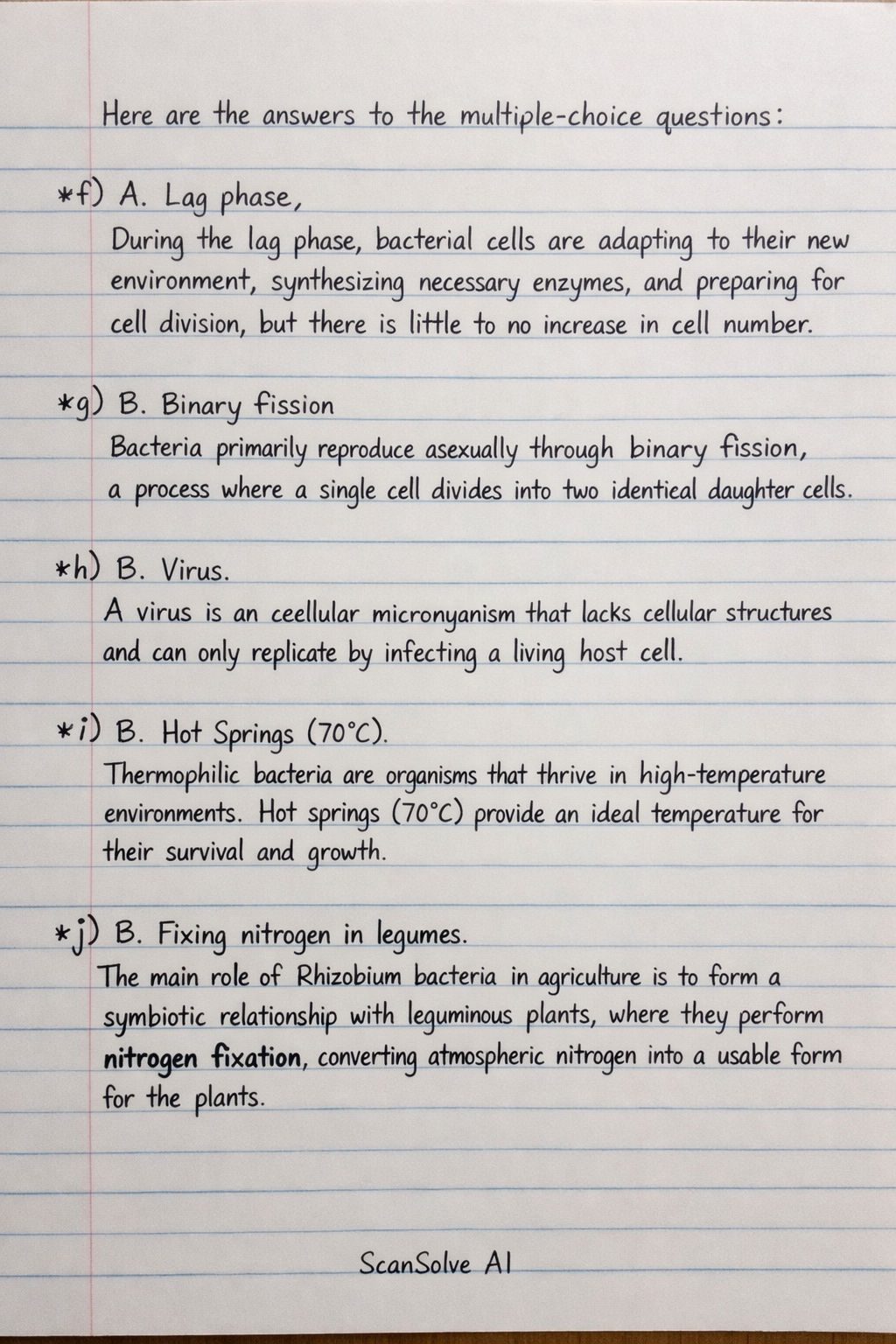
Here are the answers to the multiple-choice questions:
f) A. Lag phase
During the lag phase, bacterial cells are adapting to their new environment, synthesizing necessary enzymes, and preparing for cell division, but there is little to no increase in cell number.
g) B. Binary fission
Bacteria primarily reproduce asexually through binary fission, a process where a single cell divides into two identical daughter cells.
h) B. Virus
A virus is an acellular microorganism that lacks cellular structures and can only replicate by infecting a living host cell.
i) B. Hot Springs (70°C)
Thermophilic bacteria are organisms that thrive in high-temperature environments. Hot springs (70°C) provide an ideal temperature for their survival and growth.
j) B. Fixing nitrogen in legumes
The main role of Rhizobium bacteria in agriculture is to form a symbiotic relationship with leguminous plants, where they perform nitrogen fixation, converting atmospheric nitrogen into a usable form for the plants.
k) C. Fungi
Mycology is the branch of biology dedicated to the study of fungi.
l) B. Antony van Leeuwenhoek
Antony van Leeuwenhoek is widely recognized as the first scientist to observe and describe microorganisms using his self-made simple microscopes.
m) C. Stationary phase
In the stationary phase of bacterial growth, the rate of cell division is approximately equal to the rate of cell death, often due to nutrient depletion and the accumulation of waste products.
n) C. Facultative anaerobe
A facultative anaerobe is a bacterium that can grow in the presence of oxygen but can also switch to anaerobic metabolism and survive in its absence.
Still stuck on this one?
Ask a follow-up, and the answer starts from this question.
More Biology Questions
Handwritten Step-by-Step Solution
Get this as a handwritten image on WhatsApp — like a tutor wrote it for you.
Try on WhatsApp