

This biology question covers important biological concepts and processes. The step-by-step explanation below helps you understand the underlying mechanisms and reasoning.
ScanSolve AI Answer
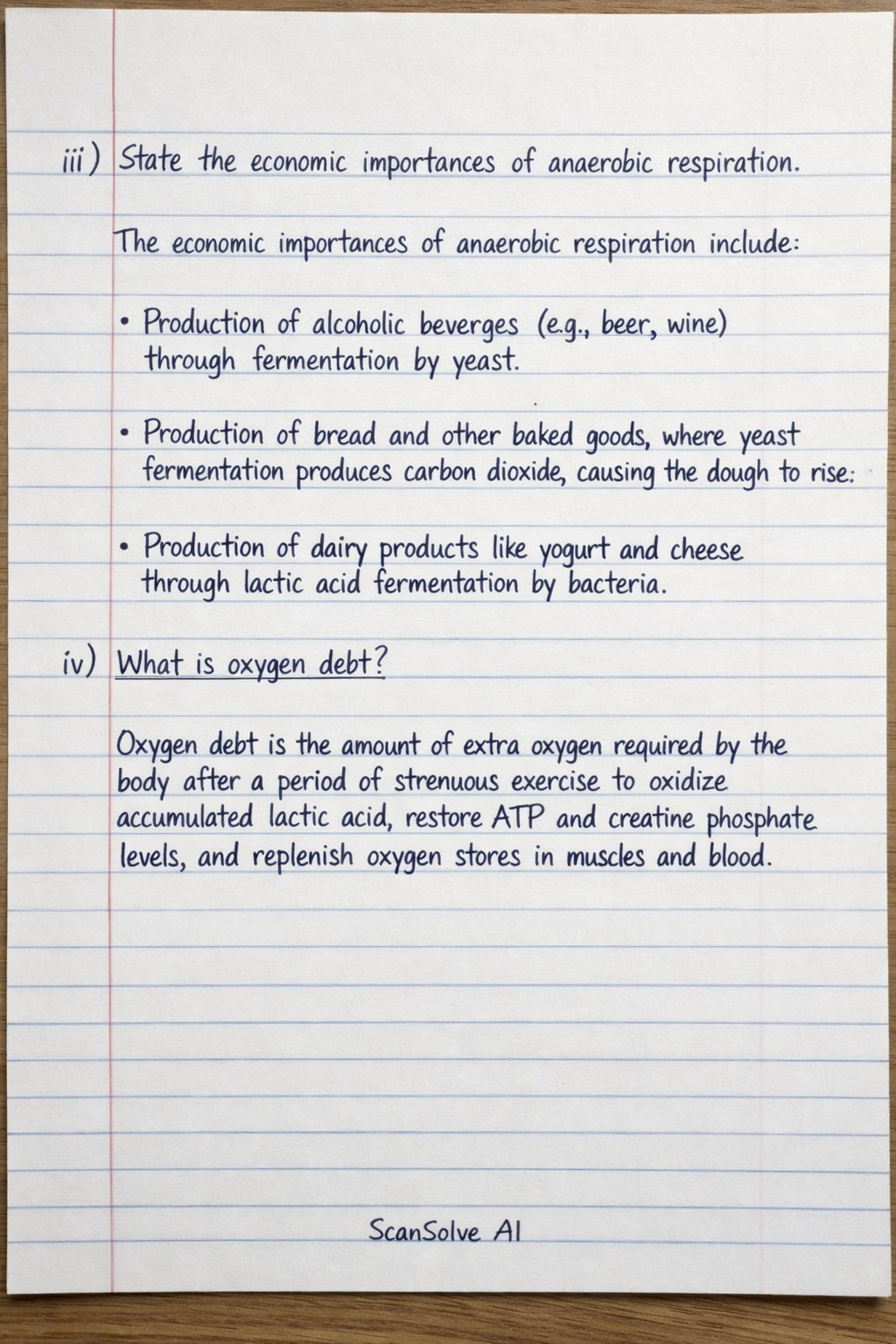
iii) State the economic importances of anaerobic respiration. The economic importances of anaerobic respiration include: • Production of alcoholic beverages (e.g., beer, wine) through fermentation by yeast. • Production of bread and other baked goods, where yeast fermentation produces carbon dioxide, causing the dough to rise. • Production of dairy products like yogurt and cheese through lactic acid fermentation by bacteria. iv) What is oxygen debt? Oxygen debt is the amount of extra oxygen required by the body after a period of strenuous exercise to oxidize accumulated lactic acid, restore ATP and creatine phosphate levels, and replenish oxygen stores in muscles and blood. 7. Define the following terms. a) phagocytosis: Phagocytosis is a cellular process by which a cell engulfs solid particles, such as bacteria, dead cells, or other debris, by extending its plasma membrane around them to form an internal vesicle called a phagosome. b) Nitrification: Nitrification is a two-step biological process in the nitrogen cycle where ammonia (NH_3) or ammonium (NH_4^+) is oxidized by nitrifying bacteria into nitrites (NO_2^-) and then into nitrates (NO_3^-). c) predation: Predation is an ecological interaction where one organism, the predator, hunts, kills, and consumes another organism, the prey, for food. 8. Describe the following biotic factors of an ecosystem. a) competition: Competition is an interaction between organisms or species in which the fitness of one is lowered by the presence of another. This occurs when two or more organisms require the same limited resources (e.g., food, water, light, space, mates) that are not sufficient to satisfy all of them. Competition can be intraspecific (between individuals of the same species) or interspecific (between individuals of different species). b) parasitism: Parasitism is a symbiotic relationship between two species where one organism, the parasite, lives on or in another organism, the host, and benefits by deriving nutrients at the host's expense. The parasite typically harms the host, but usually does not kill it directly, as its survival depends on the host. 9. Give three characteristics of monosaccharides. Three characteristics of monosaccharides are: • They are simple sugars and cannot be hydrolyzed into smaller carbohydrate units. • They are generally sweet-tasting. • They are soluble in water.