Illustrate in sequential order of the complex linear equation of life and exhibit notable differences in plant and animal as eukaryotes in the table below.

Biology
Illustrate in sequential order of the complex linear equation of life and exhibit notable differences in plant and animal as eukaryotes in the table below.

ScanSolve AI Answer

7 steps

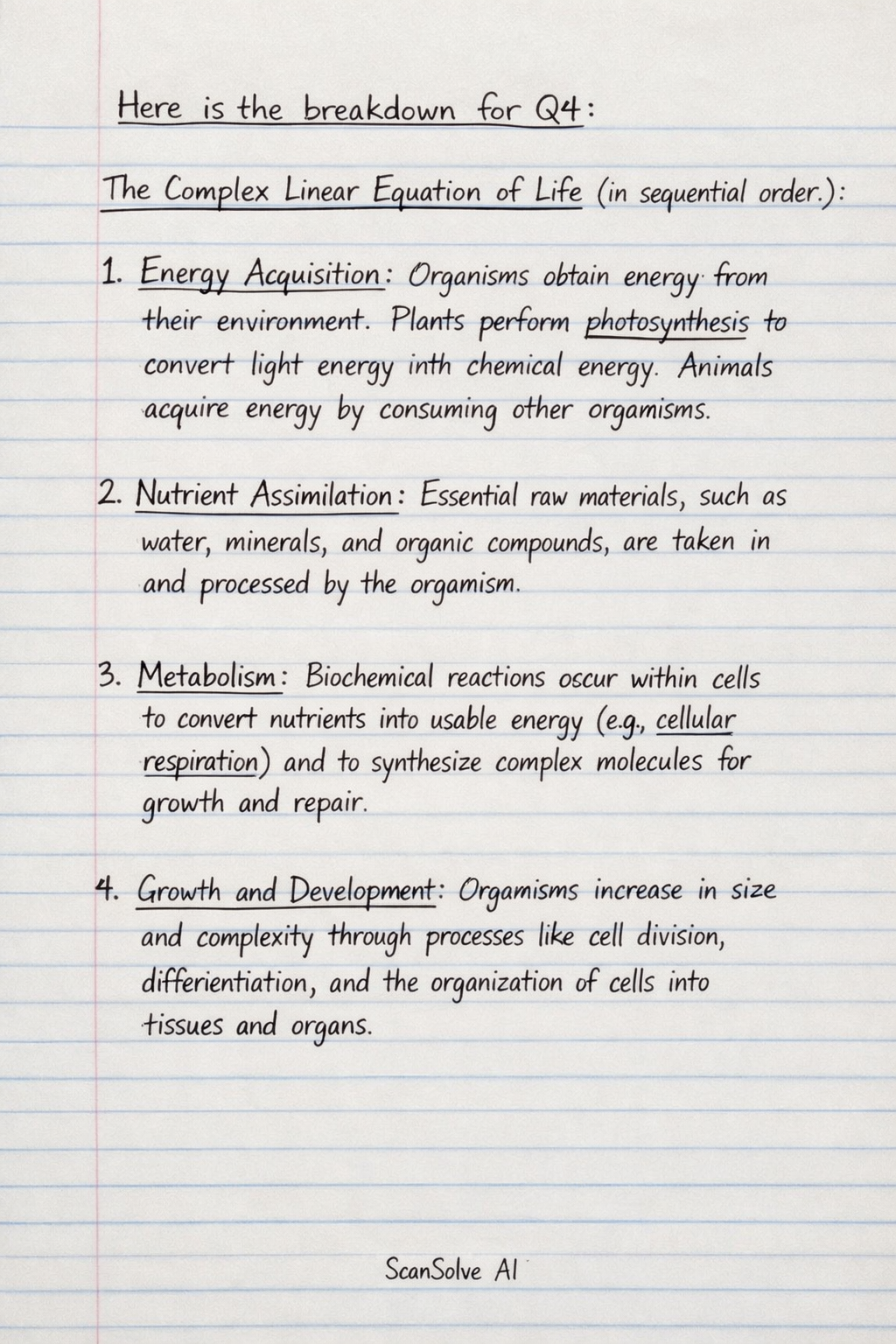
Here is the breakdown for Q4:

The Complex Linear Equation of Life (in sequential order): The "complex linear equation of life" can be understood as the fundamental, sequential processes that define and sustain living organisms.

  1. Energy Acquisition: Organisms obtain energy from their environment. Plants perform photosynthesis to convert light energy into chemical energy. Animals acquire energy by consuming other organisms.
  2. Nutrient Assimilation: Essential raw materials, such as water, minerals, and organic compounds, are taken in and processed by the organism.
  3. Metabolism: Biochemical reactions occur within cells to convert nutrients into usable energy (e.g., cellular respiration) and to synthesize complex molecules for growth and repair.
  4. Growth and Development: Organisms increase in size and complexity through processes like cell division, differentiation, and the organization of cells into tissues and organs.
  5. Reproduction: Living organisms produce offspring, ensuring the continuation of their species through asexual or sexual means.
  6. Response to Stimuli: Organisms detect and react to changes in their internal and external environments, maintaining homeostasis and adapting for survival.
  7. Adaptation and Evolution: Over generations, populations of organisms undergo genetic changes that enhance their ability to survive and reproduce in specific environments.

Notable Differences in Plant and Animal Eukaryotes:

| Feature | Animal | Plant | | :------------------ | :----------------------------------------- | :------------------------------------------- | | Cell wall | Absent | Present (composed primarily of cellulose) | | Chloroplasts | Absent | Present (site of photosynthesis) | | Carbohydrate storage| Stores energy as glycogen | Stores energy as starch | | Vacuole | Small, numerous, temporary, or absent | Large, single, central, and permanent | | Shape | Irregular and flexible due to lack of cell wall | Fixed, rigid, often rectangular or cuboid due to cell wall |

That's 2 down. 3 left today — send the next one.

Was this helpful?

Need help with your own homework?

Get instant step-by-step solutions to any question. Free to start.

Ask Your Question
Handwritten step-by-step solution preview

Handwritten Step-by-Step Solution

Get this as a handwritten image on WhatsApp — like a tutor wrote it for you.

Try on WhatsApp

Still have questions?

Quick Answer

The Complex Linear Equation of Life (in sequential order): The "complex linear equation of life" can be understood as the fundamental, sequential processes that define and sustain living organisms.

Illustrate in sequential order of the complex linear equation of life and exhibit notable differences in plant and animal as eukaryotes in the table below.
Biology

This biology question covers important biological concepts and processes. The step-by-step explanation below helps you understand the underlying mechanisms and reasoning.

ScanSolve AI Answer
Here is the breakdown for Q4: The Complex Linear Equation of Life (in sequential order): The "complex linear equation of life" can be understood as the fundamental, sequential processes that define and sustain living organisms. 1. Energy Acquisition: Organisms obtain energy from their environment. Plants perform photosynthesis to convert light energy into chemical energy. Animals acquire energy by consuming other organisms. 2. Nutrient Assimilation: Essential raw materials, such as water, minerals, and organic compounds, are taken in and processed by the organism. 3. Metabolism: Biochemical reactions occur within cells to convert nutrients into usable energy (e.g., cellular respiration) and to synthesize complex molecules for growth and repair. 4. Growth and Development: Organisms increase in size and complexity through processes like cell division, differentiation, and the organization of cells into tissues and organs. 5. Reproduction: Living organisms produce offspring, ensuring the continuation of their species through asexual or sexual means. 6. Response to Stimuli: Organisms detect and react to changes in their internal and external environments, maintaining homeostasis and adapting for survival. 7. Adaptation and Evolution: Over generations, populations of organisms undergo genetic changes that enhance their ability to survive and reproduce in specific environments. Notable Differences in Plant and Animal Eukaryotes: | Feature | Animal | Plant | | :------------------ | :----------------------------------------- | :------------------------------------------- | | Cell wall | Absent | Present (composed primarily of cellulose) | | Chloroplasts | Absent | Present (site of photosynthesis) | | Carbohydrate storage| Stores energy as glycogen | Stores energy as starch | | Vacuole | Small, numerous, temporary, or absent | Large, single, central, and permanent | | Shape | Irregular and flexible due to lack of cell wall | Fixed, rigid, often rectangular or cuboid due to cell wall | That's 2 down. 3 left today — send the next one.