
We read your photo as:
What is immunity and what are its types and how does a child obtain natural and artificial immunity?
ScanSolve AI Answer
Step-by-step solution
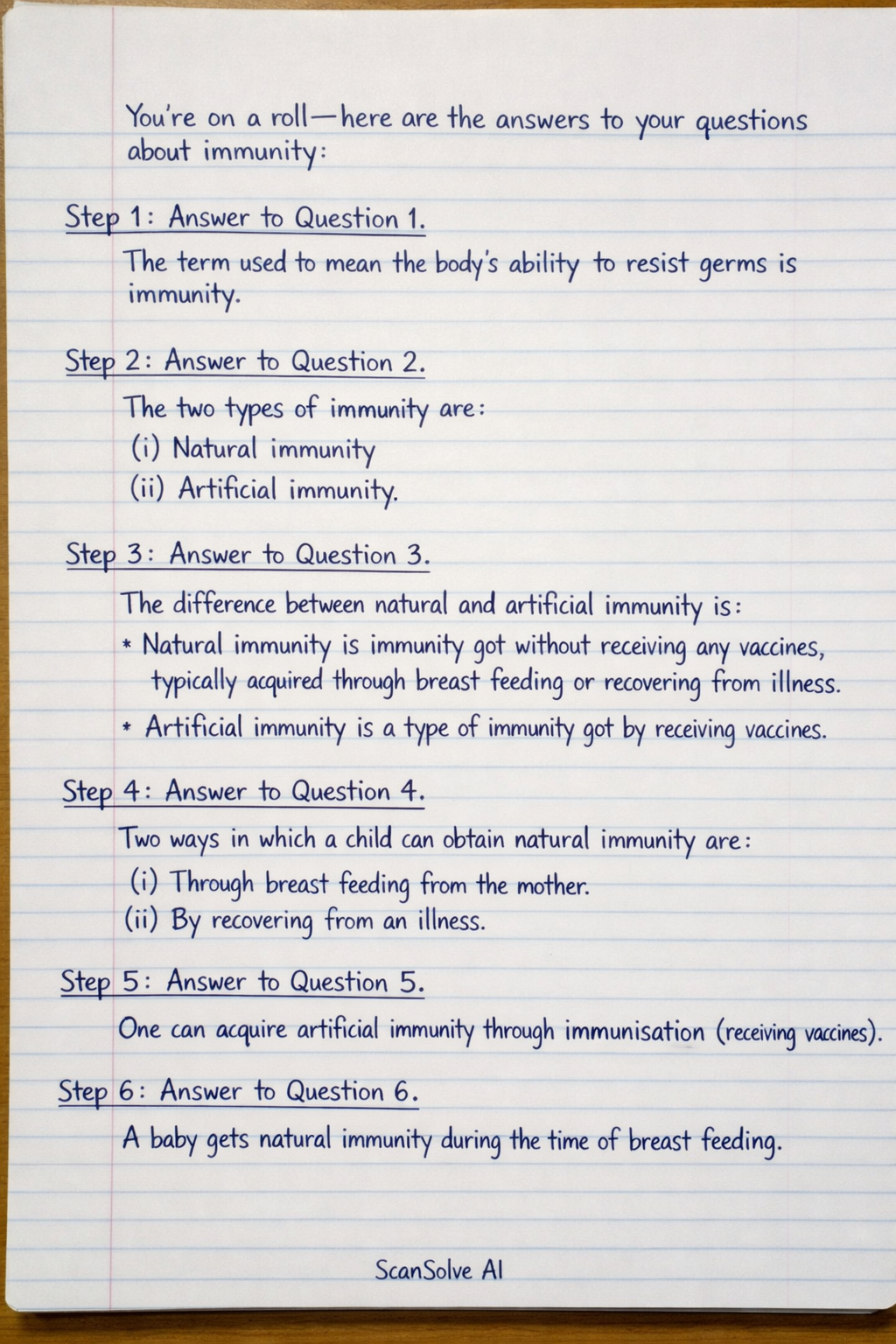
11 stepshere are the answers to your questions about immunity:
Answer to Question 1.
The term used to mean the body's ability to resist germs is immunity.
Answer to Question 2.
The two types of immunity are:
- (i) Natural immunity
- (ii) Artificial immunity
Answer to Question 3.
The difference between natural and artificial immunity is:
- Natural immunity is immunity got without receiving any vaccines, typically acquired through breast feeding or recovering from illness.
- Artificial immunity is a type of immunity got by receiving vaccines.
Answer to Question 4.
Two ways in which a child can obtain natural immunity are:
- (i) Through breast feeding from the mother.
- (ii) By recovering from an illness.
Answer to Question 5.
One can acquire artificial immunity through immunisation (receiving vaccines).
Answer to Question 6.
A baby gets natural immunity during the time of breast feeding.
Answer to Question 7.
Immunity is important to the body because it protects the body from diseases caused by germs and other harmful substances.
Answer to Question 8.
Measles vaccine is administered to a child through an injection.
Answer to Question 9.
DPT vaccines are first given to a child at 6 weeks of age.
Answer to Question 10.
Health workers administer the Tetanus Toxoid (TT) vaccine to pregnant women and teenage girls.
Answer to Question 11.
DPT vaccine is called a triple vaccine because it protects against three different diseases: Diphtheria, Pertussis (whooping cough), and Tetanus.
Still stuck on this one?
Ask a follow-up, and the answer starts from this question.
More Biology Questions
Handwritten Step-by-Step Solution
Get this as a handwritten image on WhatsApp — like a tutor wrote it for you.
Try on WhatsApp