
We read your photo as:
Distinguish between Antigen and antibody, Active immunity and passive immunity, and explain why the body does not develop full immunity against some diseases like malaria.
ScanSolve AI Answer
Step-by-step solution
5 stepsPart a(i)
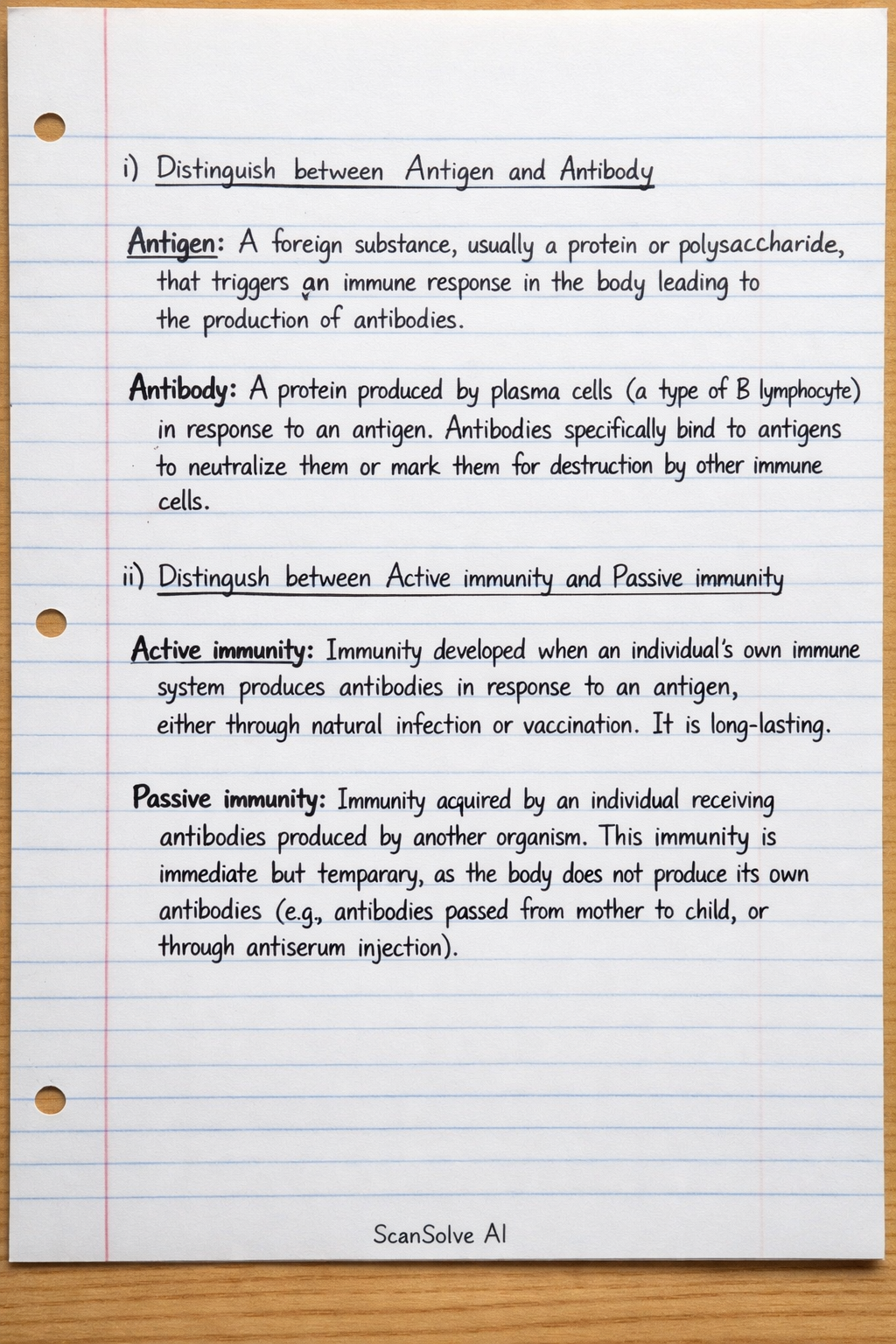
Distinguish between Antigen and antibody
- Antigen: A foreign substance, usually a protein or polysaccharide, that triggers an immune response in the body, leading to the production of antibodies.
- Antibody: A protein produced by plasma cells (a type of B lymphocyte) in response to an antigen. Antibodies specifically bind to antigens to neutralize them or mark them for destruction by other immune cells.
Part a(ii)
Distinguish between Active immunity and passive immunity
- Active immunity: Immunity developed when an individual's own immune system produces antibodies in response to an antigen, either through natural infection or vaccination. It is long-lasting.
- Passive immunity: Immunity acquired by an individual receiving antibodies produced by another organism. This immunity is immediate but temporary, as the body does not produce its own antibodies (e.g., antibodies passed from mother to child, or through antiserum injection).
Part b
Explain why the body does not develop full immunity against some diseases e.g malaria
The body does not develop full immunity against diseases like malaria because the causative parasite, Plasmodium, exhibits significant antigenic variation. This means the parasite frequently changes its surface proteins, making it difficult for the immune system to recognize and mount a sustained, effective response against all forms of the parasite. The complex life cycle of the parasite also contributes to immune evasion.
Part c
Why is prevention better than cure?
Prevention is better than cure because it avoids the onset of disease, thereby preventing suffering, disability, and potential death. It also reduces healthcare costs, minimizes the spread of infectious diseases, and maintains overall public health and productivity, whereas a cure often involves costly and sometimes painful treatments after the damage has already occurred.
Part d· 5 steps
Describe the mechanism of blood clotting.
When a blood vessel is injured, platelets adhere to the damaged site and release clotting factors.
Damaged tissue cells also release clotting factors.
These factors initiate a cascade of reactions.
Prothrombin, an inactive plasma protein, is converted into its active form, thrombin, in the presence of calcium ions and other clotting factors.
Thrombin then acts as an enzyme to convert soluble plasma protein fibrinogen into insoluble fibrin monomers.
Fibrin monomers polymerize to form a mesh-like network of threads that traps red blood cells and more platelets, forming a stable blood clot that seals the wound and stops bleeding.
Still stuck on this one?
Ask a follow-up, and the answer starts from this question.
More Biology Questions
Handwritten Step-by-Step Solution
Get this as a handwritten image on WhatsApp — like a tutor wrote it for you.
Try on WhatsApp