

This biology question covers important biological concepts and processes. The step-by-step explanation below helps you understand the underlying mechanisms and reasoning.
ScanSolve AI Answer
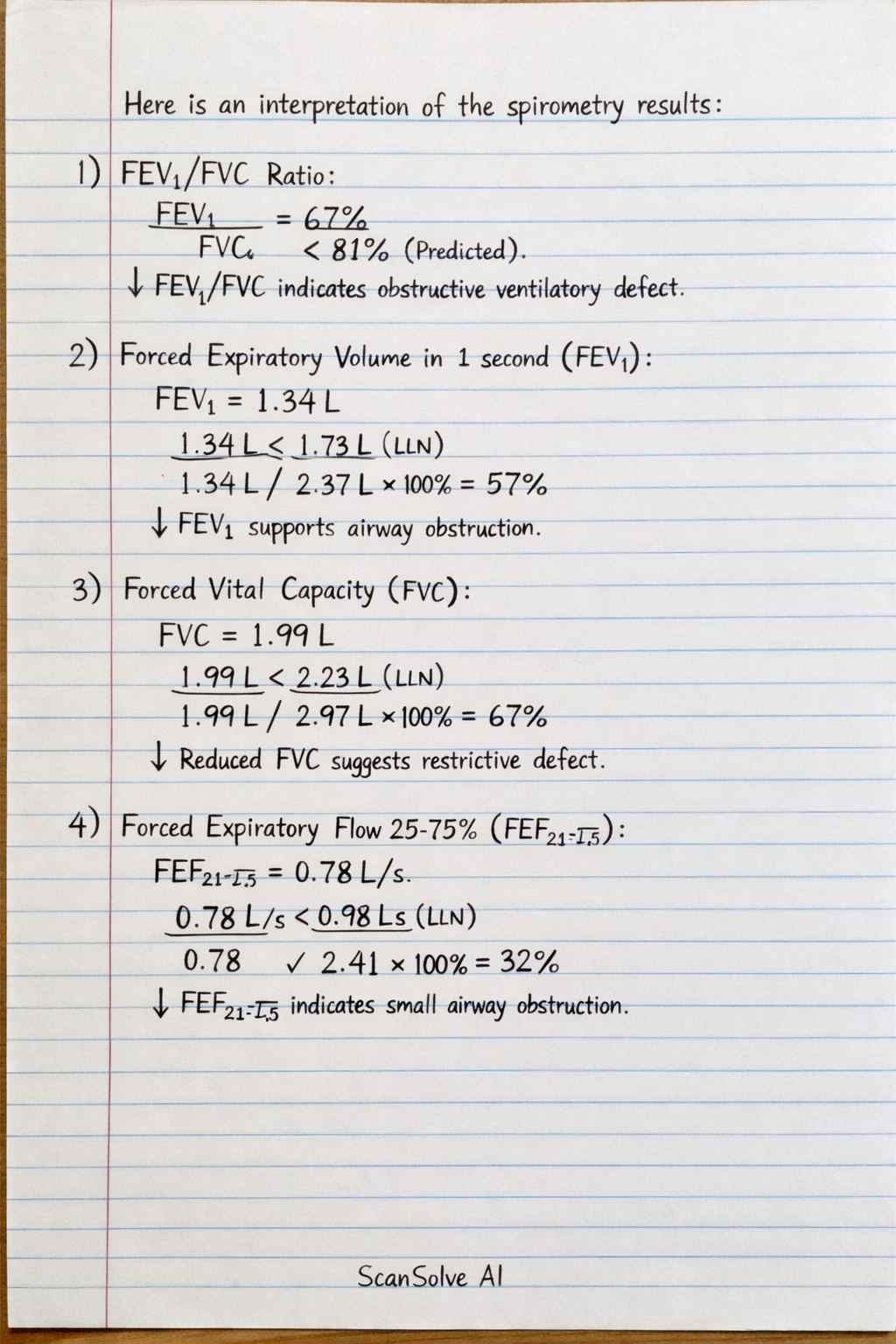
Here is an interpretation of the spirometry results: 1. FEV1/FVC Ratio: The measured FEV1/FVC ratio is 67\%. This is below the Lower Limit of Normal (LLN) of 70\% and the predicted value of 81\%. A reduced FEV1/FVC ratio is the primary indicator of an obstructive ventilatory defect. 2. Forced Expiratory Volume in 1 second (FEV1): The measured FEV1 is 1.34 L, which is 57\% of the predicted value (2.37 L) and below the LLN of 1.73 L. This significant reduction in FEV1 further supports the presence of airway obstruction. 3. Forced Vital Capacity (FVC): The measured FVC is 1.99 L, which is 67\% of the predicted value (2.97 L) and below the LLN of 2.23 L. A reduced FVC suggests a restrictive ventilatory defect. 4. Forced Expiratory Flow 25-75% (FEF25-75): The measured FEF25-75 is 0.78 L/s, which is only 32\% of the predicted value (2.41 L/s) and below the LLN of 0.98 L/s. This parameter is a sensitive indicator of small airway obstruction. 5. Forced Expiratory Time (FET): The FET is 12.89 seconds, which is prolonged, consistent with airway obstruction. Conclusion: Based on these findings, the spirometry results indicate a mixed ventilatory defect. This is because: The FEV1/FVC ratio is reduced (67\% < 70\% LLN), confirming an obstructive component*. The FVC is also reduced (1.99 L < 2.23 L LLN), confirming a restrictive component*. The preliminary impression on the report also aligns with this, stating "FEV1/VC and VC are reduced indicating Obstruction or a Mixed Obstructive/Restrictive pattern." That's 2 down. 3 left today — send the next one.