
We read your photo as:
List and describe 5 types of synovial joints and their movements.
Biology
ScanSolve AI Answer
The assignment asks to list 5 other types of joints and draw them. Since I cannot draw, I will describe each joint type and its characteristic movement.
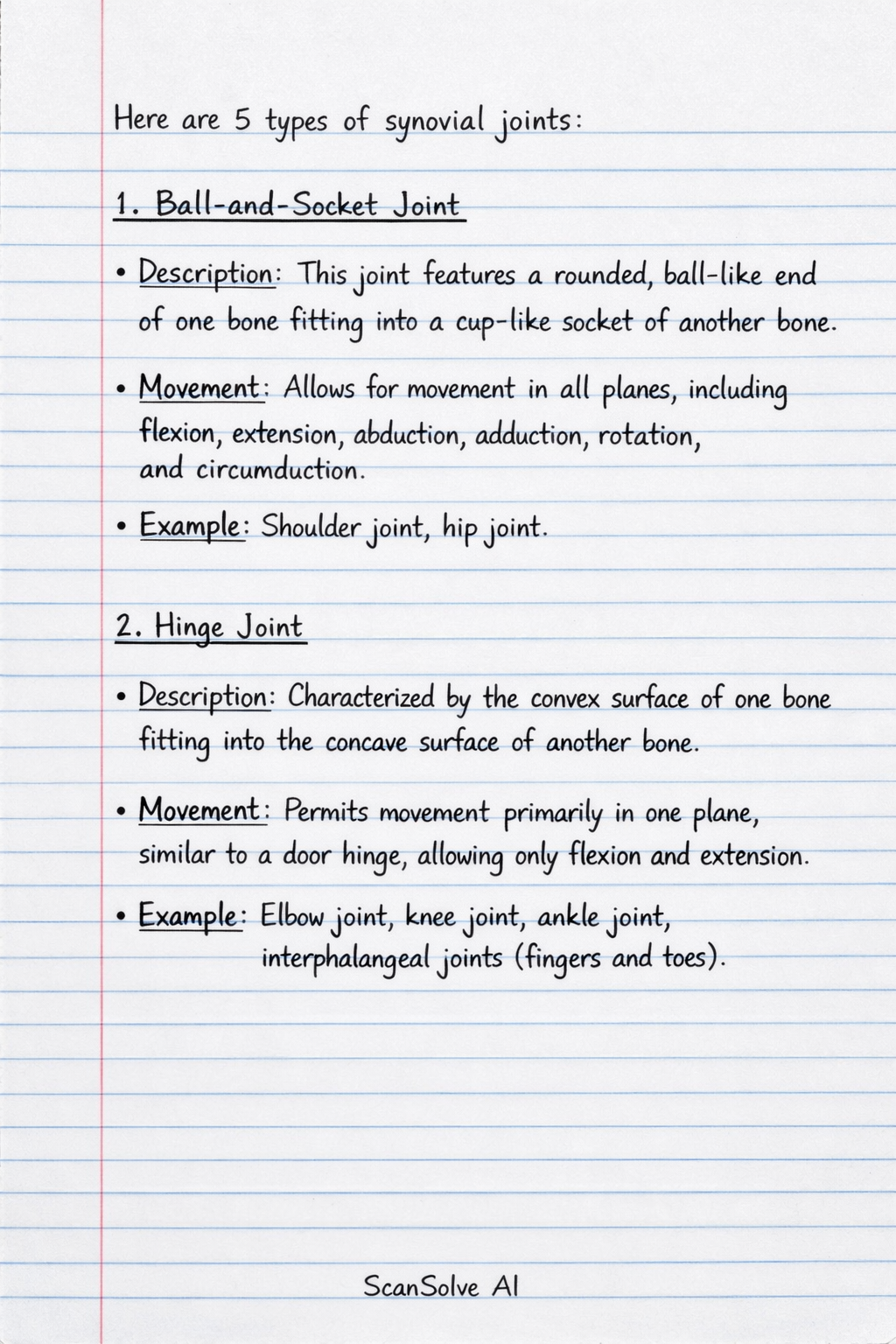
Here are 5 types of synovial joints:
-
Ball-and-Socket Joint
- Description: This joint features a rounded, ball-like end of one bone fitting into a cup-like socket of another bone.
- Movement: Allows for movement in all planes, including flexion, extension, abduction, adduction, rotation, and circumduction.
- Example: Shoulder joint, hip joint.
-
Hinge Joint
- Description: Characterized by the convex surface of one bone fitting into the concave surface of another bone.
- Movement: Permits movement primarily in one plane, similar to a door hinge, allowing only flexion and extension.
- Example: Elbow joint, knee joint, ankle joint, interphalangeal joints (fingers and toes).
-
Pivot Joint
- Description: In this joint, a rounded or pointed surface of one bone articulates with a ring formed partly by another bone and partly by a ligament.
- Movement: Allows for rotation around a central axis.
- Example: Atlanto-axial joint (between the atlas and axis vertebrae, allowing head rotation), radioulnar joint (allowing pronation and supination of the forearm).
-
Condyloid (Ellipsoidal) Joint
- Description: An oval-shaped condyle of one bone fits into an elliptical cavity of another bone.
- Movement: Allows for movement in two planes (biaxial), including flexion, extension, abduction, adduction, and circumduction, but no axial rotation.
- Example: Radiocarpal joint (wrist joint), metacarpophalangeal joints (knuckles).
-
Saddle Joint
- Description: Both articulating bones have a saddle shape, with one surface being concave in one direction and convex in the other, and the other surface being the reciprocal.
- Movement: Allows for biaxial movement, including flexion, extension, abduction, adduction, and circumduction. It provides more freedom of movement than a condyloid joint.
- Example: Carpometacarpal joint of the thumb.
Was this helpful?
Still stuck on this one?
Ask a follow-up, and the answer starts from this question.
Got a different question?Ask your own question
More Biology Questions
QDescribe the components of a synovial joint, Hilton's Law, the difference between median sagittal…QDefine anatomical position and state its purpose. Complete the table of synovial joints and their…QDescribe the components of a synovial joint, explain Hilton's law, differentiate between median and…QList five functions of the human skeletal system and distinguish between cartilage and bone in a…QDefine and provide examples for the following anatomical movements: Dorsum faces anteriorly…
Handwritten Step-by-Step Solution
Get this as a handwritten image on WhatsApp — like a tutor wrote it for you.
Try on WhatsApp