
We read your photo as:
List four adaptive features of Schistosoma, the disease it causes, and complete the table for Plasmodium, Vibrio cholerae, and Entamoeba histolytica. Define mutation and explain antibiotic resistance.
ScanSolve AI Answer
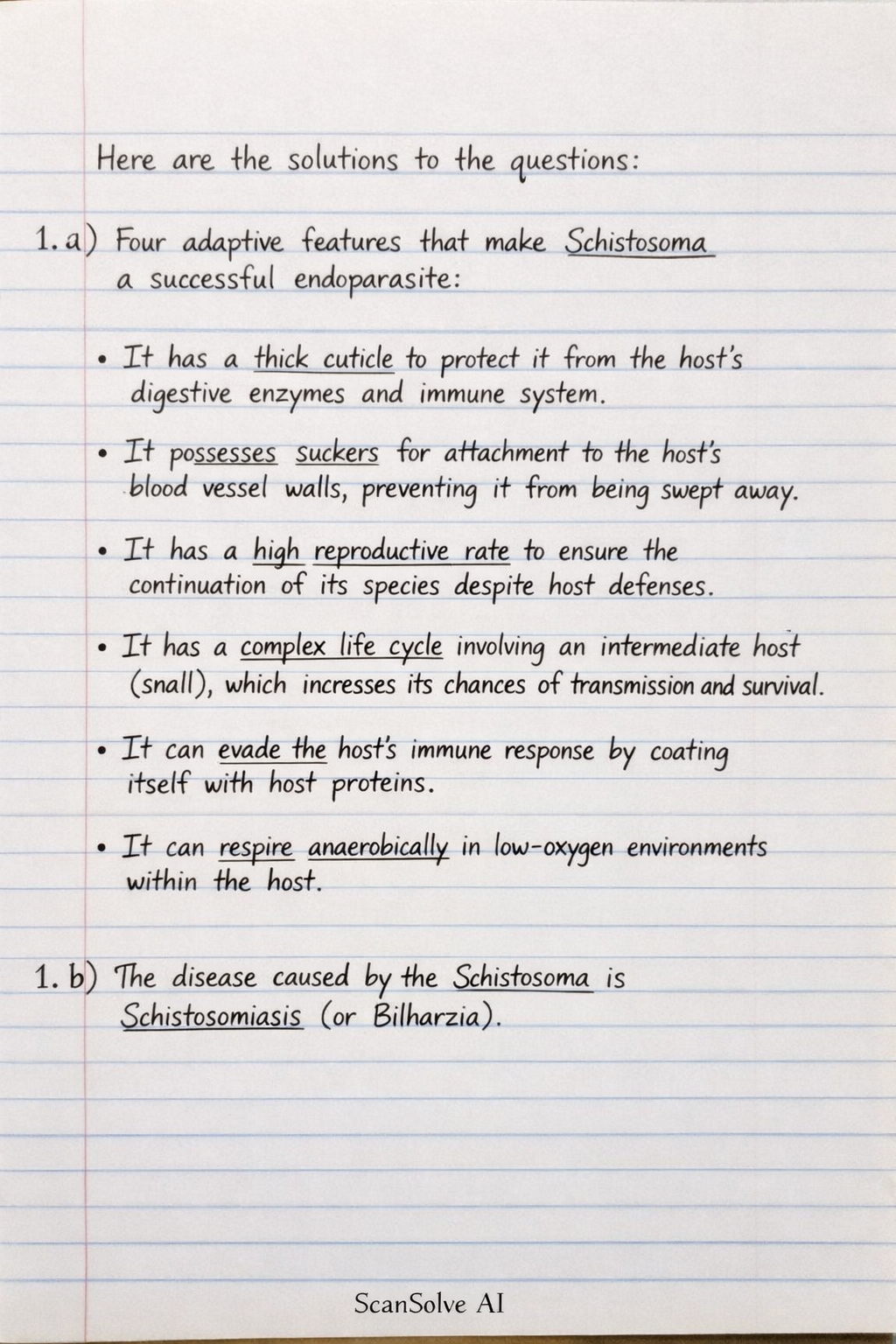
Here are the solutions to the questions:
1. a) Four adaptive features that make Schistosoma a successful endoparasite:
- It has a thick cuticle to protect it from the host's digestive enzymes and immune system.
- It possesses suckers for attachment to the host's blood vessel walls, preventing it from being swept away.
- It has a high reproductive rate to ensure the continuation of its species despite host defenses.
- It has a complex life cycle involving an intermediate host (snail), which increases its chances of transmission and survival.
- It can evade the host's immune response by coating itself with host proteins.
- It can respire anaerobically in low-oxygen environments within the host.
1. b) The disease caused by the Schistosoma is Schistosomiasis (or Bilharzia).
1. c) Complete the table:
| Parasite | Disease |
|---|---|
| i) Plasmodium | Malaria |
| ii) Vibrio cholerae | Cholera |
| iii) Entamoeba histolytica | Amoebic dysentery (or Amoebiasis) |
2. a) A mutation is a sudden, random, and permanent change in the genetic material (DNA or chromosomes) of an organism.
2. b) Certain bacteria and other pathogens become resistant to drugs over time due to natural selection.
Random mutations occur in the pathogen population, some of which confer resistance to a particular drug. When the drug is administered, the non-resistant pathogens are killed, while the resistant ones survive and reproduce, passing on their resistance genes. Over time, the proportion of resistant pathogens in the population increases, making the drug less effective.
2. c) Work out a cross between a haemophilic man married to a carrier woman for haemophilia:
Haemophilia is an X-linked recessive disorder.
Let X represent the normal allele and X represent the haemophilic allele.
- Genotype of haemophilic man: XY
- Genotype of carrier woman: XX
Parental Cross:
Gametes:
Punnett Square:
| X | X | |
|---|---|---|
| X | XX | XX |
| Y | XY | XY |
Offspring Genotypes:
- XX (Carrier female)
- XX (Haemophilic female)
- XY (Normal male)
- XY (Haemophilic male)
2. d) The phenotypic ratio of the four children is:
- 1 Normal female (carrier) : 1 Haemophilic female : 1 Normal male : 1 Haemophilic male
Still stuck on this one?
Ask a follow-up, and the answer starts from this question.
More Biology Questions
Handwritten Step-by-Step Solution
Get this as a handwritten image on WhatsApp — like a tutor wrote it for you.
Try on WhatsApp