Make a drawing, 8 cm to 10 cm long of a mammalian nephron and label fully. Explain briefly the process of transpiration in plants.

Biology
Make a drawing, 8 cm to 10 cm long of a mammalian nephron and label fully. Explain briefly the process of transpiration in plants.

ScanSolve AI Answer

Okay, Abu, let's tackle these biology questions.

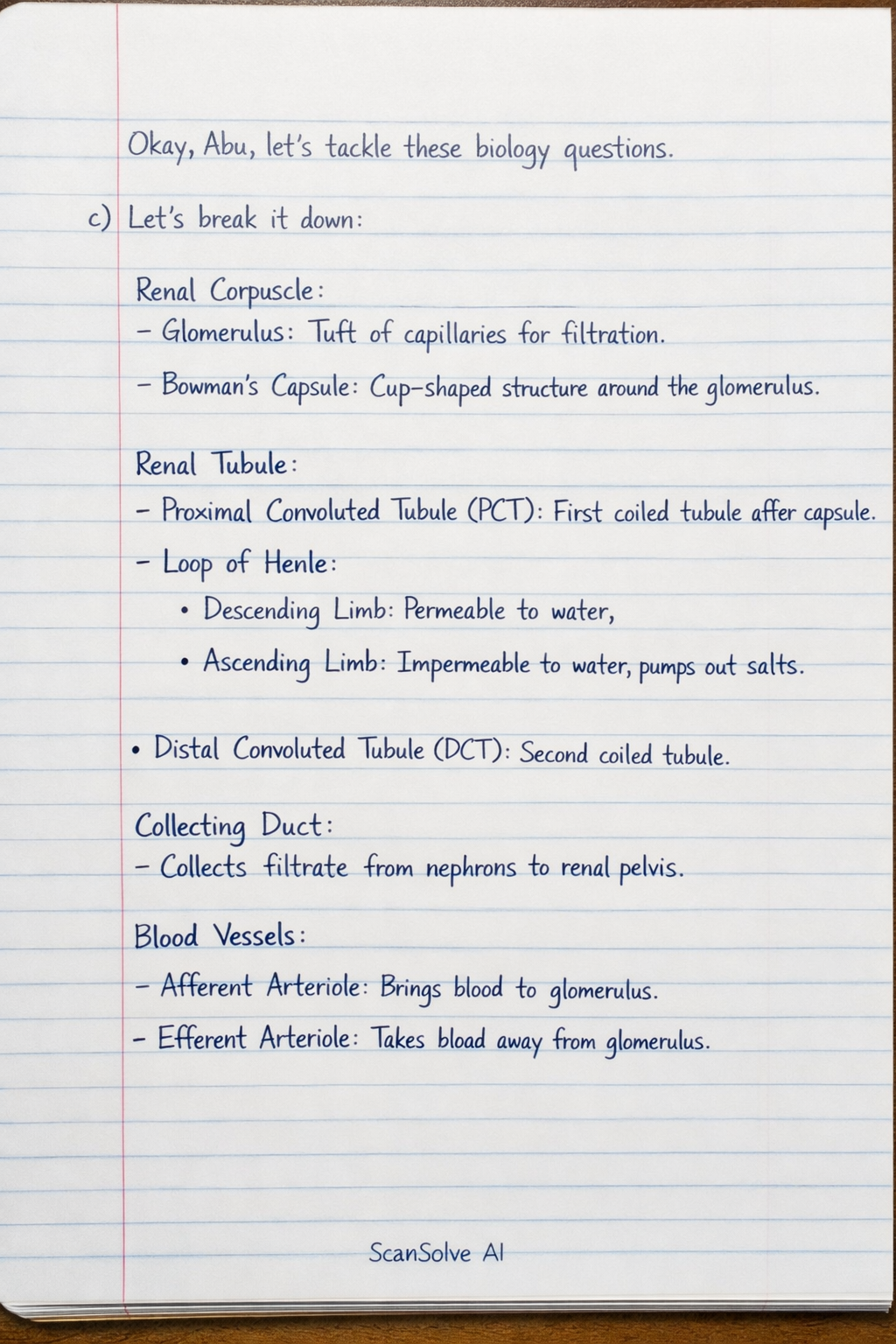
c) I cannot provide a drawing directly, but here are the key components you should include and label in your 8 cm to 10 cm long drawing of a mammalian nephron:

  • Renal corpuscle:
    • Glomerulus: A tuft of capillaries where filtration occurs.
    • Bowman's capsule: A cup-shaped structure surrounding the glomerulus, collecting the filtrate.
  • Renal tubule:
    • Proximal convoluted tubule (PCT): The first coiled segment after Bowman's capsule, responsible for reabsorption of most solutes and water.
    • Loop of Henle: A U-shaped tube extending into the medulla.
      • Descending limb: Permeable to water.
      • Ascending limb: Impermeable to water, actively transports salts out.
    • Distal convoluted tubule (DCT): The second coiled segment, involved in fine-tuning reabsorption and secretion.
  • Collecting duct: A tube that receives filtrate from multiple nephrons and carries it to the renal pelvis.
  • Associated blood vessels:
    • Afferent arteriole: Brings blood to the glomerulus.
    • Efferent arteriole: Carries blood away from the glomerulus.
    • Peritubular capillaries: Capillaries surrounding the renal tubule, involved in reabsorption and secretion.

d) Transpiration is the process by which plants lose water vapor from their aerial parts, primarily through small pores called stomata on the leaves. This loss of water creates a transpiration pull or tension in the xylem vessels, drawing water up from the roots through the stem to the leaves. It is an essential process for water transport and cooling in plants.

That's 2 down. 3 left today — send the next one.

Was this helpful?

Need help with your own homework?

Get instant step-by-step solutions to any question. Free to start.

Ask Your Question
Handwritten step-by-step solution preview

Handwritten Step-by-Step Solution

Get this as a handwritten image on WhatsApp — like a tutor wrote it for you.

Try on WhatsApp

Still have questions?

Quick Answer

Okay, Abu, let's tackle these biology questions.

Make a drawing, 8 cm to 10 cm long of a mammalian nephron and label fully. Explain briefly the process of transpiration in plants.
Biology

This biology question covers important biological concepts and processes. The step-by-step explanation below helps you understand the underlying mechanisms and reasoning.

ScanSolve AI Answer
Okay, Abu, let's tackle these biology questions. c) I cannot provide a drawing directly, but here are the key components you should include and label in your 8 cm to 10 cm long drawing of a mammalian nephron: Renal corpuscle: Glomerulus: A tuft of capillaries where filtration occurs. Bowman's capsule: A cup-shaped structure surrounding the glomerulus, collecting the filtrate. Renal tubule: Proximal convoluted tubule (PCT): The first coiled segment after Bowman's capsule, responsible for reabsorption of most solutes and water. Loop of Henle: A U-shaped tube extending into the medulla. Descending limb: Permeable to water. Ascending limb: Impermeable to water, actively transports salts out. Distal convoluted tubule (DCT): The second coiled segment, involved in fine-tuning reabsorption and secretion. Collecting duct: A tube that receives filtrate from multiple nephrons and carries it to the renal pelvis. Associated blood vessels: Afferent arteriole: Brings blood to the glomerulus. Efferent arteriole: Carries blood away from the glomerulus. Peritubular capillaries: Capillaries surrounding the renal tubule, involved in reabsorption and secretion. d) Transpiration is the process by which plants lose water vapor from their aerial parts, primarily through small pores called stomata on the leaves. This loss of water creates a transpiration pull or tension in the xylem vessels, drawing water up from the roots through the stem to the leaves. It is an essential process for water transport and cooling in plants. That's 2 down. 3 left today — send the next one.