
We read your photo as:
Calculate the number of phosphodiester bonds and hydrogen bonds in a 100 base pair dsDNA molecule where 40% of the bases are Guanine.
ScanSolve AI Answer
Answer
Step-by-step solution
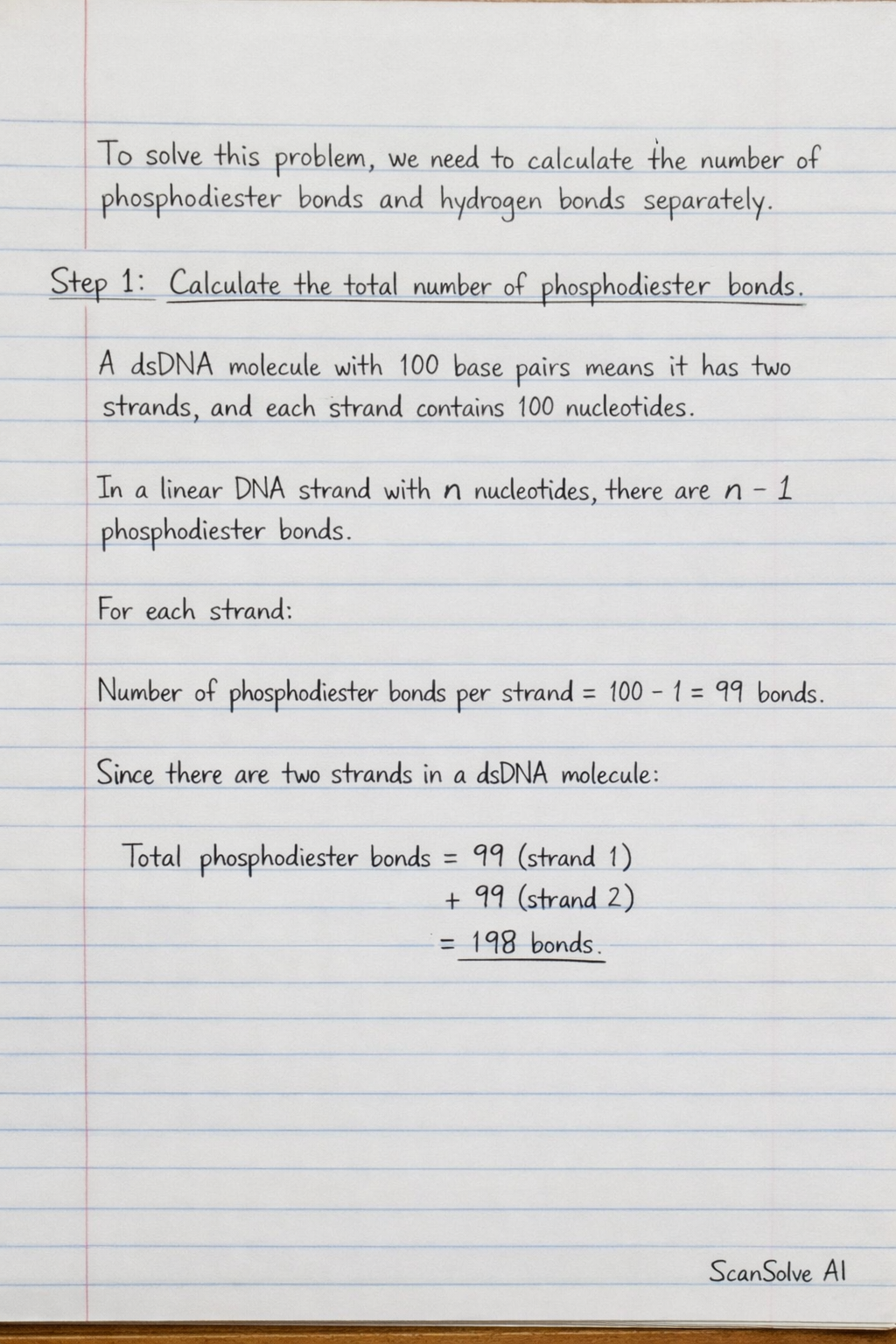
2 stepsTo solve this problem, we need to calculate the number of phosphodiester bonds and hydrogen bonds separately.
Calculate the total number of phosphodiester bonds.
A dsDNA molecule with 100 base pairs means it has two strands, and each strand contains 100 nucleotides.
In a linear DNA strand with nucleotides, there are phosphodiester bonds.
For each strand:
Number of phosphodiester bonds per strand = bonds.
Since there are two strands in a dsDNA molecule:
Total phosphodiester bonds = bonds.Calculate the total number of hydrogen bonds.
The dsDNA molecule has 100 base pairs, which means a total of bases.
We are given that 40% of the bases are Guanine (G).
Number of Guanine (G) bases = bases.
According to Chargaff's rules, in dsDNA, the number of Guanine (G) bases equals the number of Cytosine (C) bases.
Number of Cytosine (C) bases = 80 bases.
Total G and C bases = bases.
The remaining bases are Adenine (A) and Thymine (T).
Number of A and T bases = Total bases - (G + C) bases = bases.
Since the number of Adenine (A) bases equals the number of Thymine (T) bases:
Number of Adenine (A) bases = bases.
Number of Thymine (T) bases = bases.Now, we calculate the hydrogen bonds:
- Guanine (G) forms 3 hydrogen bonds with Cytosine (C).
- Adenine (A) forms 2 hydrogen bonds with Thymine (T).
Hydrogen bonds from G-C pairs = Number of G bases 3 = hydrogen bonds.
Hydrogen bonds from A-T pairs = Number of A bases 2 = hydrogen bonds.
Total hydrogen bonds = hydrogen bonds.Therefore, the total number of phosphodiester bonds is 198, and the total number of hydrogen bonds is 280.
Comparing this with the given options:
A) 198 and 280
B) 198 and 240
C) 200 and 280
D) 200 and 240The correct option is A.
The final answer is
Try one yourself
A new problem that tests the same skill.
Still stuck on this one?
Ask a follow-up, and the answer starts from this question.
More Biology Questions
Handwritten Step-by-Step Solution
Get this as a handwritten image on WhatsApp — like a tutor wrote it for you.
Try on WhatsApp