
We read your photo as:
Which of the following solutions cause plasmolysis to bacterial cells? Infections from animal origin are known as: Invasion and multiplication of microorganisms in the body is known as: The capacity o
ScanSolve AI Answer
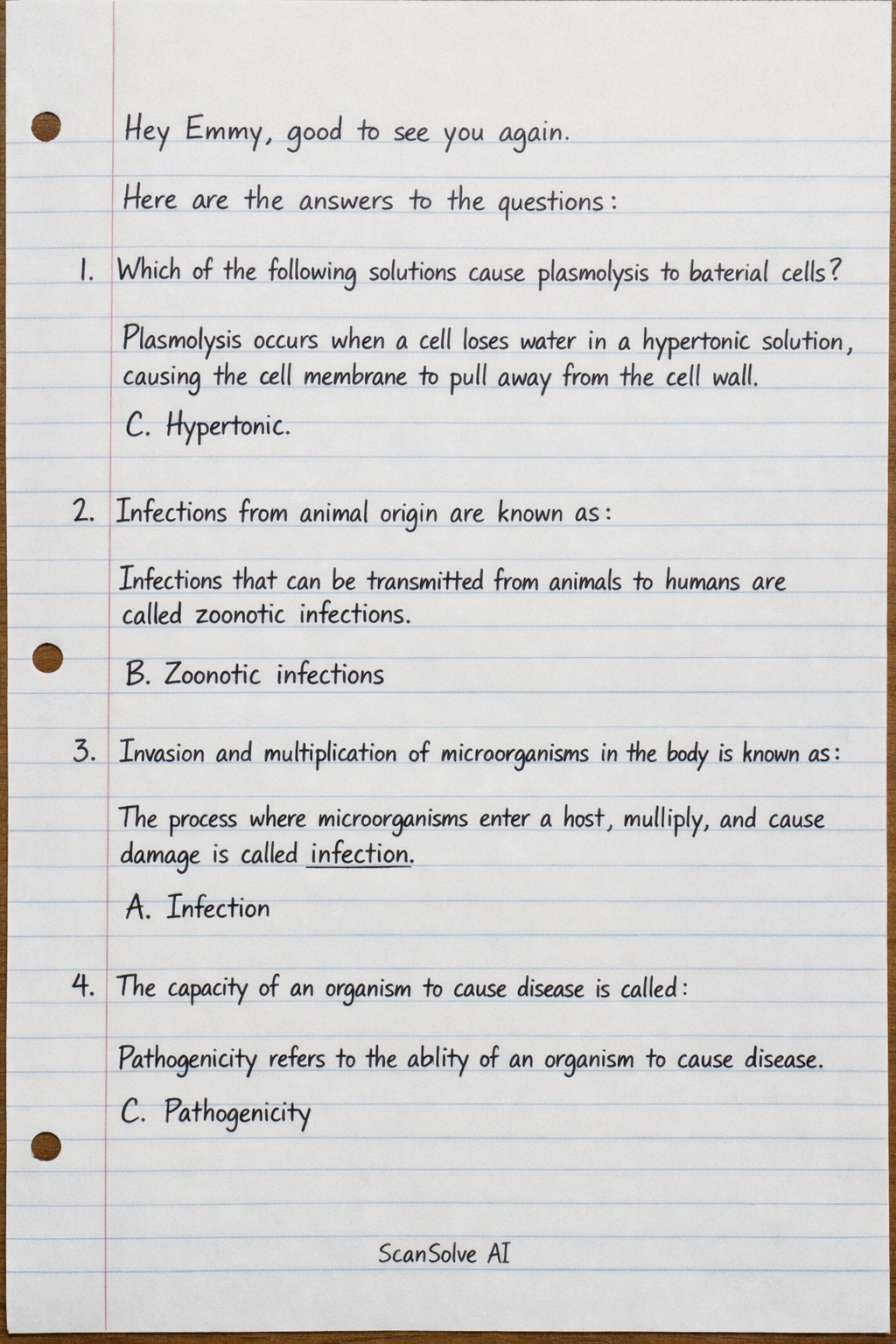
Here are the answers to the questions:
-
Which of the following solutions cause plasmolysis to bacterial cells? Plasmolysis occurs when a cell loses water in a hypertonic solution, causing the cell membrane to pull away from the cell wall.
- C. Hypertonic
-
Infections from animal origin are known as: Infections that can be transmitted from animals to humans are called zoonotic infections.
- B. Zoonotic infections
-
Invasion and multiplication of microorganisms in the body is known as: The process where microorganisms enter a host, multiply, and cause damage is called infection.
- A. Infection
-
The capacity of an organism to cause disease is called: Pathogenicity refers to the ability of an organism to cause disease.
- C. Pathogenicity
-
The structure of the bacteria which is responsible for transferring genetic materials is known as: Plasmids are small, circular DNA molecules in bacteria that can carry genes and be transferred between bacteria, often conferring antibiotic resistance or other traits.
- C. Plasmid
-
Which of the following bacteria is bean shaped? Gonococci (e.g., Neisseria gonorrhoeae) are typically described as kidney-bean shaped or coffee-bean shaped cocci, often found in pairs (diplococci).
- D. Gonococci
-
Which of the following bacteria grow well in acidic conditions? Lactobacilli are known for their ability to thrive in acidic environments, such as the human gut and vagina, where they produce lactic acid.
- B. Lactobacilli
-
Toxins secreted within the microbial cells when the organism is dead are known as: Endotoxins are components of the outer membrane of Gram-negative bacteria (specifically lipopolysaccharides) that are released when the bacterial cell dies or lyses.
- C. Endotoxins
-
Bacteria with many flagella at one end of the cell is known as: Lophotrichous bacteria have a tuft or cluster of flagella originating from one pole of the cell.
- B. Lophotrichous
-
The following are virulence factors of bacteria, except: Virulence factors are traits that allow bacteria to cause disease. The options provided are: A. Capsule (virulence factor) B. Fimbriae (virulence factor) C. Cell wall (a basic structural component, not typically considered a virulence factor in the same way as the others) D. Enzyme (many enzymes act as virulence factors) The cell wall is a fundamental structural component of most bacteria, not specifically a virulence factor that enhances pathogenicity beyond basic survival.
- C. Cell wall
Still stuck on this one?
Ask a follow-up, and the answer starts from this question.
More Biology Questions
Handwritten Step-by-Step Solution
Get this as a handwritten image on WhatsApp — like a tutor wrote it for you.
Try on WhatsApp