
We read your photo as:
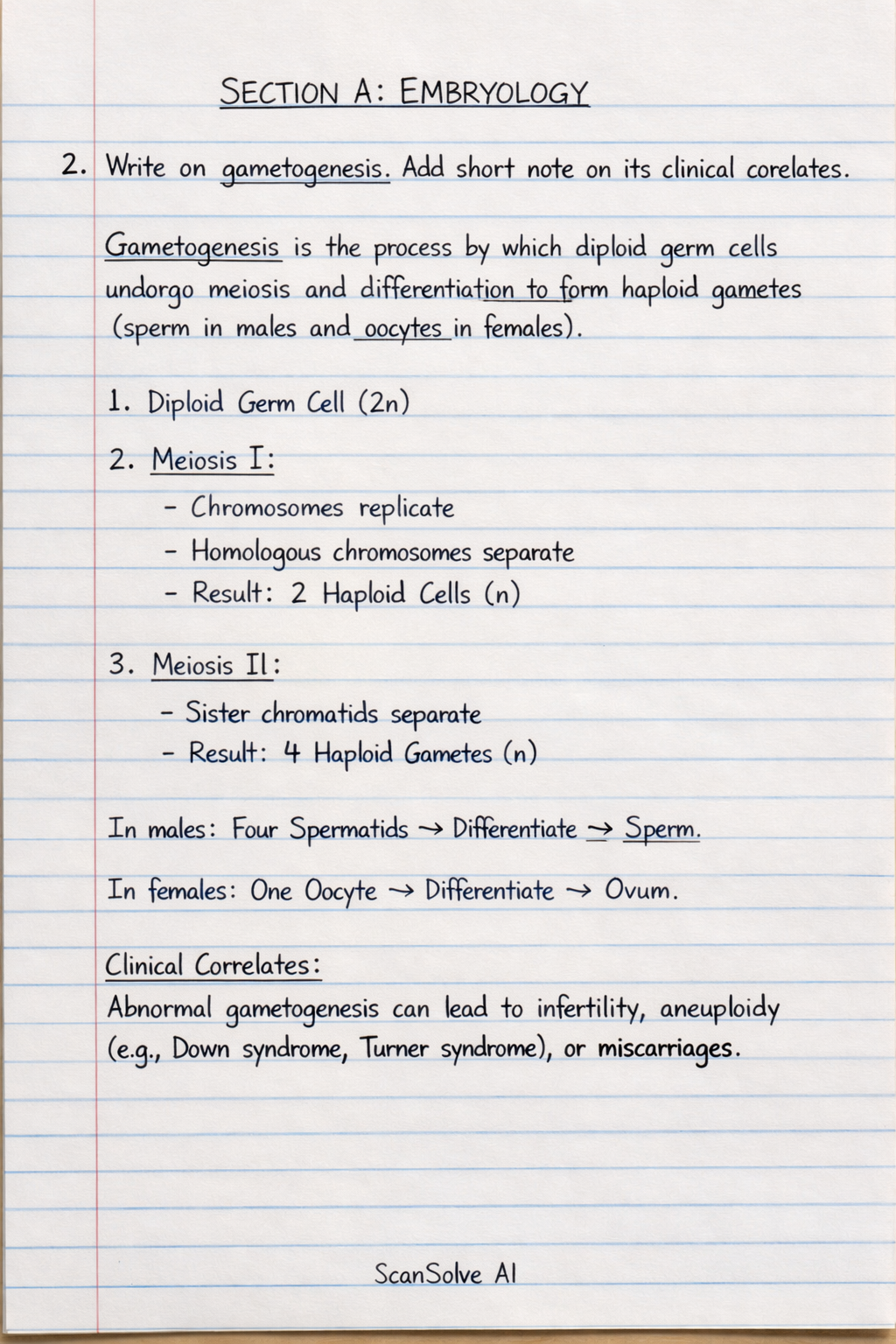
Write on gametogenesis. Add short note on its clinical correlates
ScanSolve AI Answer
here is the answer to the next question from the image.
SECTION A: EMBRYOLOGY
2. Write on gametogenesis. Add short note on its clinical correlates
Gametogenesis is the process by which diploid germ cells undergo meiosis and differentiation to form haploid gametes (sperm in males and oocytes in females). This process ensures that the offspring receive half of their genetic material from each parent, maintaining the species' chromosome number after fertilization.
Spermatogenesis (Formation of Sperm):
Spermatogenesis occurs in the seminiferous tubules of the testes and begins at puberty.
- Proliferation: Diploid spermatogonia (primordial germ cells) multiply by mitosis.
- Growth: Spermatogonia grow into larger primary spermatocytes (diploid).
- Meiosis I: Each primary spermatocyte undergoes meiosis I to form two haploid secondary spermatocytes.
- Meiosis II: Each secondary spermatocyte undergoes meiosis II to form two haploid spermatids. Thus, one primary spermatocyte yields four spermatids.
- Spermiogenesis: Spermatids undergo a maturation process called spermiogenesis, where they transform into mature, motile spermatozoa (sperm) by developing a head, midpiece, and tail, and shedding most of their cytoplasm.
Oogenesis (Formation of Oocytes):
Oogenesis occurs in the ovaries and begins during fetal development, pauses, and then resumes at puberty.
- Proliferation (Fetal life): Diploid oogonia (primordial germ cells) multiply by mitosis in the fetal ovary.
- Growth (Fetal life): Oogonia grow into larger primary oocytes (diploid). These primary oocytes enter meiosis I but arrest in prophase I until puberty.
- Meiosis I (Puberty to Menopause): At puberty, typically one primary oocyte per month completes meiosis I, forming a large haploid secondary oocyte and a small first polar body. The first polar body usually degenerates. The secondary oocyte then arrests in metaphase II.
- Meiosis II (Fertilization): Meiosis II is only completed if the secondary oocyte is fertilized by a sperm. Upon fertilization, the secondary oocyte completes meiosis II, forming a large haploid ovum (mature egg) and a small second polar body. The second polar body also degenerates.
Clinical Correlates (Anomalies of Gametogenesis):
Anomalies in gametogenesis often result from errors during meiosis, leading to an abnormal number of chromosomes (aneuploidy) in the gametes.
- Nondisjunction: The most common error, where homologous chromosomes (in meiosis I) or sister chromatids (in meiosis II) fail to separate properly. This leads to gametes with an extra chromosome (n+1) or a missing chromosome (n-1).
- Trisomy 21 (Down Syndrome): Often caused by nondisjunction of chromosome 21 during oogenesis, resulting in an oocyte with two copies of chromosome 21.
- Turner Syndrome (45, XO): Caused by a missing X chromosome, often due to nondisjunction of sex chromosomes in either parent.
- Klinefelter Syndrome (47, XXY): Caused by an extra X chromosome, often due to nondisjunction of sex chromosomes.
- Structural Chromosomal Abnormalities: Less common, these involve deletions, duplications, inversions, or translocations of parts of chromosomes, which can also arise during gametogenesis and lead to developmental issues or infertility.
Still stuck on this one?
Ask a follow-up, and the answer starts from this question.
More Biology Questions
Handwritten Step-by-Step Solution
Get this as a handwritten image on WhatsApp — like a tutor wrote it for you.
Try on WhatsApp