
We read your photo as:
Which pair of animals fits the description: breathing through lungs, having gills when young and lungs later, moist skin without scales, and laying eggs?
Biology
ScanSolve AI Answer
Step-by-step solution
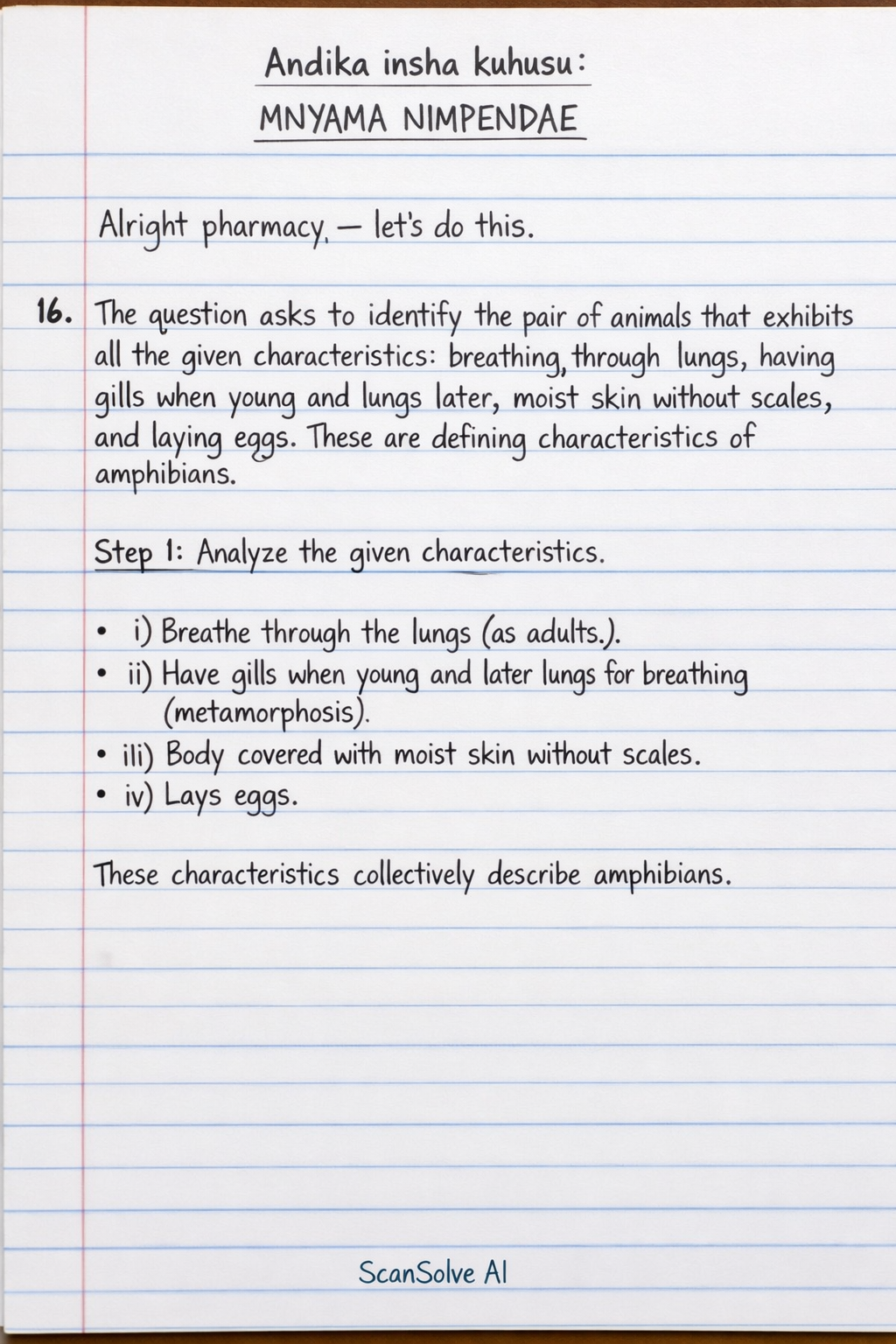
5 steps16. The question asks to identify the pair of animals that exhibits all the given characteristics: breathing through lungs, having gills when young and lungs later, moist skin without scales, and laying eggs. These are defining characteristics of amphibians.
Analyze the given characteristics.
- i) Breathe through the lungs (as adults).
- ii) Have gills when young and later lungs for breathing (metamorphosis).
- iii) Body covered with moist skin without scales.
- iv) Lays eggs. These characteristics collectively describe amphibians.
Evaluate the given options based on the characteristics of amphibians.
- A. Newt and salamander: Both are amphibians. They fit all the described characteristics.
- B. Lizard and tortoise: Both are reptiles. They breathe with lungs throughout their lives, have dry, scaly skin, and do not have gills when young.
- C. Toad and tortoise: A toad is an amphibian, but a tortoise is a reptile. This pair does not fit.
- D. Frog and tilapia: A frog is an amphibian, but a tilapia is a fish. Fish breathe with gills throughout their lives and have scales. This pair does not fit.
Conclude the correct option.
Only newts and salamanders (Option A) are amphibians and possess all the listed characteristics.
The final answer is
17. The question asks to identify a common disease of the breathing system.
Analyze each option to determine its primary affected system.
- A. Asthma: This is a chronic respiratory disease that causes inflammation and narrowing of the airways, making it difficult to breathe. It directly affects the breathing system.
- B. Malaria: This is an infectious disease caused by parasites transmitted through mosquito bites, primarily affecting red blood cells and various organs, but not primarily the breathing system.
- C. Cholera: This is a bacterial infection of the small intestine, causing severe diarrhea and dehydration. It affects the digestive system.
- D. Ringworm: This is a common fungal infection of the skin. It affects the skin.
Identify the option that is a disease of the breathing system.
Based on the analysis, Asthma is a disease of the breathing system.
The final answer is
Was this helpful?
Still stuck on this one?
Ask a follow-up, and the answer starts from this question.
Got a different question?Ask your own question
More Biology Questions
QWhich of the given animals can live both in water and on land?QIdentify the animal that fits the description: warm-blooded, has scales, breathes through lungs…QWhat are diploblastic animals?QThe following table shows some features of animals. Which features would describe a bird?QWhat are the common characteristics of birds and mammals, and what are the functions of the vagina…
Browse by topic:Anatomy
Handwritten Step-by-Step Solution
Get this as a handwritten image on WhatsApp — like a tutor wrote it for you.
Try on WhatsApp