
We read your photo as:
Physiology Year One (1st Semester) Instruction: Answer five (5) Questions only. 1. Briefly describe Erythrocyte based on its (i)shape, (ii) contained organelles, (iii) site of production, (iv) life cycle and (v) functions (2 marks each).
Biology
ScanSolve AI Answer
Step-by-step solution
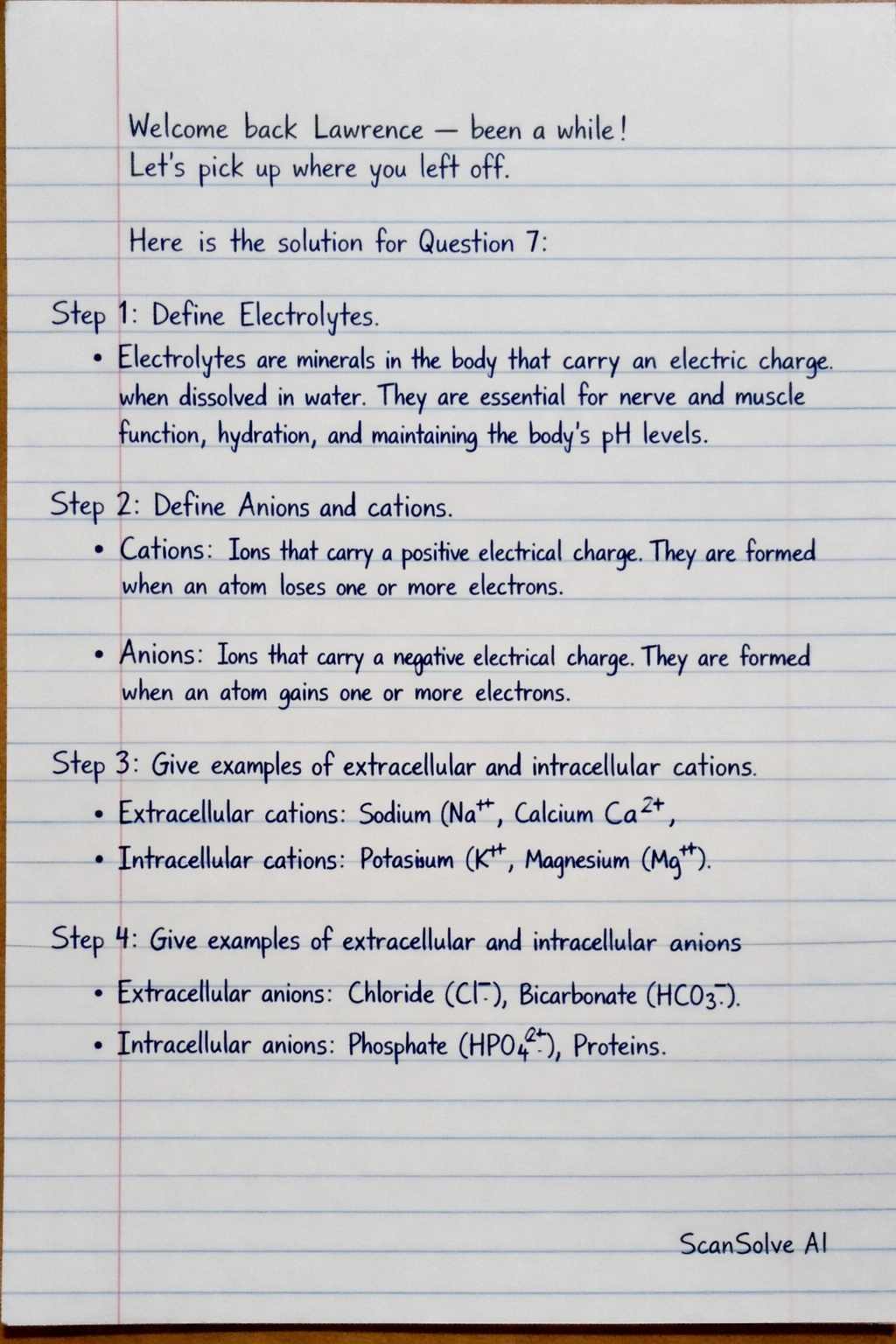
5 stepsHere is the solution for Question 7:
Define Electrolytes
Electrolytes are minerals in the body that carry an electric charge when dissolved in water. They are essential for nerve and muscle function, hydration, and maintaining the body's pH levels.
Define Anions and cations
- Cations: Ions that carry a positive electrical charge. They are formed when an atom loses one or more electrons.
- Anions: Ions that carry a negative electrical charge. They are formed when an atom gains one or more electrons.
Give examples of extracellular and intracellular cations
- Extracellular cations: Sodium (), Calcium ().
- Intracellular cations: Potassium (), Magnesium ().
Give examples of extracellular and intracellular anions
- Extracellular anions: Chloride (), Bicarbonate ().
- Intracellular anions: Phosphate (), Proteins.
State the most common intracellular and extracellular Cations and anions
- Most common extracellular cation: Sodium ()
- Most common intracellular cation: Potassium ()
- Most common extracellular anion: Chloride ()
- Most common intracellular anion: Phosphate ()
Was this helpful?
Still stuck on this one?
Ask a follow-up, and the answer starts from this question.
Got a different question?Ask your own question
More Biology Questions
QQ.3 Short Answers (Answer 7 out of 9) (7 × 5 = 35) A) Write a note on epithelial tissue. B) Explain…QPAPER 1: OBJECTIVE Answer all questions. Each question is followed by four options lettered A–D…QSECTION B Confirmed standard Answer any FIVE questions All questions carry equal Mark's QUESTION 1…QThis is a Human Physiology exam paper. Please specify which question you would like me to answer.QPlease provide answers for the following questions about human anatomy and physiology.
Handwritten Step-by-Step Solution
Get this as a handwritten image on WhatsApp — like a tutor wrote it for you.
Try on WhatsApp