
We read your photo as:
Describe the precautions when using a microscope and the structure of bread mould. List eight significances of bacteria and fungi in agriculture and food.
ScanSolve AI Answer
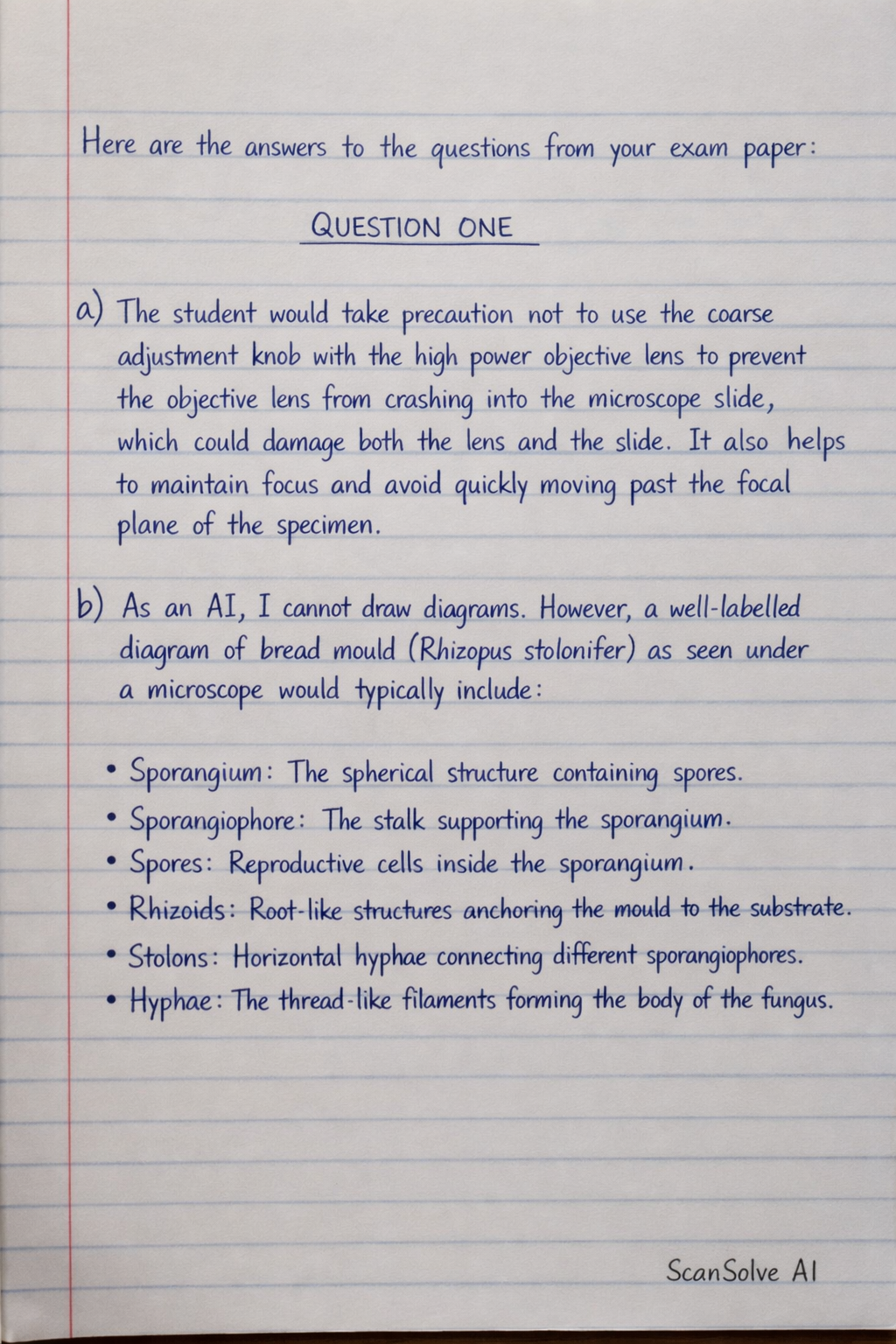
Here are the answers to the questions from your exam paper:
QUESTION ONE
a) The student would take precaution not to use the coarse adjustment knob with the high power objective lens to prevent the objective lens from crashing into the microscope slide, which could damage both the lens and the slide. It also helps to maintain focus and avoid quickly moving past the focal plane of the specimen.
b) As an AI, I cannot draw diagrams. However, a well-labelled diagram of bread mould (Rhizopus stolonifer) as seen under a microscope would typically include:
- Sporangium: The spherical structure containing spores.
- Sporangiophore: The stalk supporting the sporangium.
- Spores: Reproductive cells inside the sporangium.
- Rhizoids: Root-like structures anchoring the mould to the substrate.
- Stolons: Horizontal hyphae connecting different sporangiophores.
- Hyphae: The thread-like filaments forming the body of the fungus.
QUESTION TWO
Here are eight significances of bacteria and fungi in agriculture and food industries:
- Nitrogen Fixation: Certain bacteria (e.g., Rhizobium) convert atmospheric nitrogen into forms usable by plants, enriching soil fertility.
- Decomposition and Nutrient Cycling: Bacteria and fungi break down dead organic matter, returning essential nutrients to the soil for plant uptake.
- Food Fermentation: Microorganisms are crucial for producing fermented foods like yogurt, cheese, bread, and soy sauce, improving preservation and flavor.
- Biocontrol Agents: Some bacteria and fungi are used to control agricultural pests and plant diseases, reducing reliance on chemical pesticides.
- Mycorrhizal Associations: Fungi form symbiotic relationships with plant roots, enhancing the plant's ability to absorb water and nutrients from the soil.
- Silage Production: Lactic acid bacteria are used in the fermentation of forage crops to produce silage, a preserved animal feed.
- Food Spoilage: (Negative) Bacteria and fungi can cause significant spoilage of harvested crops and processed foods, leading to economic losses.
- Plant Diseases: (Negative) Many bacteria and fungi are plant pathogens, causing diseases that reduce crop yields and quality.
QUESTION THREE
Here are examples of disease-causing protozoa for each category:
- Flagellates: Trypanosoma brucei causes African sleeping sickness.
- Ciliates: Balantidium coli causes Balantidiasis.
- Amoebas: Entamoeba histolytica causes Amoebiasis (or amoebic dysentery).
- Sporozoans: Plasmodium falciparum causes Malaria.
QUESTION FOUR
a) A disease is any condition that impairs the normal functioning of an organism, leading to symptoms and signs. It can be caused by pathogens, genetic defects, environmental factors, or physiological dysfunction.
b) The disease triangle illustrates the three essential elements that must interact for a disease to occur and develop:
- Host: This refers to the susceptible organism (plant, animal, or human) that can be affected by the disease. Factors like genetic resistance, age, nutritional status, and overall health of the host influence its susceptibility.
- Pathogen (or Agent): This is the organism or factor that causes the disease, such as bacteria, viruses, fungi, nematodes, or even nutrient deficiencies. The virulence (ability to cause disease) and the amount of inoculum (pathogen present) are important aspects.
- Environment: These are the external conditions that influence the interaction between the host and the pathogen. Environmental factors like temperature, humidity, rainfall, soil pH, and the presence of vectors can either favor or inhibit disease development. For a disease to manifest, all three elements must be present and interact favorably. If any one element is missing or unfavorable, the disease will not develop or will be less severe.
Still stuck on this one?
Ask a follow-up, and the answer starts from this question.
More Biology Questions
Handwritten Step-by-Step Solution
Get this as a handwritten image on WhatsApp — like a tutor wrote it for you.
Try on WhatsApp