
We read your photo as:
Select the correct statement about the anatomical relationships and innervation of facial structures.
ScanSolve AI Answer
Answer
Step-by-step solution
7 stepsAnalyze Question 122.
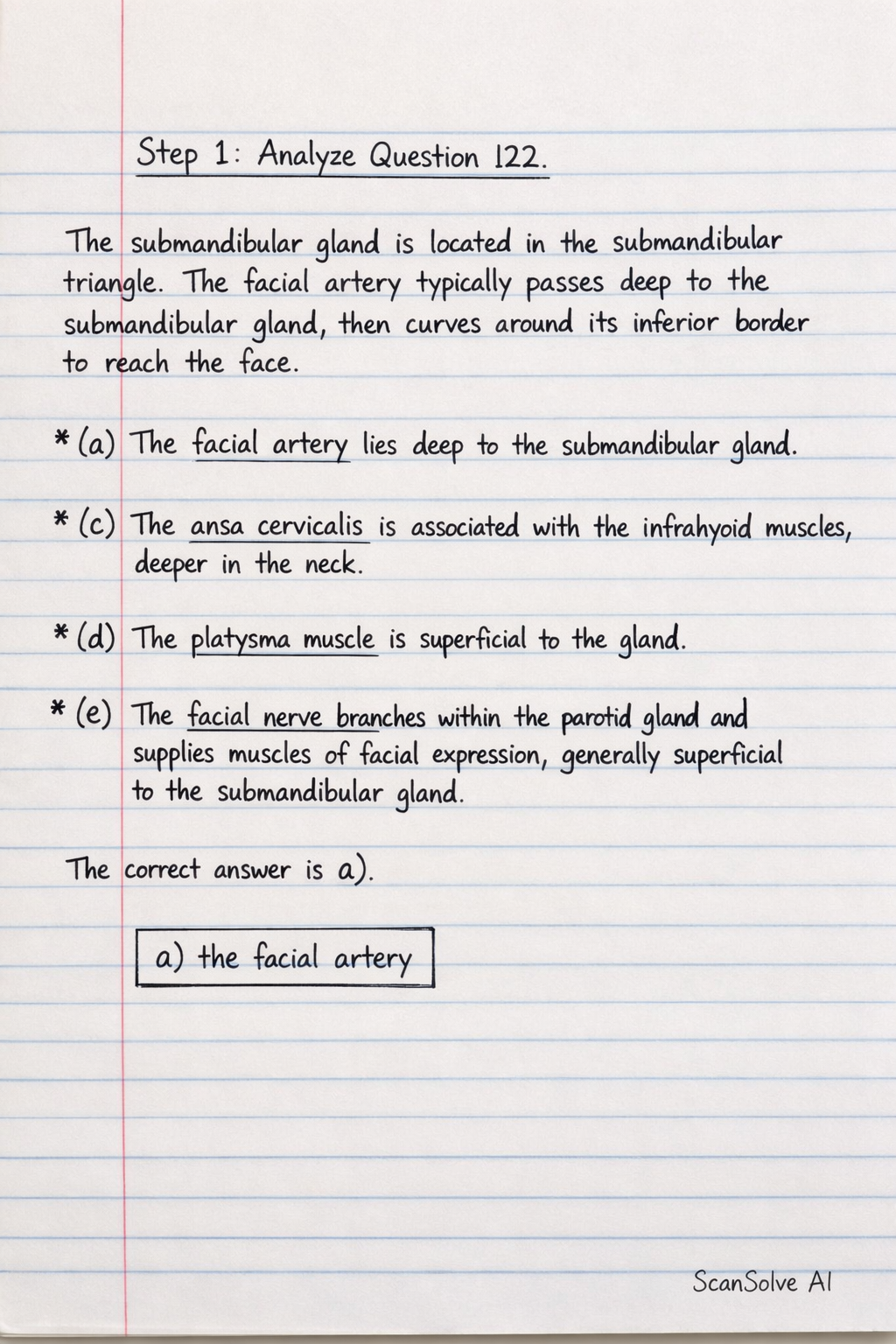
The submandibular gland is located in the submandibular triangle. The facial artery typically passes deep to the submandibular gland, then curves around its inferior border to reach the face.
- (a) The facial artery lies deep to the submandibular gland.
- (c) The ansa cervicalis is associated with the infrahyoid muscles, deeper in the neck.
- (d) The platysma muscle is superficial to the gland.
- (e) The facial nerve branches within the parotid gland and supplies muscles of facial expression, generally superficial to the submandibular gland.
The correct answer is a).
Analyze Question 123.
Muscles of facial expression are innervated by the facial nerve (cranial nerve VII).
- (a) The lateral pterygoid muscle is a muscle of mastication, innervated by the trigeminal nerve (CN V3).
- (b) The stylohyoid muscle is a suprahyoid muscle, innervated by the facial nerve, but it is not considered a muscle of facial expression.
- (c) The stapedius muscle is a muscle of the middle ear, innervated by the facial nerve, but not a muscle of facial expression.
- (d) The orbicularis oris muscle is a muscle around the mouth, responsible for lip movements and facial expression, and is innervated by the facial nerve.
The correct answer is d).
Analyze Question 124.
The carotid sheath is a fascial compartment in the neck. Its main contents are the common carotid artery (and internal carotid artery superiorly), the internal jugular vein, and the vagus nerve (CN X).
- (a) Common carotid artery is a content.
- (b) Internal carotid artery is a content (superiorly).
- (c) Internal jugular vein is a content.
- (d) The sympathetic trunk lies posterior to the carotid sheath, not within it.
- (e) The vagus nerve is a content.
The correct answer is d).
Analyze Question 125.
The cervical plexus is formed by the ventral rami of C1-C4.
- (b) The ansa cervicalis (C1-C3) is formed by the cervical plexus.
- (c) The supraclavicular nerves (C3-C4) are formed by the cervical plexus.
- (d) The transverse cervical nerve (C2-C3) is formed by the cervical plexus.
- (e) The greater auricular nerve (C2-C3) is formed by the cervical plexus.
- (a) The greater occipital nerve is the medial branch of the dorsal ramus of C2, not part of the cervical plexus (which is formed by ventral rami).
The correct answer is a).
Analyze Question 126.
The retromandibular vein is formed by the union of two major veins in the parotid gland region.
- The superficial temporal vein and the maxillary vein unite to form the retromandibular vein.
The correct answer is e).
Analyze Question 127.
The pterygomandibular raphe is a tendinous band that serves as an attachment point for two muscles.
- It connects the buccinator muscle anteriorly to the superior pharyngeal constrictor muscle posteriorly.
The correct answer is c).
Analyze Question 128.
The cavernous sinus receives blood from several sources and drains into others.
- (a) Ophthalmic veins (superior and inferior) drain directly into the cavernous sinus.
- (b) The superior petrosal sinus drains from the cavernous sinus into the transverse sinus (it is an outflow, not an inflow).
- (c) The superior sagittal sinus drains into the confluence of sinuses, which then drains into the transverse sinuses. It does not drain directly into the cavernous sinus.
- (d) The pterygoid plexus of veins communicates with the cavernous sinus via emissary veins, thus draining into it.
- (e) The inferior petrosal sinus drains from the cavernous sinus into the internal jugular vein (it is an outflow, not an inflow).
Both (b), (c), and (e) do not drain into the cavernous sinus. However, the superior and inferior petrosal sinuses are direct outflows of the cavernous sinus, meaning they are directly connected. The superior sagittal sinus has no direct connection to the cavernous sinus at all, making it the most distinct "except" answer in terms of direct drainage or connection.
The correct answer is c).
Try one yourself
A new problem that tests the same skill.
Still stuck on this one?
Ask a follow-up, and the answer starts from this question.
More Biology Questions
Handwritten Step-by-Step Solution
Get this as a handwritten image on WhatsApp — like a tutor wrote it for you.
Try on WhatsApp