
States the characteristics of all plant kingdoms and their economical importance and their differences between the kingdoms and their adaptive features of all plant kingdoms,their modes of nutrition of all plant kingdoms,their balance of ecosystem for all plants kingdom and the plant kingdoms their class order family genus and species pls
ScanSolve AI Answer
Step-by-step solution
8 stepslet's break down the plant kingdom.
General Characteristics of Kingdom Plantae
Plants are multicellular, eukaryotic organisms with cell walls primarily composed of cellulose. They are typically autotrophic, meaning they produce their own food through photosynthesis using chlorophyll. Most plants are non-motile and exhibit alternation of generations in their life cycle.
Major Divisions
Bryophytes and Pteridophytes
- Bryophytes (e.g., mosses, liverworts): These are non-vascular plants, meaning they lack true roots, stems, and leaves, and specialized vascular tissue (xylem and phloem). They are small, typically grow in damp environments, and reproduce via spores. Their adaptive features include rhizoids for anchorage and a dominant gametophyte stage.
- Pteridophytes (e.g., ferns, horsetails): These are the first vascular plants, possessing true roots, stems, and leaves, along with xylem and phloem for efficient transport. They still reproduce by spores and require water for fertilization. Adaptive features include a dominant sporophyte stage and the development of a cuticle to prevent water loss.
Major Divisions
Gymnosperms and Angiosperms
- Gymnosperms (e.g., conifers, cycads): These are vascular plants that produce "naked seeds" not enclosed within an ovary. They are typically woody trees or shrubs adapted to drier conditions. Adaptive features include pollen for wind dispersal, seeds for protection and dispersal, and a well-developed vascular system.
- Angiosperms (flowering plants): These are the most diverse and dominant group of plants, characterized by producing flowers and seeds enclosed within a fruit. They have highly efficient vascular systems and diverse reproductive strategies. Adaptive features include flowers for attracting pollinators, fruits for seed dispersal, and a wide range of adaptations to various environments.
Economic Importance of Plants
Plants are vital for human survival and economy. They provide food (grains, fruits, vegetables), oxygen through photosynthesis, and raw materials for industries (timber, fibers, rubber, medicines). Plants also contribute to soil stability and water regulation.
Modes of Nutrition
The primary mode of nutrition for almost all plants is autotrophic photosynthesis. They use sunlight, water, and carbon dioxide to synthesize organic compounds (sugars) for energy. Some plants, like parasitic plants (e.g., dodder) or carnivorous plants (e.g., Venus flytrap), have evolved heterotrophic or mixotrophic strategies to supplement their nutrition, often by absorbing nutrients from other organisms or trapping insects.
Balance of Ecosystem
Plants form the base of nearly all terrestrial food webs as producers, converting solar energy into chemical energy. They release oxygen into the atmosphere and absorb carbon dioxide, regulating global climate. Plants also prevent soil erosion, contribute to water cycling, and provide habitat and shelter for countless organisms, maintaining biodiversity.
Differences Between Major Plant Divisions
The key differences lie in their structural complexity and reproductive strategies.
- Bryophytes lack vascular tissue and true organs, relying on water for reproduction.
- Pteridophytes have vascular tissue but still reproduce via spores and require water for fertilization.
- Gymnosperms have vascular tissue, produce seeds (naked), and use pollen for reproduction, reducing reliance on water.
- Angiosperms are the most advanced, with flowers, enclosed seeds (fruits), and highly efficient vascular systems, allowing for diverse adaptations and reproductive success.
Plant Kingdoms
Class, Order, Family, Genus, and Species
The term "plant kingdoms" usually refers to the single Kingdom Plantae. Within this kingdom, organisms are classified into a hierarchical system:- Kingdom: Plantae
- Division (equivalent to Phylum in animals): e.g., Magnoliophyta (flowering plants)
- Class: e.g., Magnoliopsida (dicots)
- Order: e.g., Rosales
- Family: e.g., Rosaceae (rose family)
- Genus: e.g., Rosa
- Species: e.g., Rosa gallica (French rose)
It is impossible to list the class, order, family, genus, and species for "all plant kingdoms" as this hierarchy applies to individual plant species, not the entire kingdom or its major divisions.
Still stuck on this one?
Ask a follow-up, and the answer starts from this question.
More Biology Questions
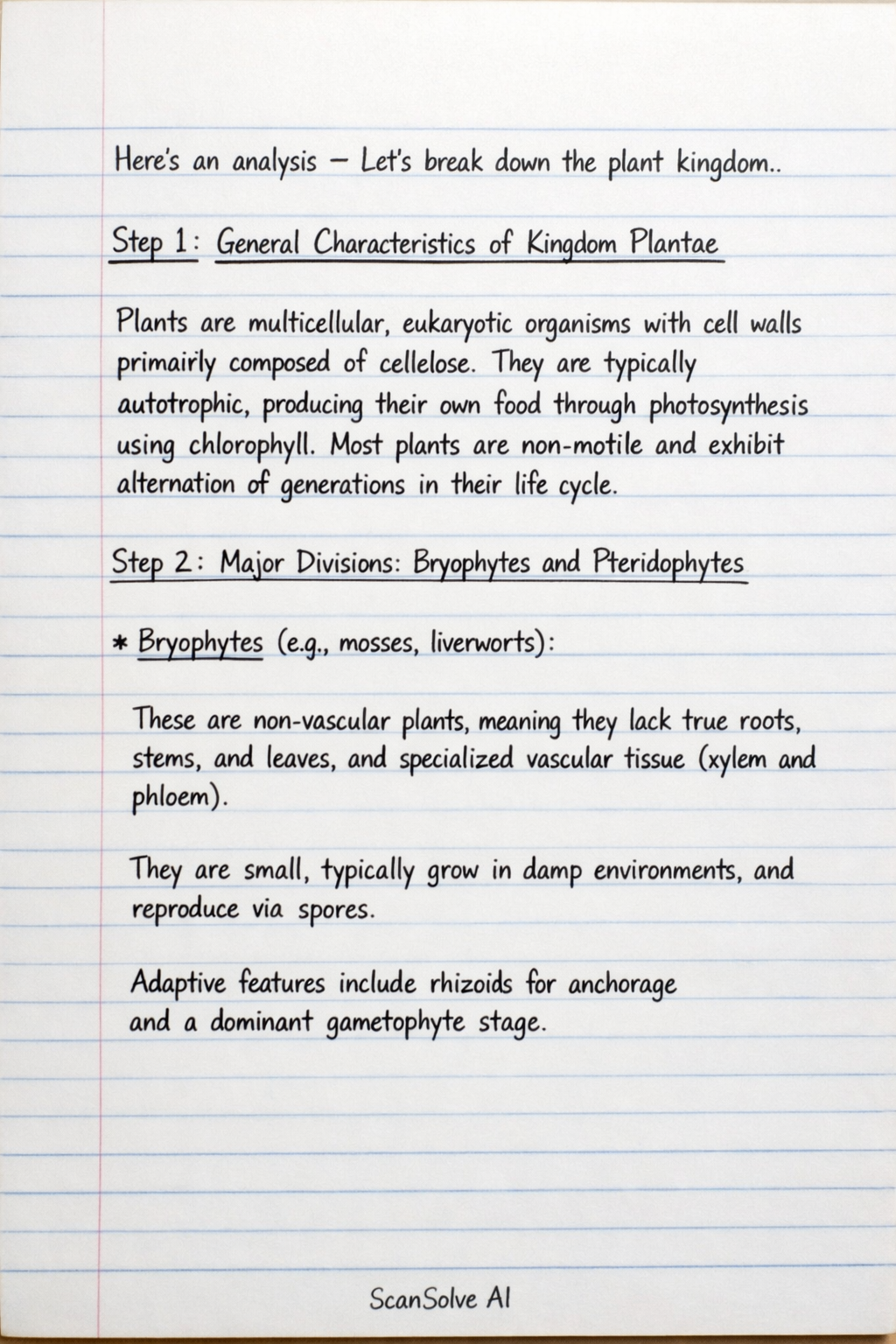
Handwritten Step-by-Step Solution
Get this as a handwritten image on WhatsApp — like a tutor wrote it for you.
Try on WhatsApp