
We read your photo as:
Which STI is associated with a characteristic "beefy red" ulcer that is painless and bleeds easily on contact?
ScanSolve AI Answer
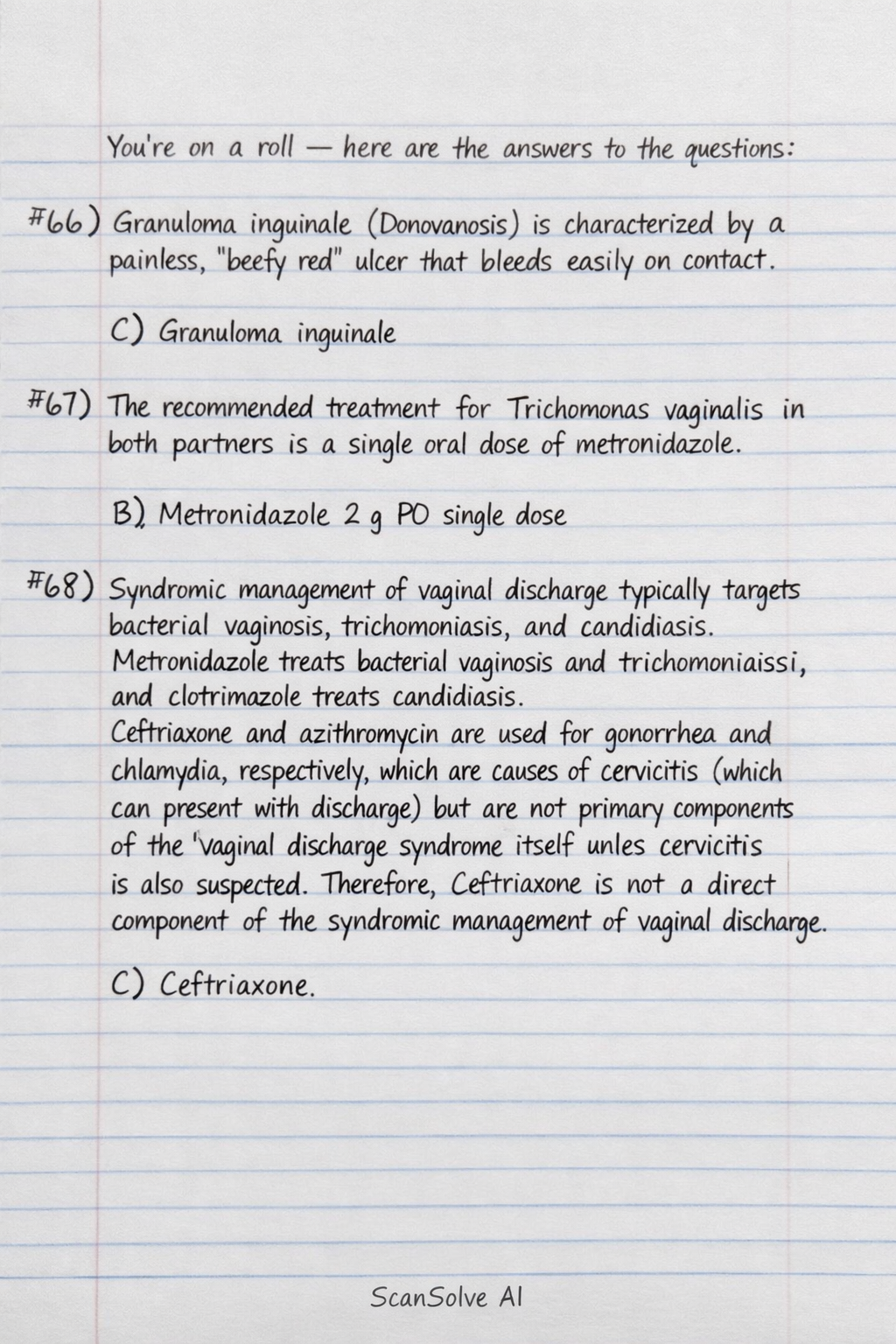
here are the answers to the questions:
66) Granuloma inguinale (Donovanosis) is characterized by a painless, "beefy red" ulcer that bleeds easily on contact.
- C) Granuloma inguinale
67) The recommended treatment for Trichomonas vaginalis in both partners is a single oral dose of metronidazole.
- B) Metronidazole 2 g PO single dose
68) Syndromic management of vaginal discharge typically targets bacterial vaginosis, trichomoniasis, and candidiasis. Metronidazole treats bacterial vaginosis and trichomoniasis, and clotrimazole treats candidiasis. Ceftriaxone and azithromycin are used for gonorrhea and chlamydia, respectively, which are causes of cervicitis (which can present with discharge) but are not primary components of the vaginal discharge syndrome itself unless cervicitis is also suspected. Therefore, Ceftriaxone is not a direct component of the syndromic management of vaginal discharge.
- C) Ceftriaxone
69) A painful inguinal bubo (swollen, inflamed lymph node) is a characteristic feature of Lymphogranuloma venereum (LGV), caused by Chlamydia trachomatis serovars L1-L3.
- B) Chlamydia serovars L1-L3
70) Herpes simplex virus type 2 (HSV-2) is the most common cause of genital herpes, although HSV-1 can also cause it. Primary infection is often symptomatic, the virus is not eradicated by antiviral therapy, and it is not self-limiting as it causes recurrent outbreaks.
- D) HSV-2 is more commonly associated with genital disease than HSV-1
SECTION B: Matching Questions: Sexually Transmitted Infections
- 1) Painless genital ulcer (chancre)
- F) Treponema pallidum (Syphilis)
- 2) Multiple painful vesicles and ulcers on genitals
- B) Herpes simplex virus (HSV)
- 3) Intracytoplasmic "Donovan bodies" on microscopy
- G) Klebsiella granulomatis (Granuloma inguinale/Donovanosis)
- 4) Strawberry cervix and frothy green vaginal discharge
- A) Trichomonas vaginalis
- 5) Often asymptomatic but may lead to PID in females
- E) Chlamydia trachomatis (serovars D-K)
- 6) Painful genital ulcer with ragged edges and suppurative lymphadenopathy
- C) Haemophilus ducreyi
- 7) Associated with oncogenic strains like types 16 and 18
- D) Human papillomavirus (HPV)
- 8) Infection with serovars L1-L3; causes inguinal buboes
- H) Chlamydia trachomatis (serovars L1-L3)
- 9) Caused by a spirochete, confirmed with dark-field microscopy
- F) Treponema pallidum (Syphilis)
- 10) Flagellated protozoan, diagnosed with wet mount microscopy
- A) Trichomonas vaginalis
Still stuck on this one?
Ask a follow-up, and the answer starts from this question.
More Biology Questions
Handwritten Step-by-Step Solution
Get this as a handwritten image on WhatsApp — like a tutor wrote it for you.
Try on WhatsApp