
We read your photo as:
Explain the structure and function of arteries and veins, the role of valves, the detection of pulses, and the concept of blood types.
ScanSolve AI Answer
here are the answers to your activity questions:
-
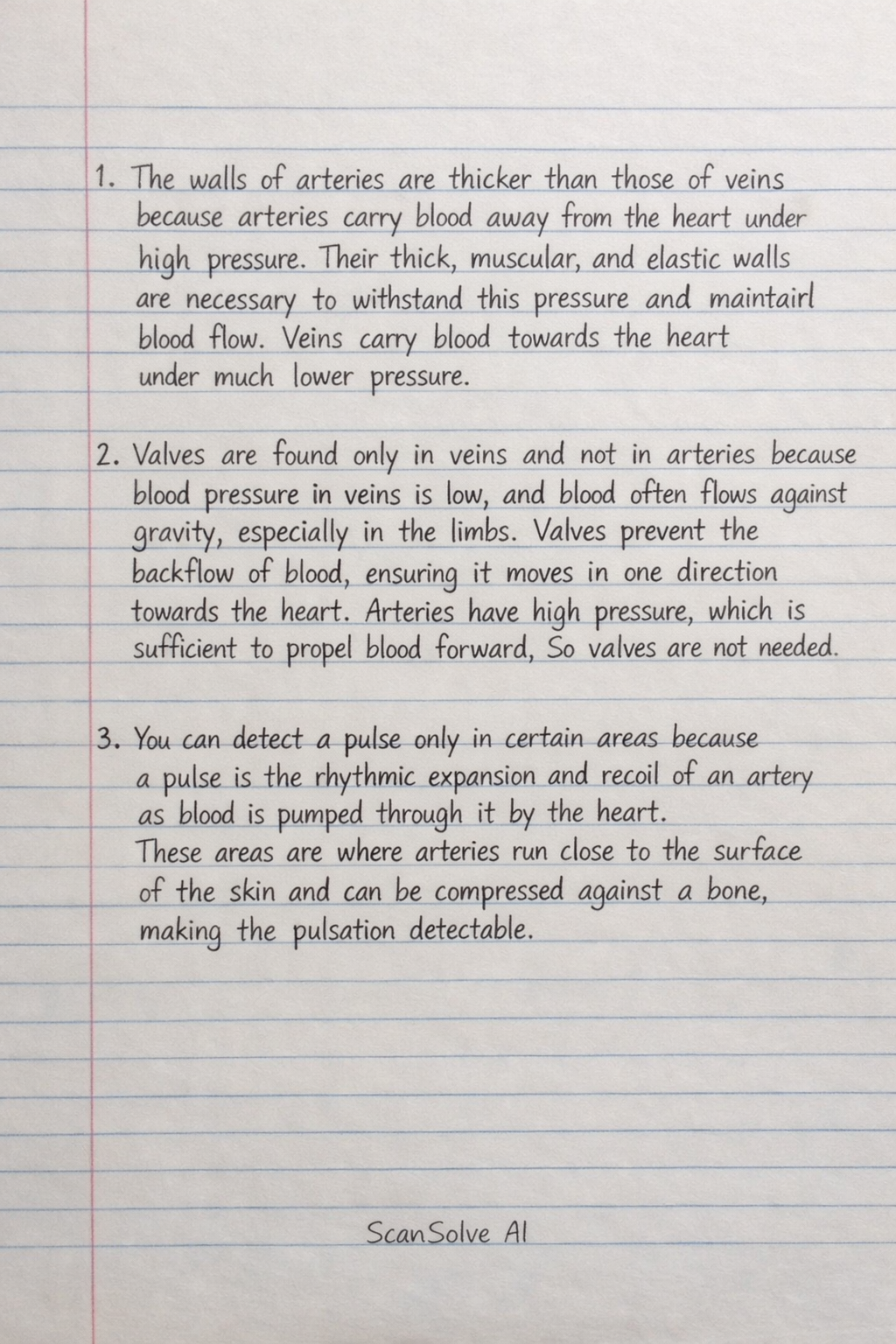
1. The walls of arteries are thicker than those of veins because arteries carry blood away from the heart under high pressure. Their thick, muscular, and elastic walls are necessary to withstand this pressure and maintain blood flow. Veins carry blood towards the heart under much lower pressure.
-
2. Valves are found only in veins and not in arteries because blood pressure in veins is low, and blood often flows against gravity, especially in the limbs. Valves prevent the backflow of blood, ensuring it moves in one direction towards the heart. Arteries have high pressure, which is sufficient to propel blood forward, so valves are not needed.
-
3. You can detect a pulse only in certain areas because a pulse is the rhythmic expansion and recoil of an artery as blood is pumped through it by the heart. These areas are where arteries run close to the surface of the skin and can be compressed against a bone, making the pulsation detectable.
-
4. All blood is red due to hemoglobin, but you cannot give or receive blood from just anyone because of blood types. Blood types are determined by specific antigens (proteins and sugars) on the surface of red blood cells. If a person receives blood with incompatible antigens, their immune system will produce antibodies that attack the foreign blood cells, leading to a dangerous reaction called agglutination.
-
5.
- The universal donor is an individual with Type O-negative blood. This is because O-negative red blood cells lack A, B, and Rh antigens, meaning they will not trigger an immune response in recipients with other blood types.
- The universal receiver is an individual with Type AB-positive blood. This is because AB-positive individuals have A, B, and Rh antigens on their red blood cells and therefore do not produce antibodies against these antigens, allowing them to safely receive blood from any blood type.
-
6. The main functions of the following systems are:
- a) Skeleton: Provides structural support for the body, protects internal organs, allows for movement, produces blood cells (hematopoiesis), and stores minerals like calcium.
- b) Circulatory: Transports oxygen, nutrients, hormones, and waste products throughout the body, helps regulate body temperature, and plays a role in immunity.
- c) Respiratory: Facilitates gas exchange, taking in oxygen and expelling carbon dioxide.
- d) Nervous: Controls and coordinates all body activities, processes sensory information, and enables thought, memory, and emotions.
- e) Urinary: Filters waste products from the blood to produce urine, regulates blood volume and pressure, and maintains electrolyte and acid-base balance.
- f) Reproductive: Produces gametes (sperm and eggs) and hormones necessary for sexual reproduction, and in females, supports fetal development.
- g) Digestive: Breaks down food into absorbable nutrients, absorbs these nutrients into the bloodstream, and eliminates undigested waste.
Still stuck on this one?
Ask a follow-up, and the answer starts from this question.
More Biology Questions
Handwritten Step-by-Step Solution
Get this as a handwritten image on WhatsApp — like a tutor wrote it for you.
Try on WhatsApp