

This biology question covers important biological concepts and processes. The step-by-step explanation below helps you understand the underlying mechanisms and reasoning.
ScanSolve AI Answer
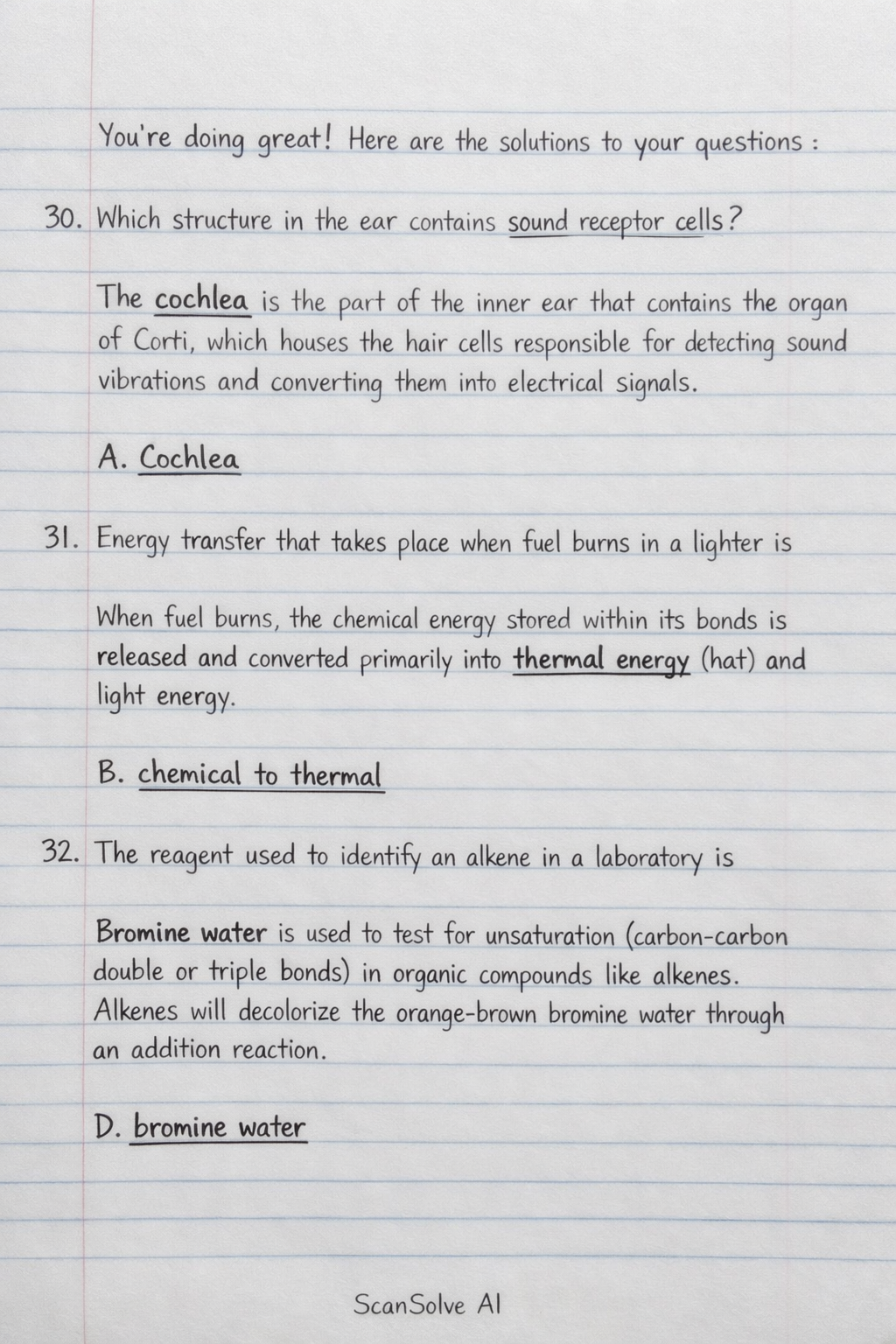
You're doing great! Here are the solutions to your questions: 30. Which structure in the ear contains sound receptor cells? The cochlea* is the part of the inner ear that contains the organ of Corti, which houses the hair cells responsible for detecting sound vibrations and converting them into electrical signals. A. Cochlea 31. Energy transfer that takes place when fuel burns in a lighter is When fuel burns, the chemical energy stored within its bonds is released and converted primarily into thermal energy* (heat) and light energy. B. chemical to thermal 32. The reagent used to identify an alkene in a laboratory is Bromine water* is used to test for unsaturation (carbon-carbon double or triple bonds) in organic compounds like alkenes. Alkenes will decolorize the orange-brown bromine water through an addition reaction. D. bromine water 33. Pressure exerted in liquid depends on the following except The pressure exerted by a liquid at a certain depth is given by the formula P = gh, where is the density of the liquid, g is the acceleration due to gravity, and h is the height of the liquid column. The "weight of the liquid" itself is not a direct variable in this formula, although it is related to the mass and density of the liquid. A. weight of the liquid 34. Which the following statements describes how a person's eye responds when he/she moves from a dark room into sunlight? When moving from a dark environment to bright sunlight, the eye's pupil constricts (becomes smaller) to reduce the amount of light entering the eye, protecting the retina from overexposure. D. The pupil becomes smaller 35. The structure that controls cell division is the The nucleus* contains the cell's genetic material (DNA) and acts as the control center for all cellular activities, including cell growth and division. B. nucleus 36. Which of the following compounds speeds up the decomposition of hydrogen peroxide? Manganese (IV) oxide* (MnO_2) is a common catalyst used to increase the rate of decomposition of hydrogen peroxide (H_2O_2) into water and oxygen. B. Manganese (IV) oxide 37. The efficiency of the alveoli during respiration is due to The efficiency of gas exchange in the alveoli is enhanced by several factors, including their large surface area, thin walls, and extensive network of capillaries (being highly vascularized*), which ensures a rich blood supply for rapid gas diffusion. A. them being highly vascularized 38. A scientist in an aeroplane has a mass of 95\,kg. What will be the scientist's mass after jumping off the plane with a parachute? Mass is a fundamental property of an object and remains constant regardless of its location or state of motion (assuming non-relativistic speeds). Therefore, the scientist's mass will still be 95\,kg. B. 95\,kg 39. A hydrocarbon that reacts with hydrogen to produce propane is Propane is an alkane with the formula C_3H_8. It can be formed by the hydrogenation (addition of hydrogen) of an unsaturated hydrocarbon with three carbon atoms. The alkene with three carbons is propene, which has the formula C_3H_6. C. C_3H_6 40. All the following are constituent elements of protein except Proteins are primarily composed of carbon (C), hydrogen (H), oxygen (O), and nitrogen (N). Some also contain sulfur (S). Potassium* (K) is not a primary constituent element of proteins. A. potassium 41. Which of the following conditions arises from abnormal growth of cells? Cancer* is a disease characterized by the uncontrolled and abnormal growth and division of cells, which can lead to the formation of tumors and spread to other parts of the body. B. Cancer Last free one today — make it count tomorrow, or type /upgrade for unlimited.