
We read your photo as:
How is the alimentary canal of the bird you have dissected adapted to its diet? Also, tabulate the differences between the alimentary canal of this animal (bird) and that of the guinea pig.
ScanSolve AI Answer
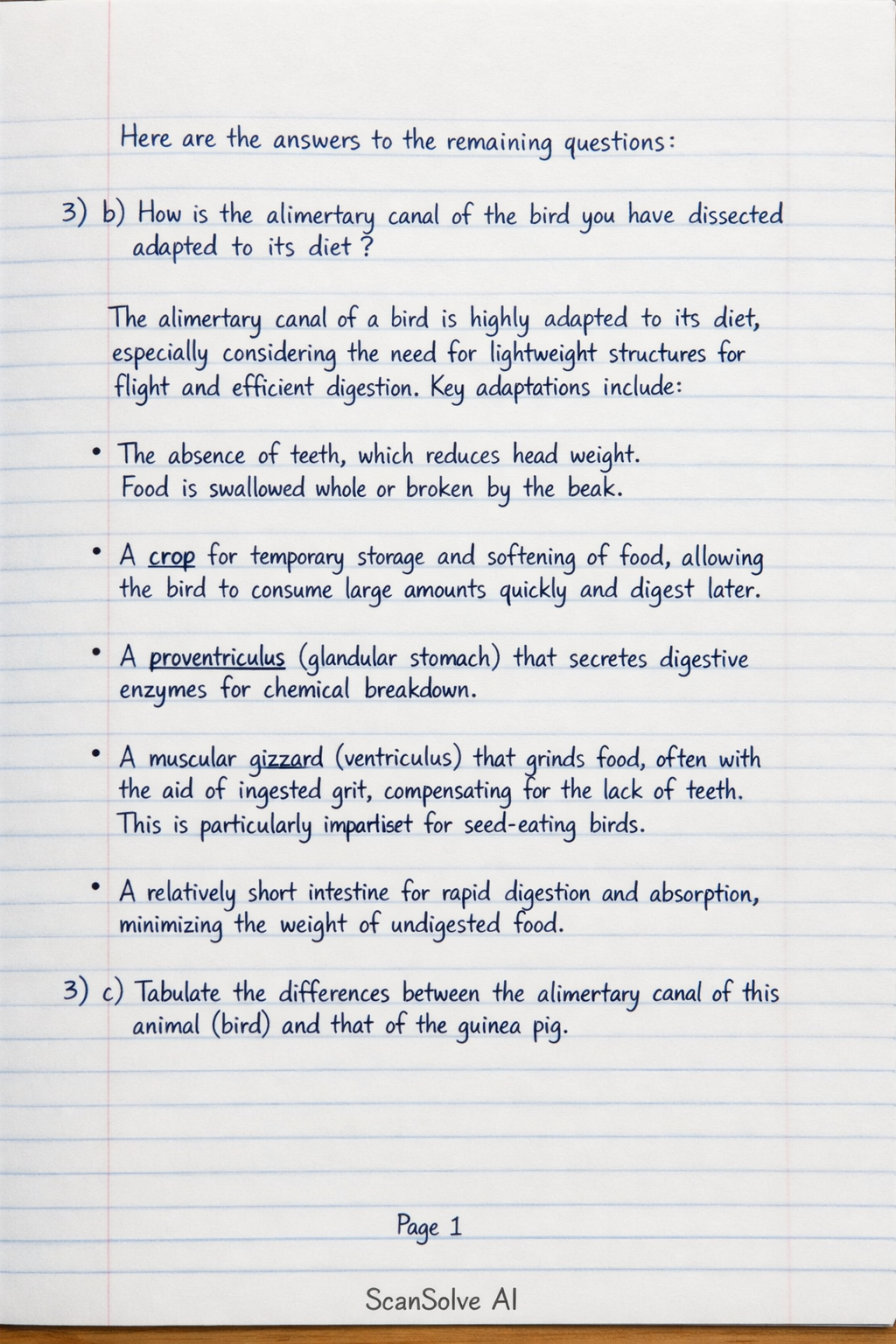
Here are the answers to the remaining questions:
3) b) How is the alimentary canal of the bird you have dissected adapted to its diet?
The alimentary canal of a bird is highly adapted to its diet, especially considering the need for lightweight structures for flight and efficient digestion. Key adaptations include:
- The absence of teeth, which reduces head weight. Food is swallowed whole or broken by the beak.
- A crop for temporary storage and softening of food, allowing the bird to consume large amounts quickly and digest later.
- A proventriculus (glandular stomach) that secretes digestive enzymes for chemical breakdown.
- A muscular gizzard (ventriculus) that grinds food, often with the aid of ingested grit, compensating for the lack of teeth. This is particularly important for seed-eating birds.
- A relatively short intestine for rapid digestion and absorption, minimizing the weight of undigested food.
3) c) Tabulate the differences between the alimentary canal of this animal (bird) and that of the guinea pig.
| Feature | Bird Alimentary Canal | Guinea Pig Alimentary Canal |
|---|---|---|
| Teeth | Absent | Present (incisors for gnawing, molars for grinding) |
| Crop | Present (for food storage and softening) | Absent |
| Stomach | Two-part: Proventriculus (glandular) and Gizzard (muscular) | Single-chambered stomach |
| Cecum | Paired, relatively small ceca (in some species) | Very large and prominent cecum (for cellulose fermentation) |
| Intestine Length | Relatively short | Very long (especially the large intestine) |
| Cloaca/Anus | Cloaca (common opening for digestive, urinary, reproductive systems) | Separate anus (digestive waste only) |
| Diet Adaptation | Adapted for rapid processing of seeds/insects, grinding in gizzard | Adapted for extensive fermentation of plant matter (herbivorous) |
4) a) i) Make labeled drawings to show the two types of seeds (maize and beans) which have started to germinate.
Since I cannot draw, I will describe the key features you should include and label in your drawings:
-
Germinating Maize Seed (Monocotyledonous):
- Draw an elongated, oval seed.
- Show the radicle (embryonic root) emerging downwards, protected by the coleorhiza.
- Show the plumule (embryonic shoot) emerging upwards, protected by the coleoptile.
- Label the scutellum (single cotyledon) which remains underground and absorbs nutrients from the endosperm.
- Label the endosperm as the main food storage tissue.
- Show developing adventitious roots emerging from the base of the stem.
-
Germinating Bean Seed (Dicotyledonous):
- Draw a kidney-shaped seed.
- Show the radicle emerging downwards, developing into the primary root.
- Show the hypocotyl (part of the stem below the cotyledons) elongating and arching, pulling the cotyledons above ground (epigeal germination).
- Show the two large cotyledons (seed leaves) that contain stored food and emerge above ground.
- Show the epicotyl (part of the stem above the cotyledons) with the developing plumule (first true leaves) emerging from between the cotyledons.
- Label the testa (seed coat) which may still be attached.
4) a) ii) Comment on any two differences that can be observed.
- Number of Cotyledons: The germinating maize seed has one cotyledon (monocot), while the germinating bean seed has two cotyledons (dicot).
- Food Storage: In maize, the primary food storage is in the endosperm, with the scutellum absorbing nutrients. In beans, the food is stored directly within the two large cotyledons.
- Germination Type: Maize typically exhibits hypogeal germination, where the cotyledon(s) remain below ground. Beans typically show epigeal germination, where the cotyledons are carried above ground by the elongating hypocotyl.
- Protective Sheaths: Maize has protective sheaths like the coleoptile (covering the plumule) and coleorhiza (covering the radicle), which are absent in beans.
4) b) Investigate the presence of starch, reducing sugar, proteins and lipids in S. Give a detailed description of your methods. Record and comment on your results.
First, dissolve a small amount of Powder (S) in distilled water to create a solution for testing.
| Test for | Procedure
Still stuck on this one?
Ask a follow-up, and the answer starts from this question.
More Biology Questions
Handwritten Step-by-Step Solution
Get this as a handwritten image on WhatsApp — like a tutor wrote it for you.
Try on WhatsApp