
We read your photo as:
What are the answers to questions 6a, 6b, 6c, and 6d regarding mosquito control, environmental impact of gold extraction, cover cropping, and uses of metals/non-metals?
ScanSolve AI Answer
It looks like you're asking for questions 6, 7, and 8 again. Here are the solutions, formatted as requested:
6.
-
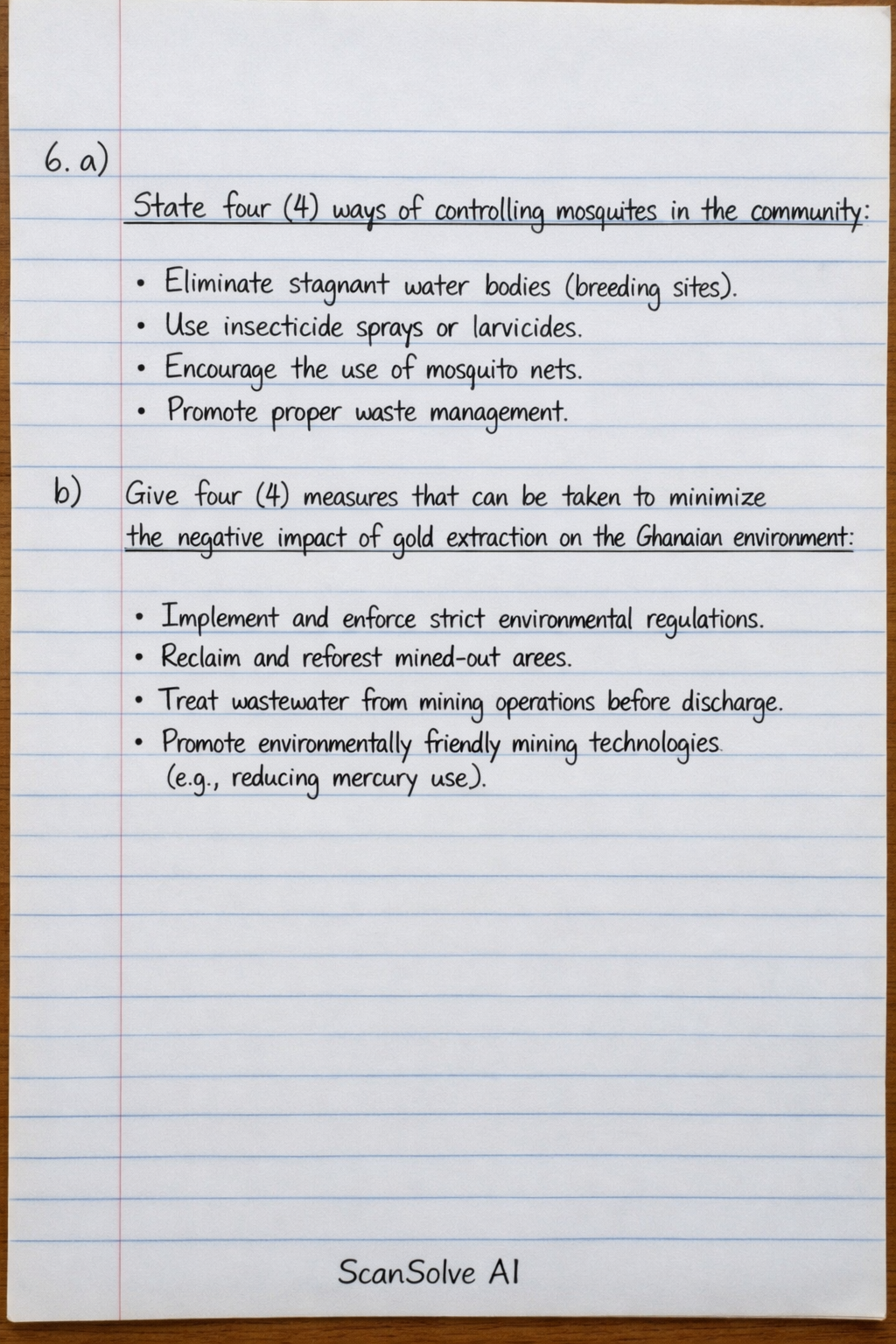
a) State four (4) ways of controlling mosquitoes in the community.
- Eliminate stagnant water bodies (breeding sites).
- Use insecticide sprays or larvicides.
- Encourage the use of mosquito nets.
- Promote proper waste management.
-
b) Give four (4) measures that can be taken to minimize the negative impact of gold extraction on the Ghanaian environment.
- Implement and enforce strict environmental regulations.
- Reclaim and reforest mined-out areas.
- Treat wastewater from mining operations before discharge.
- Promote environmentally friendly mining technologies (e.g., reducing mercury use).
-
c) State four (4) importance of cover cropping in crop production.
- Soil erosion control: Protects soil from wind and water.
- Weed suppression: Outcompetes weeds.
- Soil fertility improvement: Adds organic matter and fixes nitrogen.
- Moisture retention: Reduces evaporation.
-
d) State two (2) uses of each of the following
- i) Metals
- Used in construction (e.g., steel for buildings).
- Used for electrical wiring (e.g., copper).
- ii) Non-metals
- Oxygen is essential for respiration.
- Carbon (as coal) is used as a fuel source.
- i) Metals
7.
-
a) i) Define light energy. Light energy is a form of electromagnetic radiation that is visible to the human eye and travels in waves.
-
a) ii) Explain two (2) ways in which light energy is useful to living organisms.
- Photosynthesis: Plants use light energy to convert carbon dioxide and water into glucose and oxygen.
- Vision: Animals use light energy to perceive their surroundings, aiding navigation and food finding.
-
b) i) Define an atom. An atom is the smallest unit of an element that retains the chemical identity of that element, consisting of a nucleus surrounded by electrons.
-
b) ii) An atom has 11 electrons.
- a) Draw the electronic configuration of the atom. The electronic configuration is .
- b) Type of bond the element will form with chlorine. The element will form an ionic bond with chlorine.
- c) Give two (2) reasons for the type of chemical bond stated in (β) above.
- There is a large difference in electronegativity between the metal (sodium) and the non-metal (chlorine).
- Sodium transfers its valence electron to chlorine, forming stable ions (Na and Cl).
-
c) i) Define food poisoning. Food poisoning is an illness caused by consuming food contaminated with harmful microorganisms or their toxins.
-
c) ii) Explain two causes of food poisoning.
- Improper cooking: Food not cooked to the correct temperature may not kill harmful pathogens.
- Cross-contamination: Transfer of pathogens from raw foods to ready-to-eat foods.
-
d) State two (2) methods of soil conservation.
- Contour plowing: Plowing across slopes to reduce runoff.
- Crop rotation: Alternating crops to maintain soil fertility and structure.
8.
-
a) i) State the law of floatation. The law of floatation states that a floating object displaces a weight of fluid equal to its own weight.
-
a) ii) Explain how a submarine operates. A submarine operates by changing its buoyancy. It fills ballast tanks with water to increase density and dive, and expels water with compressed air to decrease density and surface.
-
b) i) State three (3) ways of preventing dental decay.
- Brush teeth regularly with fluoride toothpaste.
- Limit sugary foods and drinks.
- Floss daily.
-
b) ii) State one (1) cause each of:
- a) Constipation: One cause is insufficient fiber in the diet.
- b) Indigestion: One cause is eating too quickly or consuming fatty/spicy foods.
-
c) i) What is an alloy? An alloy is a mixture of two or more elements, at least one of which is a metal, combined to create a new material with enhanced properties.
-
c) ii) Name the main elements present in each of the following:
- a) Bronze:
- b) Nichrome:
- c) Duralumin:
-
d) i) List two (2) types of animal parasites.
- Endoparasites (e.g., tapeworms)
- Ectoparasites (e.g., ticks)
-
d) ii) State three (3) economic importance of the grasshopper.
- Crop damage: They are agricultural pests that destroy crops, causing economic losses.
- Food source: They serve as a food source for various animals in the ecosystem.
- Bait: They can be used as bait for fishing.
Still stuck on this one?
Ask a follow-up, and the answer starts from this question.
More Biology Questions
Handwritten Step-by-Step Solution
Get this as a handwritten image on WhatsApp — like a tutor wrote it for you.
Try on WhatsApp