
We read your photo as:
What are the answers to questions (iii), (iv), and (v) regarding copper extraction and slag?
ScanSolve AI Answer
Answer
Here are the answers to the questions:
(iii) Write the formula of the major component of slag.
The major component of slag is calcium silicate.
Formula:
(iv) Write a balanced equation to show how is obtained from .
(v) Draw a well labelled diagram to show how copper is obtained from blister copper.
I cannot draw a diagram, but I can describe the process of electrolytic refining of copper:
- Setup: An electrolytic cell is used. The anode is made of impure blister copper, and the cathode is a thin sheet of pure copper. The electrolyte is an aqueous solution of copper(II) sulfate () and dilute sulfuric acid ().
- At the anode (oxidation): When current is passed, impure copper at the anode oxidizes. Copper atoms lose electrons and enter the solution as ions. More reactive metal impurities (e.g., zinc, iron) also oxidize and dissolve into the electrolyte. Less reactive metal impurities (e.g., silver, gold, platinum) do not oxidize and fall to the bottom as anode sludge.
- At the cathode (reduction): ions from the electrolyte migrate to the cathode, gain electrons, and are deposited as pure copper metal. The more reactive metal ions remain in the solution because they are harder to reduce than ions.
This process results in high-purity copper being deposited on the cathode.
(vi) Give one major use of copper.
- Electrical wiring (due to its excellent electrical conductivity).
b) Give one major effect of extracting copper on the environment.
- Air pollution: Smelting of copper sulfide ores releases sulfur dioxide () gas, which contributes to acid rain.
Try one yourself
A new problem that tests the same skill.
Still stuck on this one?
Ask a follow-up, and the answer starts from this question.
More Chemistry Questions
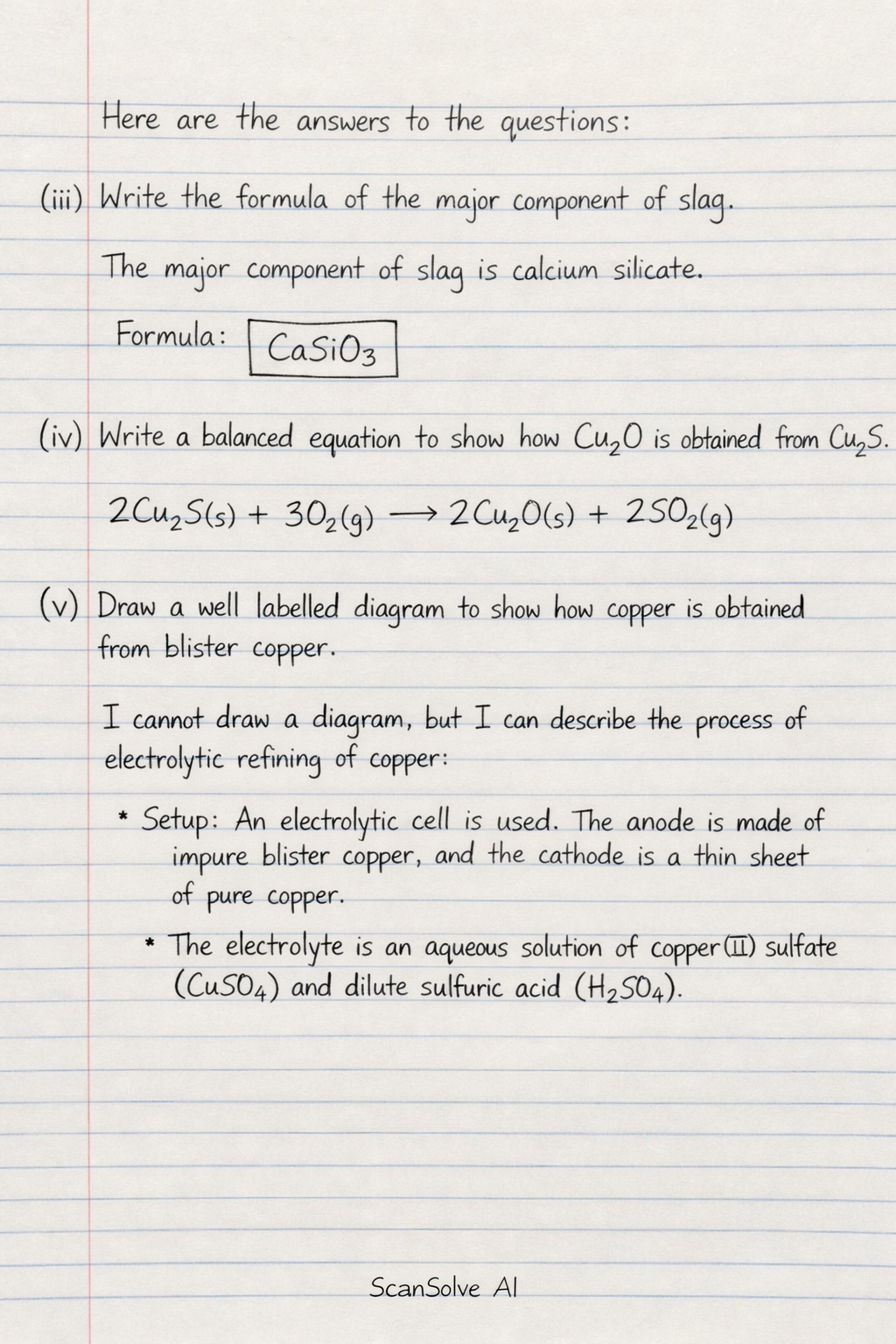
Handwritten Step-by-Step Solution
Get this as a handwritten image on WhatsApp — like a tutor wrote it for you.
Try on WhatsApp