
We read your photo as:
Provide answers for the extraction of zinc and sequence of copper reactions questions, including chemical equations and observations.
ScanSolve AI Answer
Step-by-step solution
5 stepshere are the solutions to the questions.
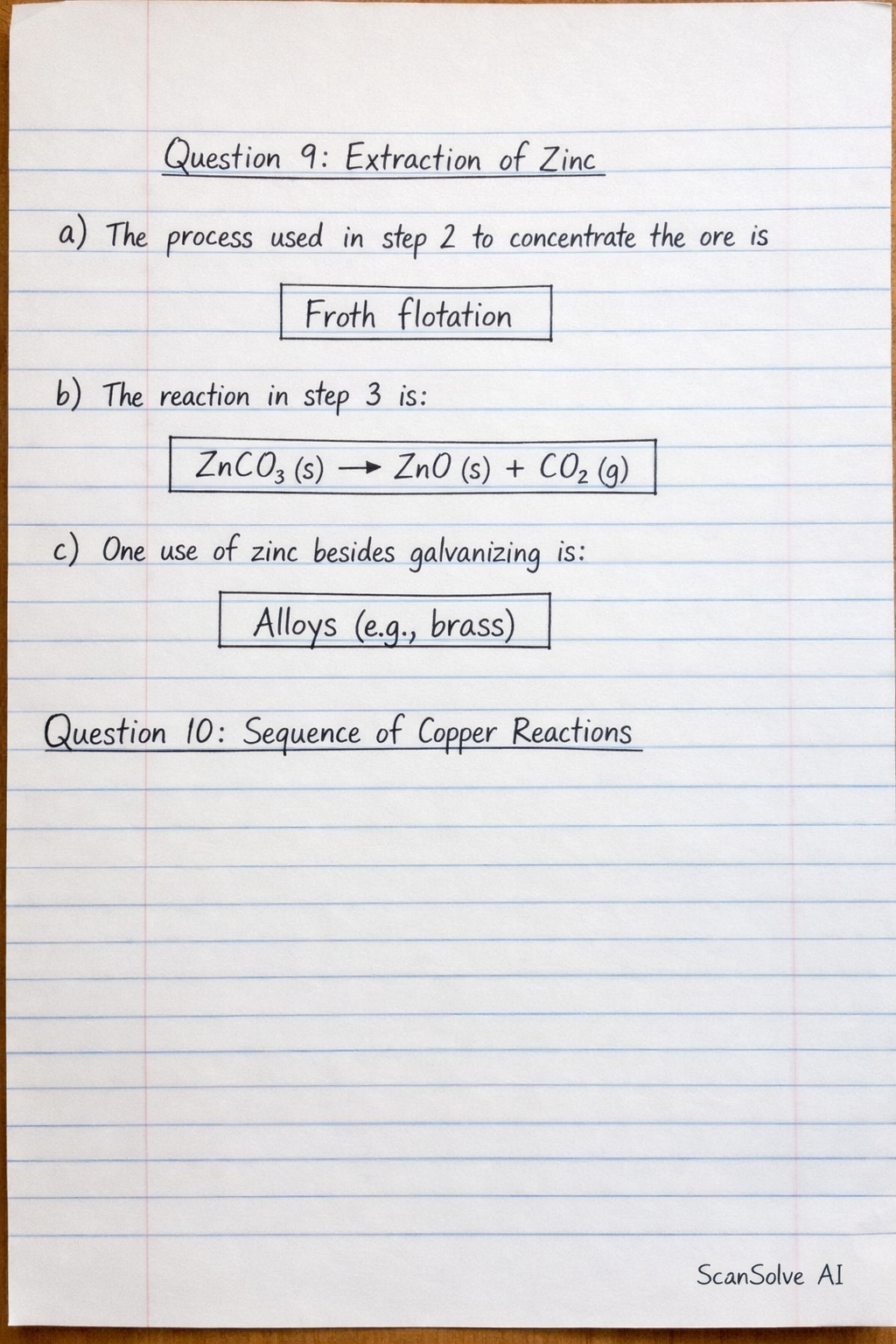
Question 9: Extraction of Zinc
a) The process used in step 2 to concentrate the ore is froth flotation (or gravity separation).
b) The reaction that takes place in step 3 is the thermal decomposition of zinc carbonate to zinc oxide and carbon dioxide.
c) One use of zinc other than galvanizing is in the production of alloys (e.g., brass) or dry cell batteries.
Question 10: Sequence of Copper Reactions
a) In step 1, excess 3M nitric acid was added to 0.5g of copper powder.
- (i) Two observations made were:
- The reddish-brown copper powder dissolves, and the solution turns blue.
- A brown gas is evolved.
- (ii) Dilute hydrochloric acid cannot be used in step 1 because copper is less reactive than hydrogen and therefore cannot displace hydrogen from hydrochloric acid. Hydrochloric acid is also a non-oxidizing acid.
- (iii) I. The equation for the reaction in step 1 is:
- (iii) II. Calculate the volume of 3M nitric acid needed.
Calculate moles of copper.
$$ \text{Moles of Cu} = \frac{\text{Mass}}{\text{Molar mass}} = \frac{0.5 \text{ g}}{63.5 \text{ g/mol}} \approx 0.007874 \text{ mol} $$Use stoichiometry to find moles of nitric acid.
From the equation, reacts with .
Calculate the volume of nitric acid.
$$ \text{Volume of HNO}_3 = \frac{\text{Moles}}{\text{Concentration}} = \frac{0.031496 \text{ mol}}{3 \text{ mol/dm}^3} \approx 0.010499 \text{ dm}^3 $$ Converting to $\text{cm}^3$: $$ \text{Volume of HNO}_3 = 0.010499 \text{ dm}^3 \times 1000 \text{ cm}^3/\text{dm}^3 \approx 10.5 \text{ cm}^3 $$ $$ \boxed{10.5 \text{ cm}^3} $$b) The names of the types of reactions that took place in steps 4 and 5 are:
is an acid-base reaction (or neutralization).
is a displacement reaction.
c) Apart from good conductivity of electricity, two other properties of copper that make it suitable for the electrical industry are:
- Ductility (can be drawn into wires).
- Malleability (can be hammered into sheets).
Question 11: Investigation of Temperature Changes
a) Two factors that must be kept constant in this experiment are:
- Initial temperature of the acid and sodium hydroxide solutions.
- Concentration of the acid and sodium hydroxide solutions.
- Volume of the acid.
b) The use of a polystyrene cup will reduce heat loss to the surroundings because polystyrene is a good thermal insulator. This will lead to a more accurate measurement of the temperature change.
Question 12: Molar Heat of Displacement and Energy Level Diagram
a) The molar heat of displacement is the enthalpy change when one mole of a metal is displaced from its salt solution by a more reactive metal.
b) The reaction has , meaning it is an exothermic reaction.
The energy level diagram for an exothermic reaction shows the products at a lower energy level than the reactants.\begin{tikzpicture} \draw[->] (0,0) -- (0,4) node[above] {Energy}; \draw[->] (0,0) -- (4,0) node[right] {Reaction progress}; \draw[thick] (0.5,3.5) -- (1.5,3.5) node[right] {Reactants: $\text{Z}^{2+}(\text{aq}) + \text{Y}(\text{s})$}; \draw[thick] (2.5,1.5) -- (3.5,1.5) node[right] {Products: $\text{Z}(\text{s}) + \text{Y}^{2+}(\text{aq})$}; \draw[<->, dashed] (1.5,3.5) -- (2.5,1.5) node[midway, right] {$\Delta \text{H} = -\text{ve}$}; \end{tikzpicture}
Still stuck on this one?
Ask a follow-up, and the answer starts from this question.
More Chemistry Questions
Handwritten Step-by-Step Solution
Get this as a handwritten image on WhatsApp — like a tutor wrote it for you.
Try on WhatsApp