
We read your photo as:
Describe the extraction of zinc and the production of sulfuric acid from zinc ore, including relevant equations and processes.
ScanSolve AI Answer
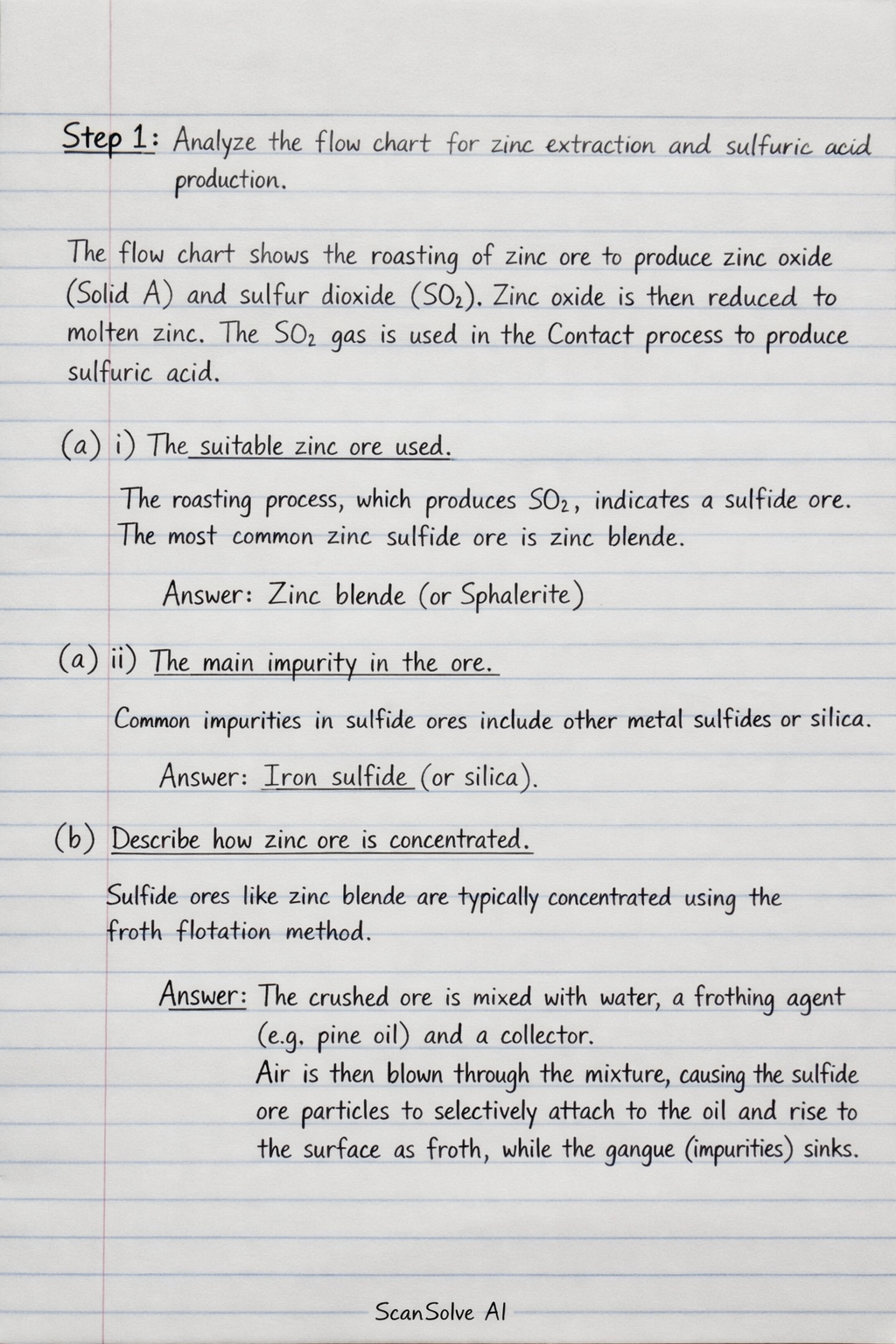
Step 1: Analyze the flow chart for zinc extraction and sulfuric acid production.
The flow chart shows the roasting of zinc ore to produce zinc oxide (Solid A) and sulfur dioxide (). Zinc oxide is then reduced to molten zinc. The gas is used in the Contact process to produce sulfuric acid.
a) i) The suitable zinc ore used.
The roasting process, which produces , indicates a sulfide ore. The most common zinc sulfide ore is zinc blende.
Answer: Zinc blende (or Sphalerite)
a) ii) The main impurity in the ore.
Common impurities in sulfide ores include other metal sulfides or silica.
Answer: Iron sulfide (or silica)
b) Describe how zinc ore is concentrated.
Sulfide ores like zinc blende are typically concentrated using the froth flotation method.
Answer: The crushed ore is mixed with water, a frothing agent (e.g., pine oil), and a collector. Air is then blown through the mixture, causing the sulfide ore particles to selectively attach to the oil and rise to the surface as froth, while the gangue (impurities) sinks.
c) Write an equation for the reaction taking place in the roasting furnace.
In the roasting furnace, zinc sulfide reacts with oxygen from the hot air blast to form zinc oxide and sulfur dioxide.
d) Describe what happens in the reduction chamber.
Solid A, which is zinc oxide (), is reduced to molten zinc in the reduction chamber. This is typically done by heating with carbon (coke).
Answer: Zinc oxide (Solid A) is reduced by carbon (coke) at high temperatures to produce molten zinc and carbon monoxide.
e) Identify substances:
- W: After the catalytic chamber, reacts with to form sulfur trioxide ().
- M: In the Contact process, is absorbed in concentrated sulfuric acid in Chamber L to form oleum. M is the product from Chamber L.
- P: Oleum (M) is then diluted with water (P) in Chamber N to produce sulfuric acid. Answer:
- W: Sulfur trioxide ()
- M: Oleum ()
- P: Water ()
f) Write the equation for the reaction that occurs in chamber N.
In Chamber N, oleum reacts with water to form sulfuric acid.
g) Explain why sulphur (VI) oxide is not dissolved directly in water.
Sulfur (VI) oxide () reacts violently and highly exothermically with water, producing a fine mist of sulfuric acid that is difficult to condense and handle efficiently.
Answer: The direct reaction of sulfur (VI) oxide () with water is highly exothermic and produces a corrosive mist of sulfuric acid, which is difficult to absorb and handle safely and efficiently.
h) Explain the danger caused by this process to the environment.
The main environmental danger is the release of unreacted sulfur dioxide () gas, which is a major air pollutant.
Answer: The release of unreacted sulfur dioxide () gas into the atmosphere causes acid rain, which damages buildings, vegetation, and aquatic ecosystems. It also contributes to respiratory problems in humans.
Still stuck on this one?
Ask a follow-up, and the answer starts from this question.
More Chemistry Questions
Handwritten Step-by-Step Solution
Get this as a handwritten image on WhatsApp — like a tutor wrote it for you.
Try on WhatsApp