
We read your photo as:
What is the appearance of the vaginal discharge in advance cervical cancer?
ScanSolve AI Answer
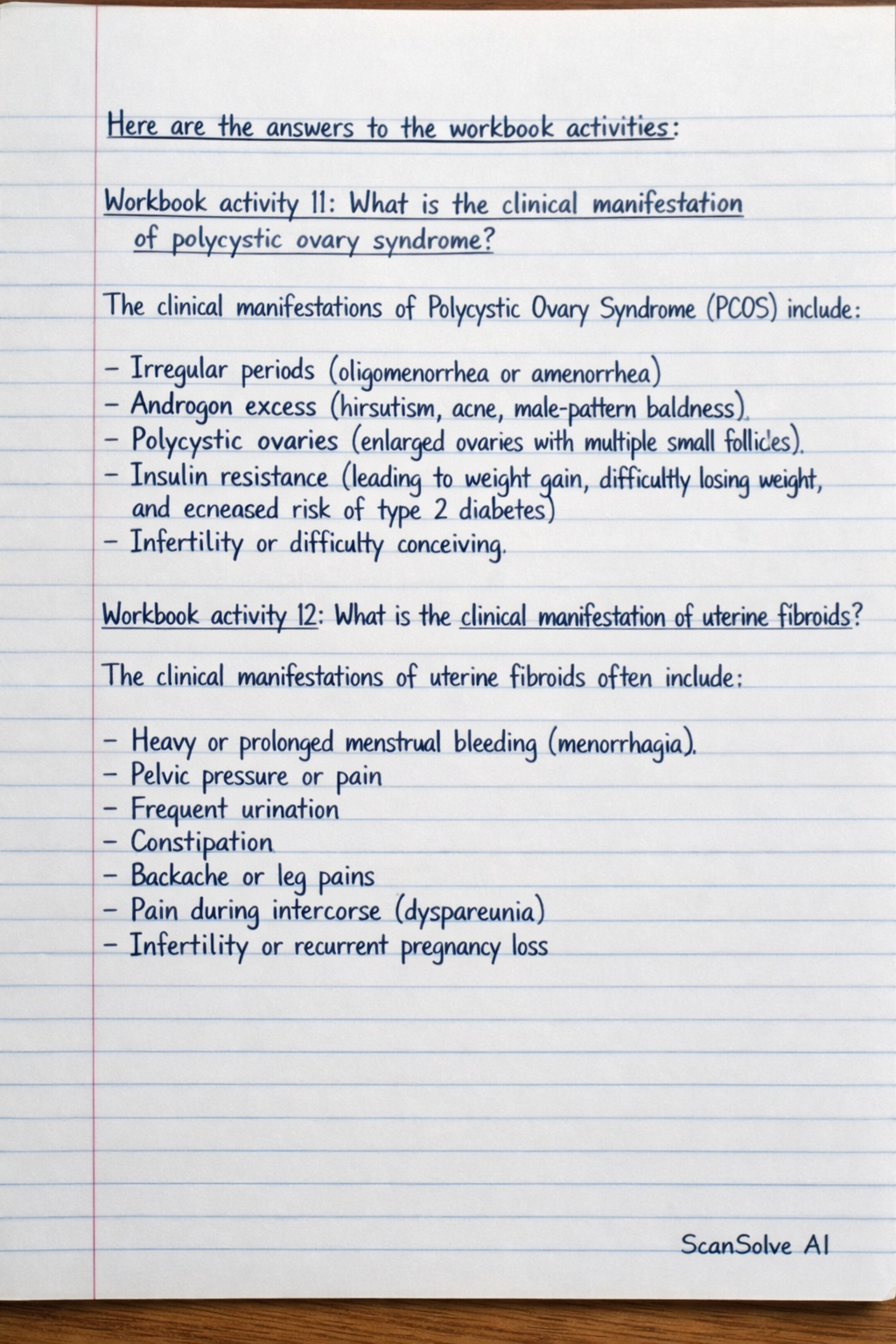
Here are the answers to the workbook activities:
Workbook activity 11: What is the clinical manifestation of polycystic ovary syndrome?
The clinical manifestations of Polycystic Ovary Syndrome (PCOS) include:
- Irregular periods (oligomenorrhea or amenorrhea)
- Androgen excess (hirsutism, acne, male-pattern baldness)
- Polycystic ovaries (enlarged ovaries with multiple small follicles)
- Insulin resistance (leading to weight gain, difficulty losing weight, and increased risk of type 2 diabetes)
- Infertility or difficulty conceiving
Workbook activity 12: What is the clinical manifestation of uterine fibroids?
The clinical manifestations of uterine fibroids often include:
- Heavy or prolonged menstrual bleeding (menorrhagia)
- Pelvic pressure or pain
- Frequent urination
- Constipation
- Backache or leg pains
- Pain during intercourse (dyspareunia)
- Infertility or recurrent pregnancy loss
Workbook activity 13: Illustrate by means of a simple schematic drawing uterine fibroids.
As an AI, I cannot create drawings. However, a simple schematic drawing of uterine fibroids would typically show a uterus with various benign growths (fibroids) located in different positions:
- Intramural fibroids: Within the muscular wall of the uterus.
- Subserosal fibroids: On the outer surface of the uterus.
- Submucosal fibroids: Protruding into the uterine cavity.
- Pedunculated fibroids: Attached to the uterus by a stalk.
Workbook activity 14: What are types of cervical cancer?
The main types of cervical cancer are:
- Squamous cell carcinoma: This is the most common type, accounting for about 80-90% of cervical cancers. It develops from the squamous cells that line the outer part of the cervix.
- Adenocarcinoma: This type accounts for about 10-20% of cervical cancers. It develops from the glandular cells that line the cervical canal.
- Mixed adenosquamous carcinoma: A rare type that has features of both squamous cell carcinoma and adenocarcinoma.
Workbook activity 15: What are the preventative measures for cervical cancer?
Preventative measures for cervical cancer include:
- HPV vaccination: Vaccination against Human Papillomavirus (HPV) is highly effective in preventing infections that cause most cervical cancers.
- Regular cervical cancer screening (Pap tests and HPV tests): These tests can detect precancerous changes in the cervix, allowing for early treatment before cancer develops.
- Safe sexual practices: Using condoms and limiting the number of sexual partners can reduce the risk of HPV infection.
- Avoiding smoking: Smoking increases the risk of cervical cancer.
Workbook activity 16: What is the appearance of the vaginal discharge in advance cervical cancer?
In advanced cervical cancer, the vaginal discharge can appear as:
- Watery, bloody, or foul-smelling discharge.
- It may be pale, brown, or mixed with blood, often described as a foul-smelling, watery, or purulent discharge.
- The discharge can be heavy and persistent, distinct from normal vaginal discharge.
Still stuck on this one?
Ask a follow-up, and the answer starts from this question.
More Biology Questions
Handwritten Step-by-Step Solution
Get this as a handwritten image on WhatsApp — like a tutor wrote it for you.
Try on WhatsApp