
We read your photo as:
What are the functions of iron, assimilation, food labels, food quality, humectants, marasmus, and vitamin D? Explain the induced-fit model.
ScanSolve AI Answer
Answer
22) Iron is a component of hemoglobin, which is responsible for oxygen transport in the blood.
- The correct option is B.
23) Assimilation is the process by which absorbed nutrients are incorporated into the body's cells and used for growth, repair, and energy production.
- The correct option is A.
24) Reading food labels provides information about ingredients, nutritional content, allergens, and expiry dates, enabling consumers to make informed decisions about the product's quality and safety.
- The correct option is B.
25) Food quality refers to the overall characteristics that make food safe, nutritious, and acceptable for consumption, including sensory attributes like taste, smell, and appearance.
- The correct option is C.
26) Humectants are food additives that attract and retain moisture, thereby preventing food products from drying out and maintaining their texture.
- The correct option is A.
27) Marasmus is a severe form of malnutrition characterized by a significant deficiency in both calories and protein, leading to extreme wasting of muscles and fat.
- The correct option is D.
28) Vitamin D is crucial for the absorption of calcium and phosphorus, which are essential for bone development. A deficiency in Vitamin D leads to Rickets.
- The correct option is C.
29) The induced-fit model suggests that the active site of an enzyme is flexible and undergoes a slight conformational change upon binding to its specific substrate, allowing for a more precise fit.
- The correct option is B.
30) Emulsifying agents (emulsifiers) work by reducing the interfacial tension between two immiscible liquids, allowing them to mix and form a stable emulsion.
- The correct option is B.
31) Kwashiorkor is a form of severe protein malnutrition. Low levels of protein, particularly albumin, in the blood reduce the blood's osmotic pressure, causing fluid to leak into the tissues and resulting in edema.
- The correct option is D.
32) Family traditions and cultural practices significantly influence the types of food children are exposed to and learn to prefer from a young age.
- The correct option is A.
33) Amino acids are the building blocks of proteins and are essential nutrients, not anti-nutrients. Goitrogens, phytates, and tannins are substances that interfere with nutrient absorption or utilization.
- The correct option is C.
34) Rancidity is the chemical deterioration of fats and oils, typically through oxidation or hydrolysis, which produces unpleasant odors and flavors in lipid-containing foods during storage.
- The correct option is B.
35) Tocopherol, commonly known as Vitamin E, is a fat-soluble vitamin that acts as a powerful antioxidant, protecting cells from damage by free radicals.
- The correct option is A.
36) Microminerals (or trace minerals) are required by the body in small amounts (less than 100 mg per day). Iron is an essential micromineral involved in oxygen transport. Manganese is also a micromineral.
- The correct option is D.
37) Stearic acid is a saturated fatty acid, meaning it contains no double bonds in its hydrocarbon chain. Linolenic, linoleic, and oleic acids are all unsaturated fatty acids.
- The correct option is A.
38) Fehling's test detects reducing sugars, which have a free aldehyde or ketone group. Glucose, maltose, and galactose are reducing sugars. Sucrose is a non-reducing sugar because its anomeric carbons are involved in the glycosidic bond, preventing ring opening to expose a free aldehyde or ketone group.
- The correct option is C.
39) Misbranding refers to false or misleading labeling or advertising of a product, which is a deceptive practice and not a means of educating consumers. Labelling, packaging, and advertisements can all be used to provide information to consumers.
- The correct option is D.
40) The Sudan III test is used to detect the presence of lipids (fats and oils) by staining them red-orange. Millon's test, Biuret test, and the Foam test (for certain proteins) are methods used to detect proteins.
- The correct option is D.
Try one yourself
A new problem that tests the same skill.
Still stuck on this one?
Ask a follow-up, and the answer starts from this question.
More Biology Questions
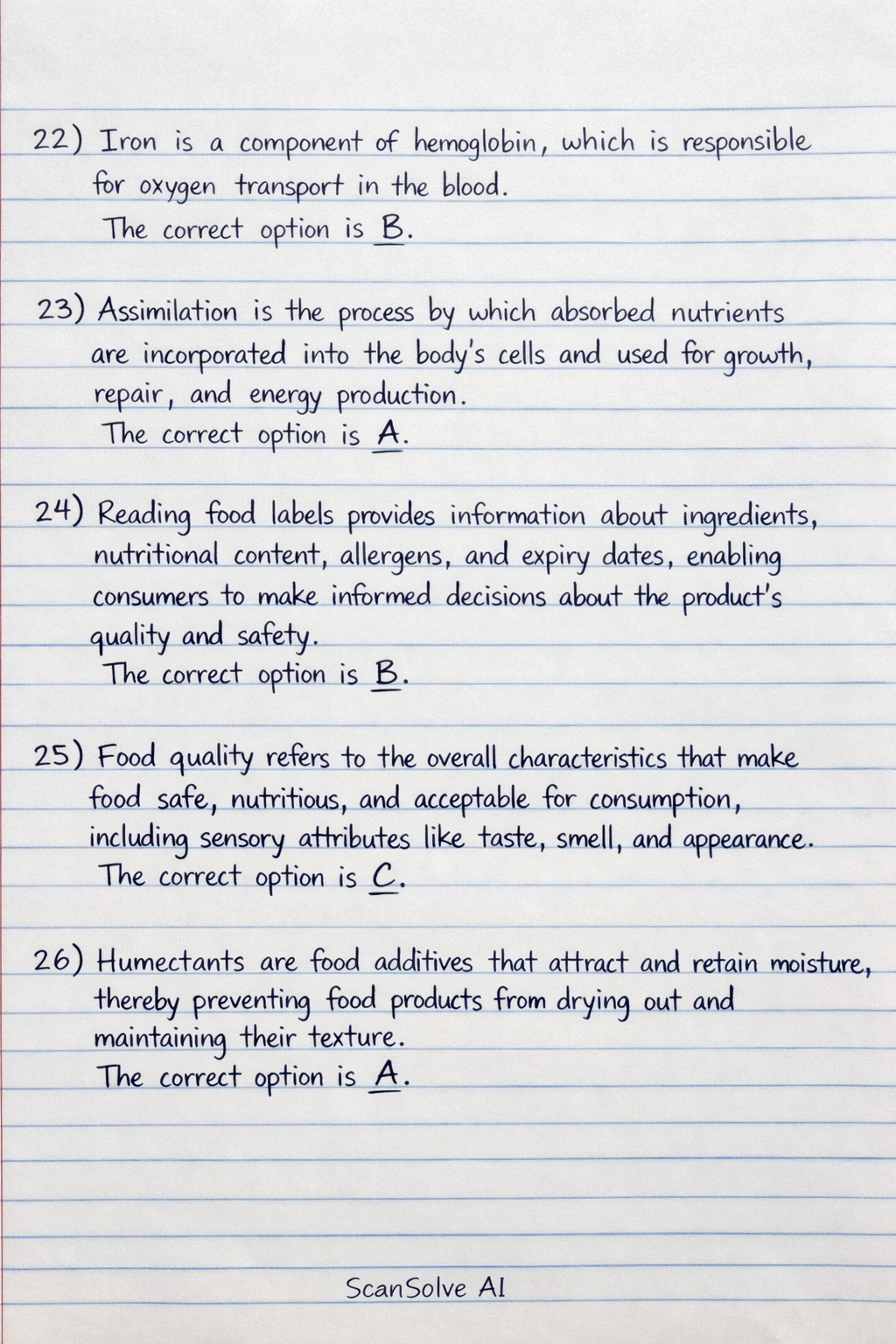
Handwritten Step-by-Step Solution
Get this as a handwritten image on WhatsApp — like a tutor wrote it for you.
Try on WhatsApp