
We read your photo as:
What are the key aspects of aseptic technique in nursing, including its definition, types, importance, and principles?
ScanSolve AI Answer
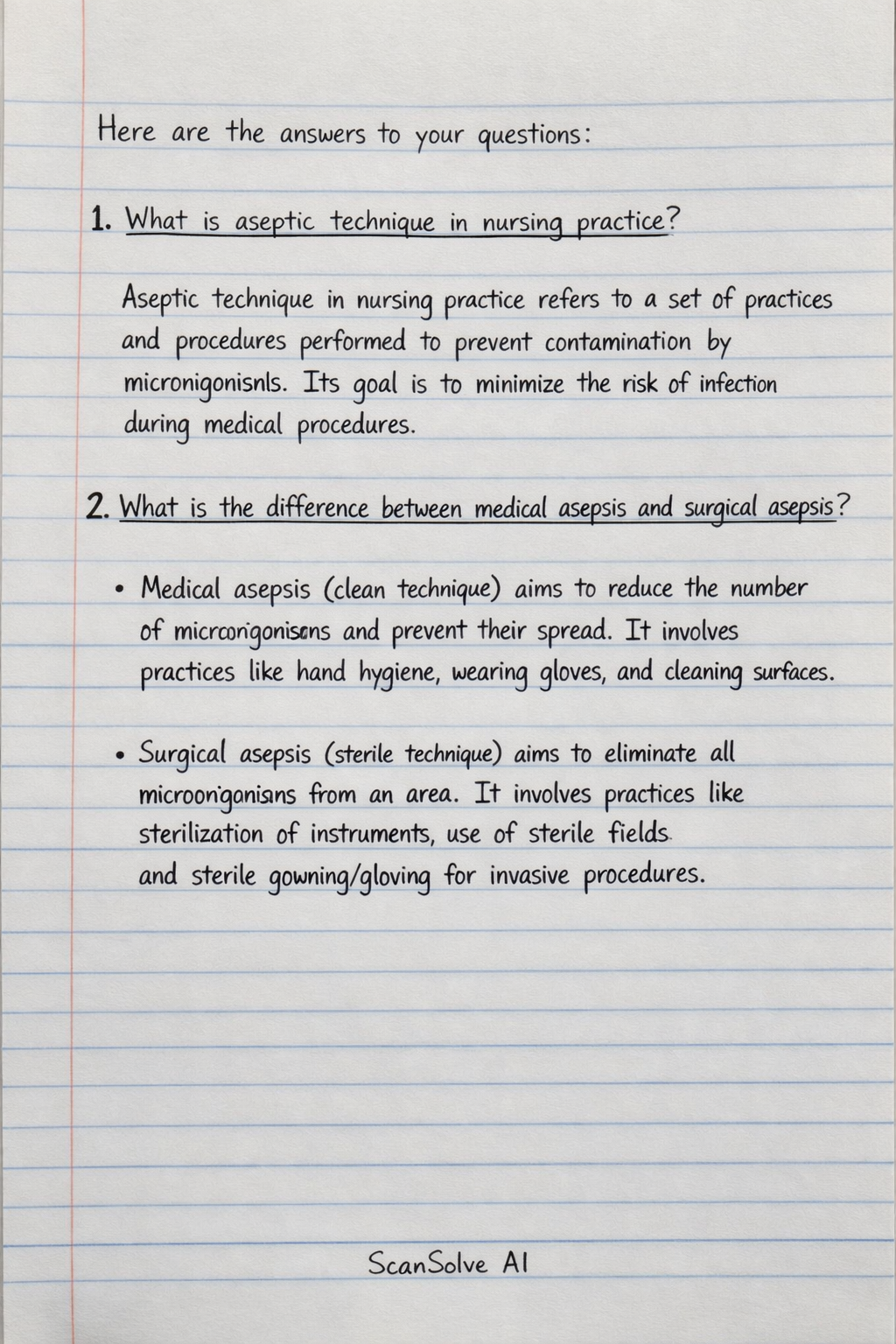
Here are the answers to your questions:
-
What is aseptic technique in nursing practice? Aseptic technique in nursing practice refers to a set of practices and procedures performed to prevent contamination by microorganisms. Its goal is to minimize the risk of infection during medical procedures.
-
What is the difference between medical asepsis and surgical asepsis?
- Medical asepsis (clean technique) aims to reduce the number of microorganisms and prevent their spread. It involves practices like hand hygiene, wearing gloves, and cleaning surfaces.
- Surgical asepsis (sterile technique) aims to eliminate all microorganisms from an area. It involves practices like sterilization of instruments, use of sterile fields, and sterile gowning/gloving for invasive procedures.
-
Why is aseptic technique important in patient care? Aseptic technique is crucial in patient care to prevent healthcare-associated infections (HAIs). By minimizing the introduction of pathogens into the patient's body, it reduces the risk of complications, improves patient outcomes, and shortens hospital stays.
-
Mention the principles of aseptic technique. The principles of aseptic technique include:
- Sterile objects remain sterile only when touched by other sterile objects.
- Only sterile objects may be placed on a sterile field.
- A sterile object or field out of the range of vision or below the waist is considered contaminated.
- A sterile object or field becomes contaminated by prolonged exposure to air.
- When a sterile surface comes in contact with a wet, contaminated surface, the sterile object or field becomes contaminated by capillary action.
- Fluid flows in the direction of gravity.
- The edges of a sterile field or container are considered contaminated.
-
What is cross infection? Cross infection (or cross-contamination) is the transmission of infectious agents from one person or object to another, often within a healthcare setting. This can occur directly (person-to-person) or indirectly (via contaminated surfaces or equipment).
-
What is the difference between contamination and infection?
- Contamination is the presence of unwanted microorganisms on a surface, object, or in a substance. It does not necessarily mean disease will occur.
- Infection occurs when microorganisms invade the body, multiply, and cause tissue damage or disease, leading to symptoms.
-
What are the sources of infection in the hospital? Sources of infection in a hospital can include:
- Patients (endogenous flora or existing infections).
- Healthcare workers (hands, clothing, respiratory droplets).
- Contaminated medical equipment (catheters, ventilators, surgical instruments).
- Environmental surfaces (bed rails, call buttons, floors).
- Airborne particles (dust, aerosols).
- Visitors.
-
Define sterilization. Sterilization is a process that destroys or eliminates all forms of microbial life, including bacteria, viruses, fungi, and spores, from an object or surface.
-
Define disinfection. Disinfection is a process that eliminates most pathogenic microorganisms (excluding bacterial spores) from inanimate objects or surfaces. It reduces the number of microbes to a safe level.
-
What is the difference between sterilization and disinfection? The key difference is the extent of microbial destruction:
- Sterilization eliminates all forms of microbial life, including spores.
- Disinfection eliminates most pathogenic microorganisms but typically does not kill bacterial spores.
-
What is autoclaving? Autoclaving is a method of sterilization that uses moist heat (steam under pressure) to kill all microorganisms, including spores. It is commonly used for sterilizing heat-resistant medical instruments, laboratory equipment, and waste.
-
What temperature is used in autoclave sterilization? Common temperatures used in autoclave sterilization are 121°C (250°F) for 15-30 minutes or 132°C (270°F) for 4-15 minutes, depending on the load and type of autoclave.
-
Mention three methods of sterilization. Three methods of sterilization are:
- Steam sterilization (autoclaving)
- Dry heat sterilization
- Ethylene oxide gas sterilization
- Hydrogen peroxide gas plasma sterilization
- Radiation sterilization (e.g., gamma radiation)
-
What are sterile gloves? Sterile gloves are gloves that have been processed to be free of all microorganisms, including spores. They are individually packaged and used for procedures requiring surgical asepsis to prevent the introduction of pathogens into a patient's body.
-
When should sterile gloves be used? Sterile gloves should be used for procedures that require surgical asepsis or involve contact with normally sterile body cavities or tissues. Examples include:
- Surgical procedures
- Insertion of central venous catheters
- Insertion of urinary catheters
- Dressing changes for extensive burns or open wounds
- Any procedure where the risk of infection is high and a sterile barrier is essential.
-
Demonstrate proper hand washing technique. Proper hand washing technique involves several steps:
- Wet hands with warm water.
- Apply soap and lather thoroughly.
- Rub hands vigorously for at least 20 seconds, covering all surfaces: palms, back of hands, between fingers, thumbs, and under fingernails.
- Rinse hands thoroughly under running water.
- Dry hands completely with a clean, disposable towel or air dryer.
- Use the towel to turn off the faucet to avoid recontamination.
-
What are the five moments of hand hygiene? The World Health Organization (WHO) defines the five moments of hand hygiene as:
- Before touching a patient.
- Before clean/aseptic procedures.
- After body fluid exposure risk.
- After touching a patient.
- After touching patient surroundings.
-
What is the purpose of wearing a mask during procedures? The purpose of wearing a mask during procedures is to prevent the transmission of respiratory droplets from the healthcare worker to the patient (and vice versa). It acts as a barrier to protect the sterile field and the patient from microorganisms expelled during talking, coughing, or sneezing.
-
What is a sterile field? A sterile field is a designated area that is free of all microorganisms and is prepared to receive sterile supplies and instruments during a medical or surgical procedure. It provides a barrier against contamination.
-
Mention rules of maintaining a sterile field. Rules for maintaining a sterile field include:
- Never turn your back on a sterile field.
- Keep sterile items within your line of sight and above waist level.
- Avoid reaching over a sterile field.
- Do not talk, cough, or sneeze over a sterile field.
- Keep sterile fields dry; moisture can wick contaminants.
- The outer 1-inch (2.5 cm) border of a sterile field is considered contaminated.
- Only sterile items may touch a sterile field.
-
What happens if a sterile field becomes contaminated? If a sterile field becomes contaminated, it is no longer considered sterile and must be immediately discarded and replaced with a new sterile field and new sterile supplies. Continuing a procedure with a contaminated field significantly increases the risk of infection for the patient.
-
What is the correct way to open a sterile pack? The correct way to open a sterile pack involves:
- Place the pack on a clean, dry surface.
- Open the first flap away from you.
- Open the side flaps, touching only the outside of the wrapper.
- Open the last flap towards you, again touching only the outside.
- Ensure your hands do not cross over the sterile contents.
-
What is the correct way to pour sterile solution? The correct way to pour sterile solution is:
- Check the solution for expiration date, clarity, and integrity of the container.
- Remove the cap and place it face up on a clean surface or hold it.
- Pour a small amount (1-2 mL) of the solution into a waste receptacle (lip the bottle) to cleanse the rim.
- Pour the solution slowly into the sterile receptacle, holding the bottle approximately 4-6 inches above the container, without touching the container or crossing over the sterile field.
- Replace the cap without contaminating the inside.
-
What is PPE? PPE stands for Personal Protective Equipment. It refers to specialized clothing or equipment worn by healthcare workers to protect themselves from exposure to infectious agents and to prevent the spread of infection. Examples include gloves, gowns, masks, respirators, and eye protection.
Still stuck on this one?
Ask a follow-up, and the answer starts from this question.
More Biology Questions
Handwritten Step-by-Step Solution
Get this as a handwritten image on WhatsApp — like a tutor wrote it for you.
Try on WhatsApp