
We read your photo as:
What are the modes of transmission for AIDS, the effects of drug abuse, four endocrine glands, and the definition of a shadow?
ScanSolve AI Answer
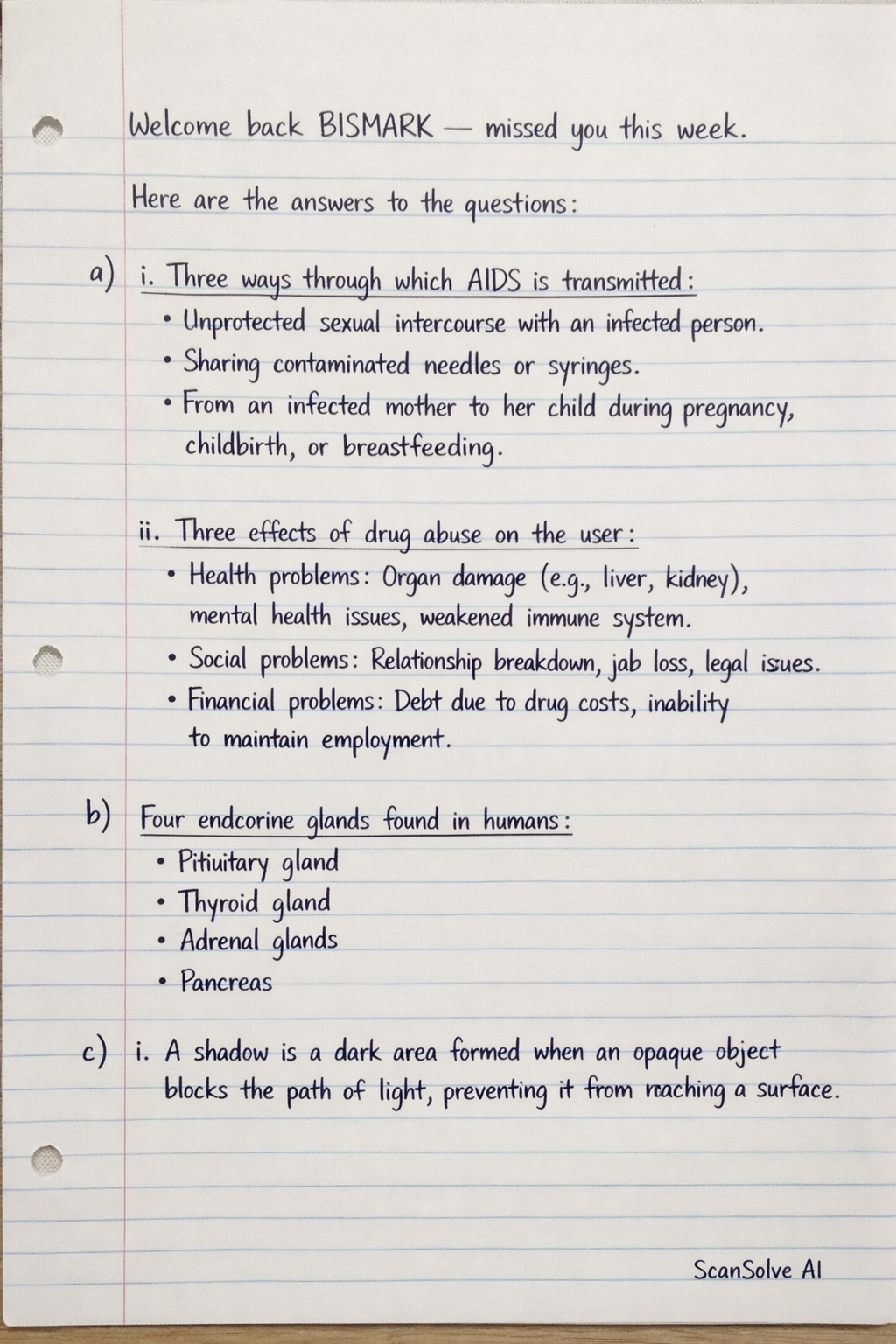
Here are the answers to the questions:
a)
i. Three ways through which AIDS is transmitted:
- Unprotected sexual intercourse with an infected person.
- Sharing contaminated needles or syringes.
- From an infected mother to her child during pregnancy, childbirth, or breastfeeding.
ii. Three effects of drug abuse on the user:
- Health problems: Organ damage (e.g., liver, kidney), mental health issues, weakened immune system.
- Social problems: Relationship breakdown, job loss, legal issues.
- Financial problems: Debt due to drug costs, inability to maintain employment.
b) Four endocrine glands found in humans:
- Pituitary gland
- Thyroid gland
- Adrenal glands
- Pancreas
c)
i. A shadow is a dark area formed when an opaque object blocks the path of light, preventing it from reaching a surface.
ii. Ray diagram illustrating a ray of light travelling from glass to air:
(Note: Since I cannot draw images, I will describe the ray diagram. When light travels from a denser medium (glass) to a less dense medium (air), it bends away from the normal. If the angle of incidence is greater than the critical angle, total internal reflection occurs.)
Description of the ray diagram:
- Draw a horizontal line representing the boundary between glass (bottom) and air (top).
- Draw a normal (a perpendicular line) to the boundary at the point of incidence.
- Draw an incident ray originating in the glass, striking the boundary at an angle to the normal.
- Draw a refracted ray in the air, bending away from the normal. The angle of refraction will be greater than the angle of incidence.
- (Optional, for critical angle illustration): If the incident ray's angle is large enough, draw a ray that undergoes total internal reflection, staying within the glass, with the angle of reflection equal to the angle of incidence.
d)
i. Artificial insemination is a reproductive technology where semen is collected from a male animal and manually introduced into the reproductive tract of a female animal for the purpose of conception, without natural mating.
ii. Three advantages of artificial insemination in animal production:
- Allows for the use of superior male genetics to improve herd quality rapidly.
- Reduces the risk of transmitting sexually transmitted diseases between animals.
- Eliminates the need to keep and manage expensive or dangerous breeding males on the farm.
Still stuck on this one?
Ask a follow-up, and the answer starts from this question.
More Biology Questions
Handwritten Step-by-Step Solution
Get this as a handwritten image on WhatsApp — like a tutor wrote it for you.
Try on WhatsApp