
We read your photo as:
The provided pedigree chart shows a family with a history of haemophilia. Determine the genotypes of the individuals indicated as unaffected females who must be carriers.
ScanSolve AI Answer
Answers
3 partsStep-by-step solution
12 stepsPart 9.1· 4 steps
Identify affected individuals (shaded) and unaffected individuals (unshaded).
Understand that haemophilia is a sex-linked recessive disorder.
Males () cannot be carriers; they are either affected () or unaffected (). Females () can be unaffected (), unaffected carriers (), or affected ().
Identify unaffected females who must be carriers because they have an affected son.
- Individual 1 is an unaffected female but has an affected son (Individual 4, ). Therefore, Individual 1 must be a carrier ().
- Individual 5 is an unaffected female but has an affected son (Individual 11, ). Therefore, Individual 5 must be a carrier ().
- Individual 3 is an unaffected female whose mother (Individual 1) is a carrier. She has a 50% chance of being a carrier, but we cannot definitively say she is a carrier without further information (e.g., if she had an affected son).
- Individual 7 is an unaffected female. Her parents are Individual 3 and Individual 8 (). Since Individual 3's carrier status is not definite, Individual 7's carrier status is also not definite.
Count the definite carriers.
- There are 2 definite carriers (Individual 1 and Individual 5).
Part 9.2
Haemophilia is a sex-linked recessive disorder, meaning the gene is located on the X chromosome. Males have only one X chromosome (), so if they inherit the recessive allele () on their single X chromosome, they will express the disorder. Females have two X chromosomes (), and typically need to inherit two copies of the recessive allele () to be affected. If a female inherits only one recessive allele (), she is a carrier but usually unaffected, as the dominant allele on her other X chromosome masks the recessive one. This makes it much more common for males to be affected by sex-linked recessive disorders.
Part 9.3
Part a
Individual 1
Individual 1 is an unaffected female.
She has an affected son (Individual 4, ).
For her son to be affected, he must have inherited the allele from her.
Since she is unaffected, she must also possess the dominant allele.
- Genotype:
Part b
Individual 4
Individual 4 is an affected male (shaded square).
Males have one X and one Y chromosome.
Since he is affected, his X chromosome must carry the recessive haemophilia allele.
- Genotype:
Part 9.4· 1 step
Determine the genotypes of Individual 10 and his wife.
- Individual 10 is an unaffected male, so his genotype is $\text{X}^{\text{
Try one yourself
A new problem that tests the same skill.
Still stuck on this one?
Ask a follow-up, and the answer starts from this question.
More Biology Questions
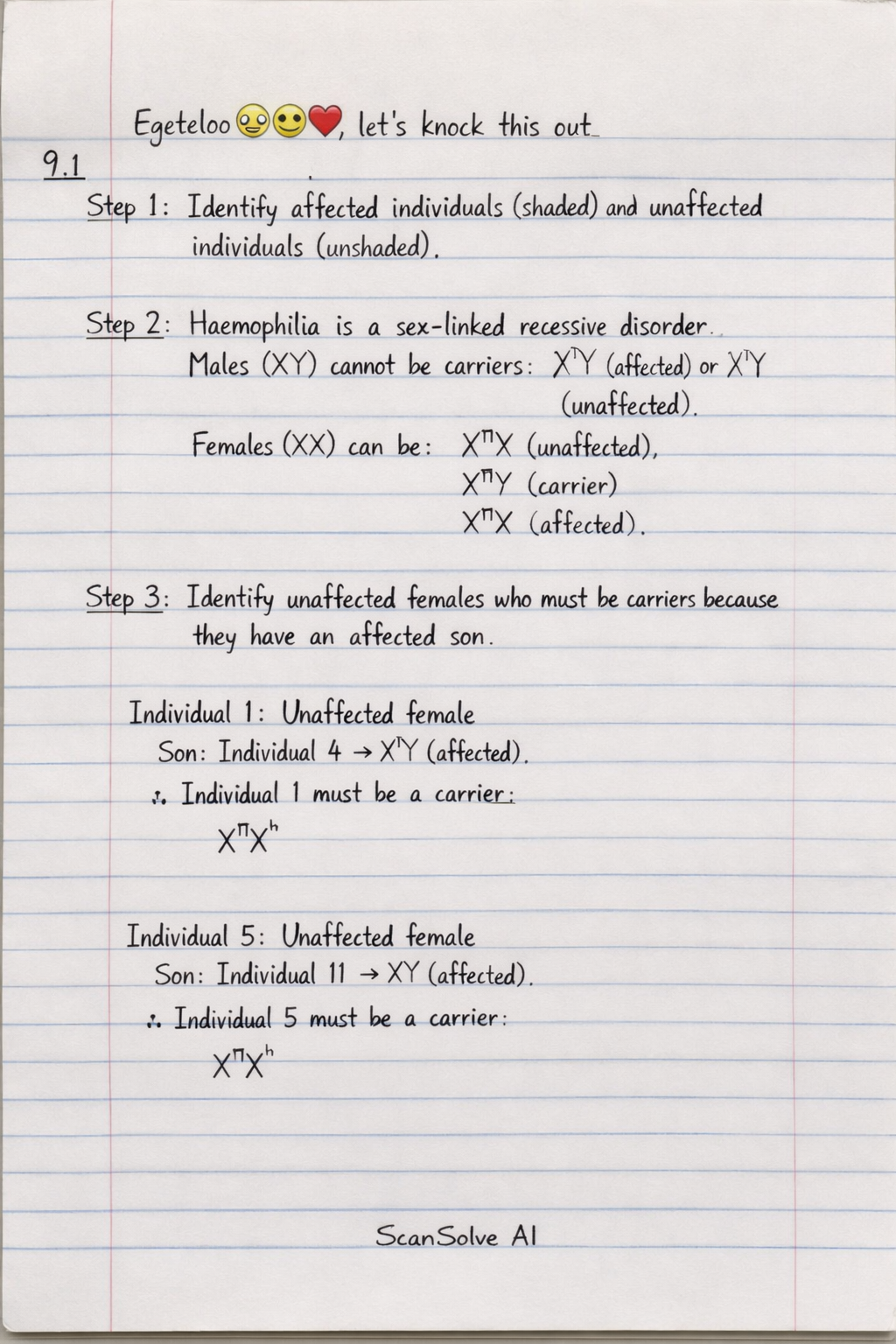
Handwritten Step-by-Step Solution
Get this as a handwritten image on WhatsApp — like a tutor wrote it for you.
Try on WhatsApp