
We read your photo as:
What are the typical steps for vaccine-preventable disease surveillance and the definition of disease control?
ScanSolve AI Answer
Answer
Step-by-step solution
7 stepsAnswer Question 15.
The correct steps to conduct vaccine-preventable disease surveillance typically begin with case detection, followed by investigation, sample collection, classification, data analysis, and reporting. Options A and B describe this sequence accurately. Option C starts with "Case investigation," which usually follows "Case detection." Therefore, C is not the most accurate initial step. Since C is not fully correct, "All of the above" cannot be the answer. Options A and B are identical and represent the correct sequence.
The correct option is A.
- A. Case detection, case investigation, sample collection, case classification, data analysis and reporting
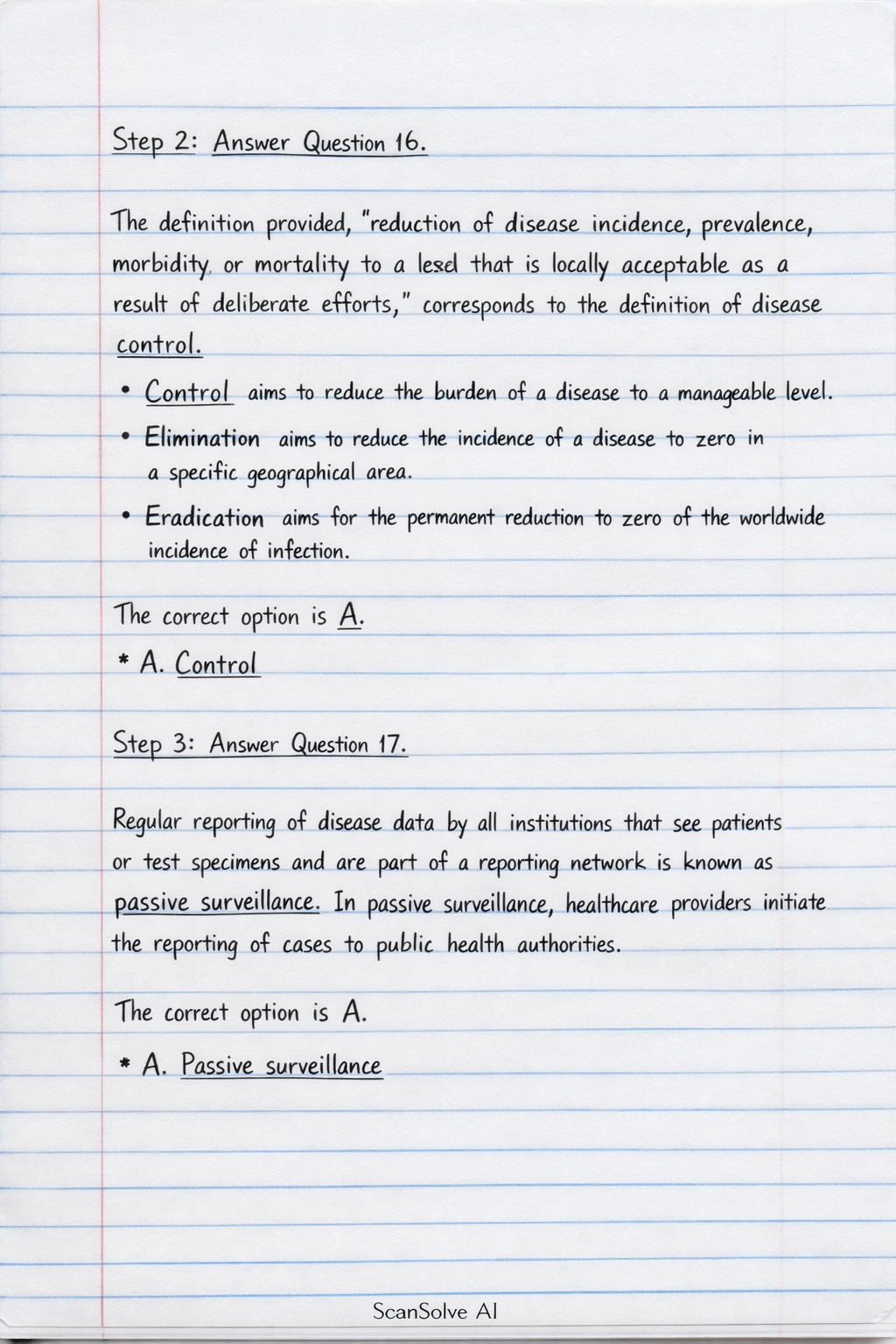
Answer Question 16.
The definition provided, "reduction of disease incidence, prevalence, morbidity, or mortality to a level that is locally acceptable as a result of deliberate efforts," corresponds to the definition of disease control.
- Control aims to reduce the burden of a disease to a manageable level.
- Elimination aims to reduce the incidence of a disease to zero in a specific geographical area.
- Eradication aims for the permanent reduction to zero of the worldwide incidence of infection.
The correct option is A.
- A. Control
Answer Question 17.
Regular reporting of disease data by all institutions that see patients or test specimens and are part of a reporting network is known as passive surveillance. In passive surveillance, healthcare providers initiate the reporting of cases to public health authorities.
The correct option is A.
- A. Passive surveillance
Answer Question 18.
AEFI (Adverse Events Following Immunization) monitoring aims to ensure vaccine safety, prevent program errors, distinguish coincidental events from vaccine-related ones, and maintain public confidence. Increasing vaccine efficacy (how well the vaccine prevents disease) is a goal of vaccine development and research, not a primary purpose of AEFI monitoring.
The correct option is D.
- D. Increase vaccine efficacy
Answer Question 19.
All the listed options (ensuring targets are vaccinated, timely delivery of vaccines and equipment, and well-trained/supervised staff) are important elements of monitoring to improve the quality of an immunization program. Therefore, none of them is not an important element.
The correct option is D.
- D. None of the above
Answer Question 20.
An immunization register is used for recording individual vaccinations. A tally sheet is used for summarizing doses administered or daily activities. A temperature monitoring chart is used to record vaccine storage temperatures. All three are essential tools for immunization monitoring, recording, and reporting.
The correct option is D.
- D. All
Answer Question 21.
Data quality problems include inconsistencies in responses, non-standardized data collection, and staff doubts about data reliability. Complete and timely data collection and reporting is a characteristic of good data quality, not a problem.
The correct option is D.
- D. Complete and timely data collection and reporting
Try one yourself
A new problem that tests the same skill.
Still stuck on this one?
Ask a follow-up, and the answer starts from this question.
More Biology Questions
Handwritten Step-by-Step Solution
Get this as a handwritten image on WhatsApp — like a tutor wrote it for you.
Try on WhatsApp