
We read your photo as:
This is a set of questions about genetics, including terms like heterozygous, chromosome number, probability in genetic crosses, epistasis, incomplete dominance, and crossing over.
ScanSolve AI Answer
Step-by-step solution
5 stepsHere are the solutions to the questions:
Part 29
A carrier is an individual who is heterozygous for a recessive trait, meaning they carry one copy of the recessive allele but do not express the trait themselves.
- C. Heterozygous
Part 30
The typical number of chromosomes in human somatic cells is 46, arranged in 23 pairs.
- B. 46
Part 31· 3 steps
For the 'A' gene, the cross is Aa × Aa.
The probability of obtaining AA is .
For the 'B' gene, the cross is Bb × Bb.
The probability of obtaining BB is .
The probability of obtaining the genotype AABB is the product of the individual probabilities
- C.
Part 32
Epistasis occurs when one gene (the epistatic gene) masks or modifies the expression of another gene at a different locus.
- C. Epistatic gene
Question 33: In incomplete dominance, the heterozygous phenotype is intermediate between the two homozygous phenotypes. A cross between two F1 heterozygotes (e.g., Rr × Rr) yields a phenotypic ratio of 1:2:1 (homozygous dominant : heterozygous : homozygous recessive).
- B. 1:2:1
Question 34: Crossing over, which occurs during meiosis, involves the exchange of genetic material between homologous chromosomes, creating new combinations of alleles and significantly increasing genetic variation.
- C. Crossing over
Part 35
Genes that are 50 map units (centimorgans) apart on a chromosome are considered to be unlinked and will assort independently, as if they were on different chromosomes.
- C. Assort independently
Part 36· 2 steps
Hemophilia is an X-linked recessive disorder.
The woman is a carrier (XX) and the man is normal (XY).
Step 2
Still stuck on this one?
Ask a follow-up, and the answer starts from this question.
More Biology Questions
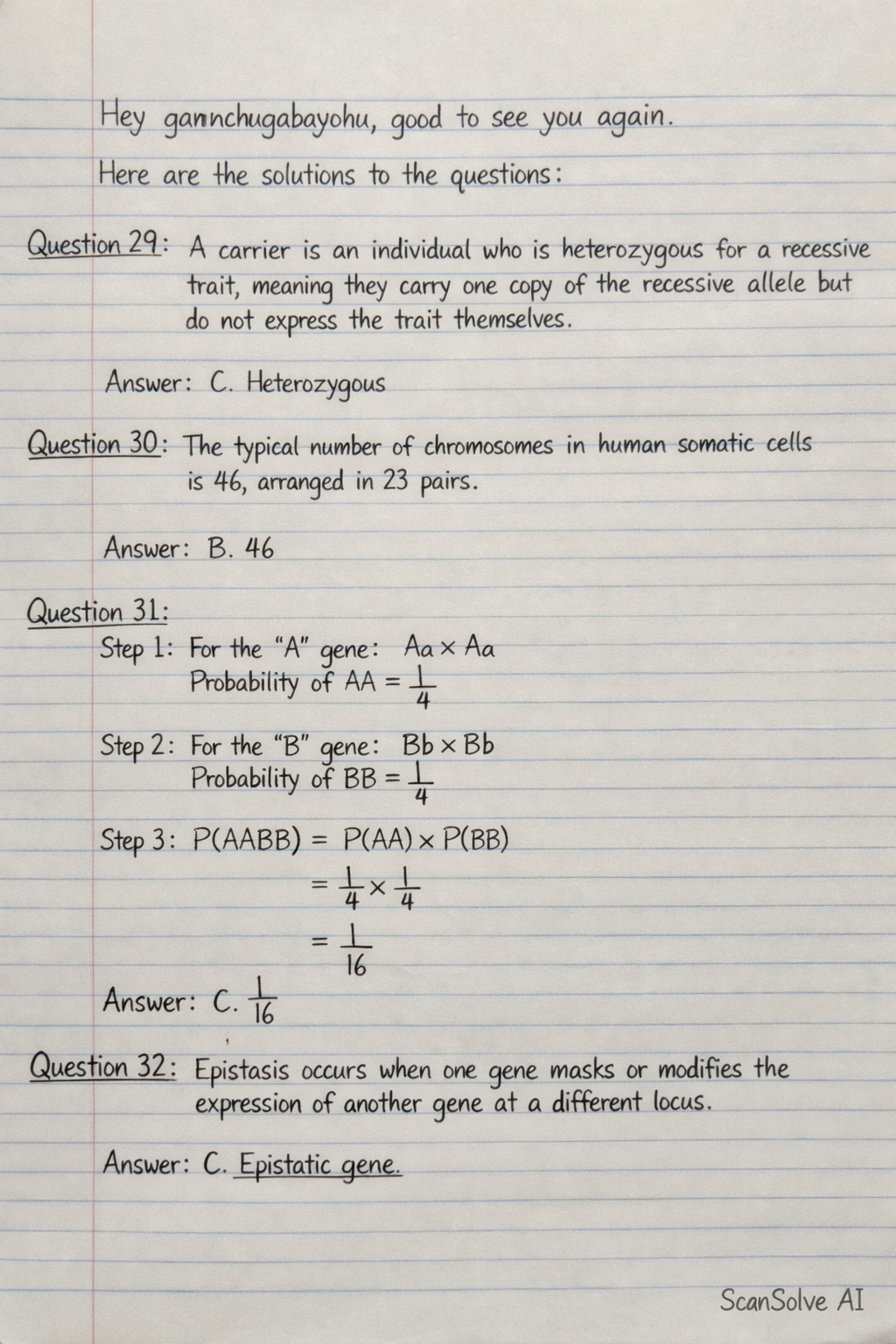
Handwritten Step-by-Step Solution
Get this as a handwritten image on WhatsApp — like a tutor wrote it for you.
Try on WhatsApp