
We read your photo as:
State THREE structural differences between arteries and veins in mammals. Why does carboxyhaemoglobin lead to death? Name two gaseous exchange sites in higher plants. State the importance of cartilage
ScanSolve AI Answer
here are the solutions to the questions:
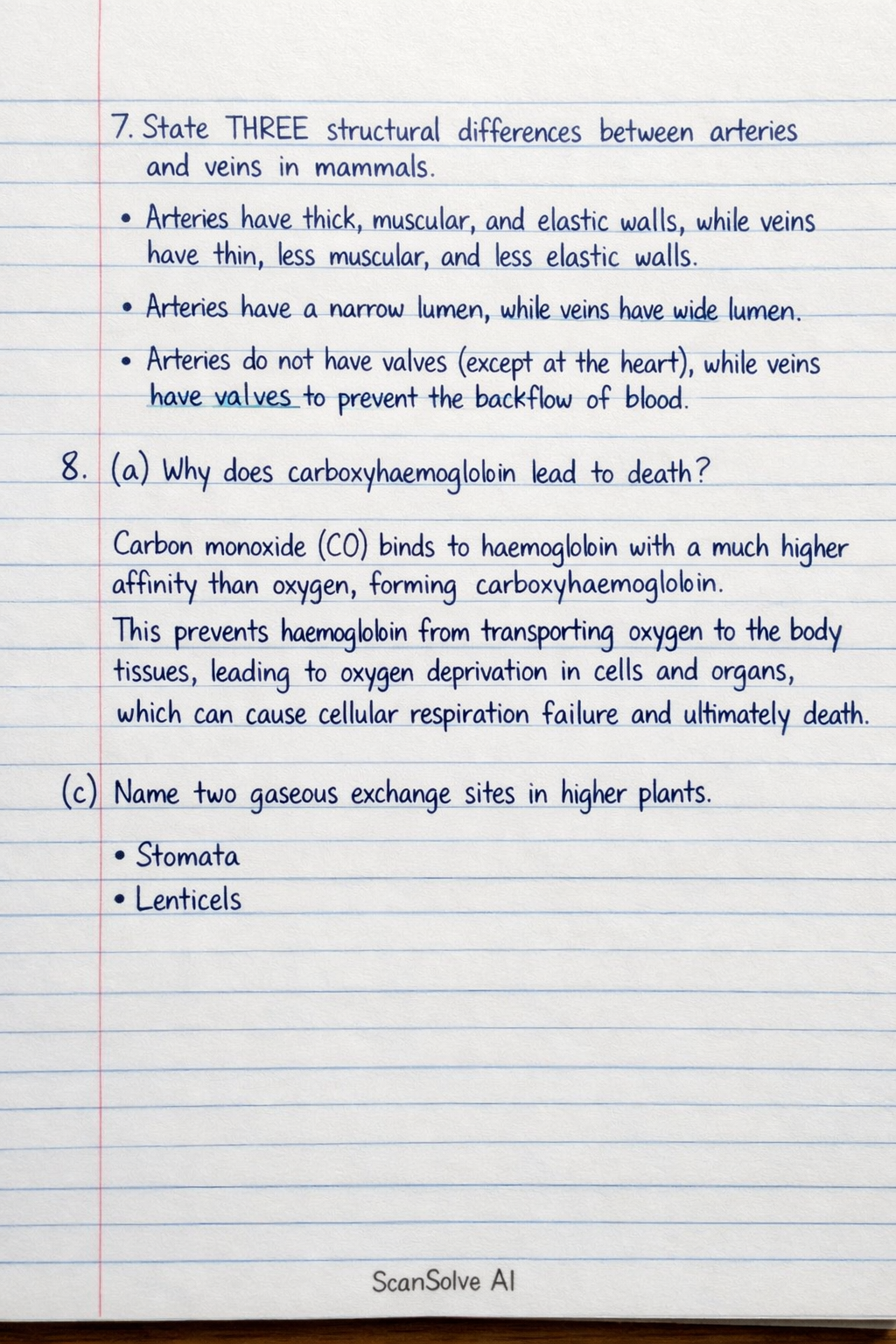
7. State THREE structural differences between arteries and veins in mammals.
- Arteries have thick, muscular, and elastic walls, while veins have thin, less muscular, and less elastic walls.
- Arteries have a narrow lumen, while veins have a wide lumen.
- Arteries do not have valves (except at the heart), while veins have valves to prevent the backflow of blood.
8. (a) Why does carboxyhaemoglobin lead to death?
Carbon monoxide (CO) binds to haemoglobin with a much higher affinity than oxygen, forming carboxyhaemoglobin. This prevents haemoglobin from transporting oxygen to the body tissues, leading to oxygen deprivation in cells and organs, which can cause cellular respiration failure and ultimately death.
(c) Name two gaseous exchange sites in higher plants.
- Stomata
- Lenticels
9. State the importance of the following features in gaseous exchange:
(i) cartilage in the trachea
The C-shaped cartilage rings in the trachea provide structural support, preventing the trachea from collapsing and ensuring a continuous, open airway for air to pass to and from the lungs.
(ii) Moisture on the surface of the alveoli.
The moisture on the surface of the alveoli allows oxygen to dissolve before it diffuses across the alveolar and capillary membranes into the bloodstream, and similarly for carbon dioxide to dissolve before diffusing out. This facilitates efficient gas exchange.
10. The equation below shows an oxidation reaction of food substances:
(i) Determine respiratory quotient of the Oxidation of the food substance above.
The Respiratory Quotient (RQ) is calculated as the ratio of the volume of carbon dioxide produced to the volume of oxygen consumed.
From the balanced equation:
The respiratory quotient is .
(ii) Identify the food substance.
The food substance has a high carbon and hydrogen content relative to its oxygen content, which is characteristic of a fat or lipid.
11. (a) A dog weighing 15.2kg requires 216kg while a mouse weighing 50g.
This statement implies a difference in metabolic rate. A mouse, being a smaller animal, has a larger surface area to volume ratio compared to a dog. This leads to greater heat loss from its body. To maintain a constant body temperature, the mouse must have a higher metabolic rate per unit body mass, meaning it requires proportionally more energy (and thus food) per kilogram of its body weight than a larger animal like a dog.
(b) Under what condition is lactic acid formed in human muscles?
Lactic acid is formed in human muscles during anaerobic respiration. This occurs when there is an insufficient supply of oxygen to the muscle cells to meet the energy demands, typically during intense physical activity.
15. Equal amounts of crushed Irish potato were placed in equal volumes of hydrogen peroxide solution at indicated PH. The volume of the gas produced was measured and recorded as shown in the table below.
| PH | 4.0 | 7.0 | 9.0 |
|---|---|---|---|
| Volume of gas () | 2.7 | 9.0 | 0.0 |
(a) Name the gas that was produced.
Crushed Irish potato contains the enzyme catalase, which breaks down hydrogen peroxide () into water and oxygen gas. Therefore, the gas produced was oxygen.
Still stuck on this one?
Ask a follow-up, and the answer starts from this question.
More Biology Questions
Handwritten Step-by-Step Solution
Get this as a handwritten image on WhatsApp — like a tutor wrote it for you.
Try on WhatsApp