
We read your photo as:
Describe two basic types of cell inclusions with examples and differentiate between calcium oxalate and calcium carbonate inclusions in vegetable drugs.
Biology
ScanSolve AI Answer
here are the answers to question 7:
-
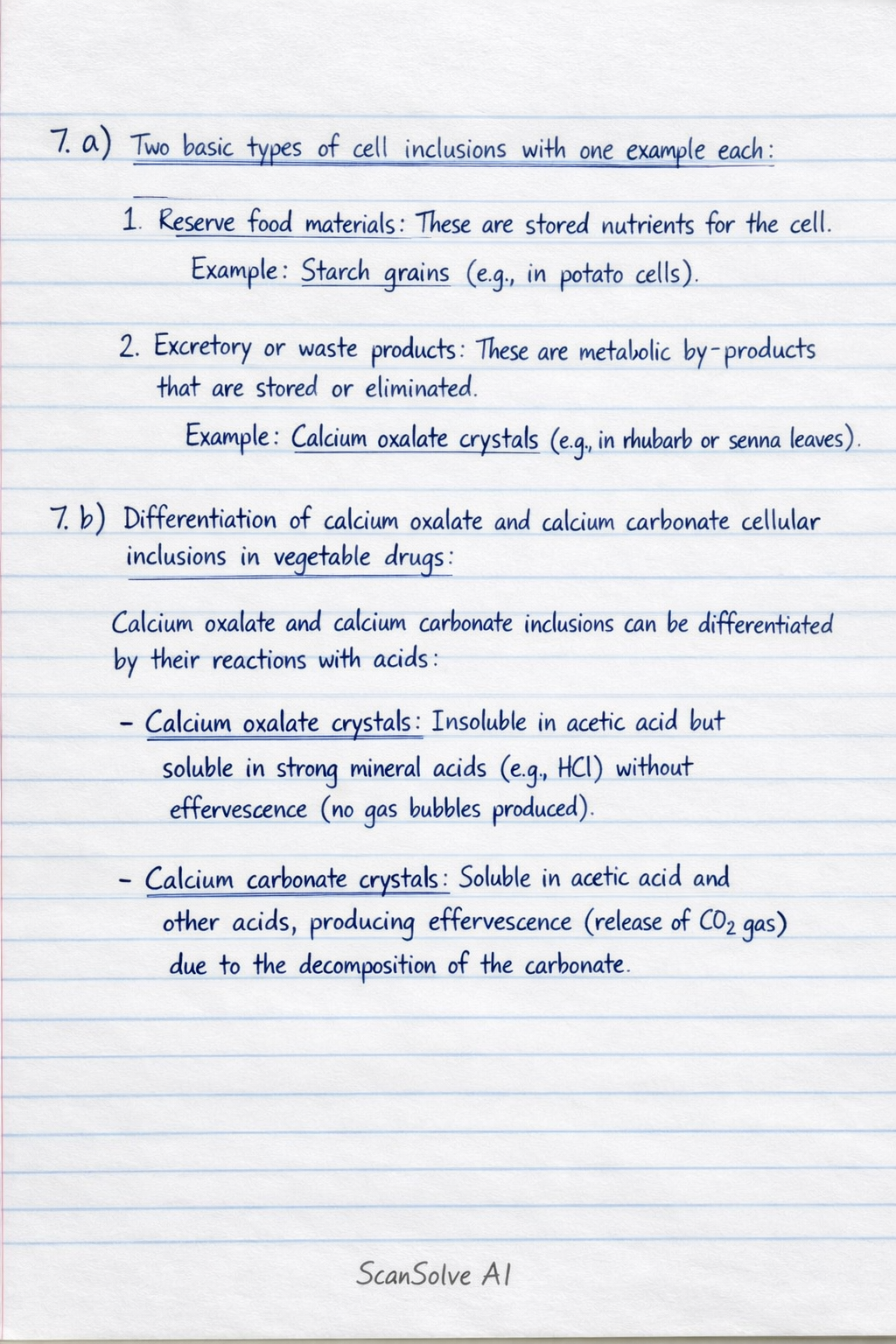
a) Two basic types of cell inclusions with one example each:
- Reserve food materials: These are stored nutrients for the cell.
- Example: Starch grains (e.g., in potato cells).
- Excretory or waste products: These are metabolic by-products that are stored or eliminated.
- Example: Calcium oxalate crystals (e.g., in rhubarb or senna leaves).
b) Differentiation of calcium oxalate and calcium carbonate cellular inclusions in vegetable drugs:
Calcium oxalate and calcium carbonate inclusions can be differentiated by their reactions with acids:- Calcium oxalate crystals: These are insoluble in acetic acid but soluble in strong mineral acids (like hydrochloric acid) without effervescence (no gas bubbles produced).
- Calcium carbonate crystals: These are soluble in acetic acid and other acids, producing effervescence (release of carbon dioxide gas, ) due to the decomposition of the carbonate.
- Reserve food materials: These are stored nutrients for the cell.
Was this helpful?
Still stuck on this one?
Ask a follow-up, and the answer starts from this question.
Got a different question?Ask your own question
More Biology Questions
QCalcium Oxide is commonly known as Which one of the following substance hygroscopic in nature?QBelow is a diagram of a specialised animal cell. Identify the enzyme and describe its role. Also…QSpecies X and Y belong to the plant kingdom. State two structures found in cells from species X and…QWhat is chemomicrosopy and what reagents detect lignin in vegetable drugs? Also, what is a…QList 4 common laboratory preservatives and differentiate between bilateral and radial symmetry with…
Browse by topic:Pharmacology
Handwritten Step-by-Step Solution
Get this as a handwritten image on WhatsApp — like a tutor wrote it for you.
Try on WhatsApp