
We read your photo as:
What is chemomicrosopy and what reagents detect lignin in vegetable drugs? Also, what is a microscope and its importances in studying crude vegetable drugs?
ScanSolve AI Answer
Here are the answers to your questions:
-
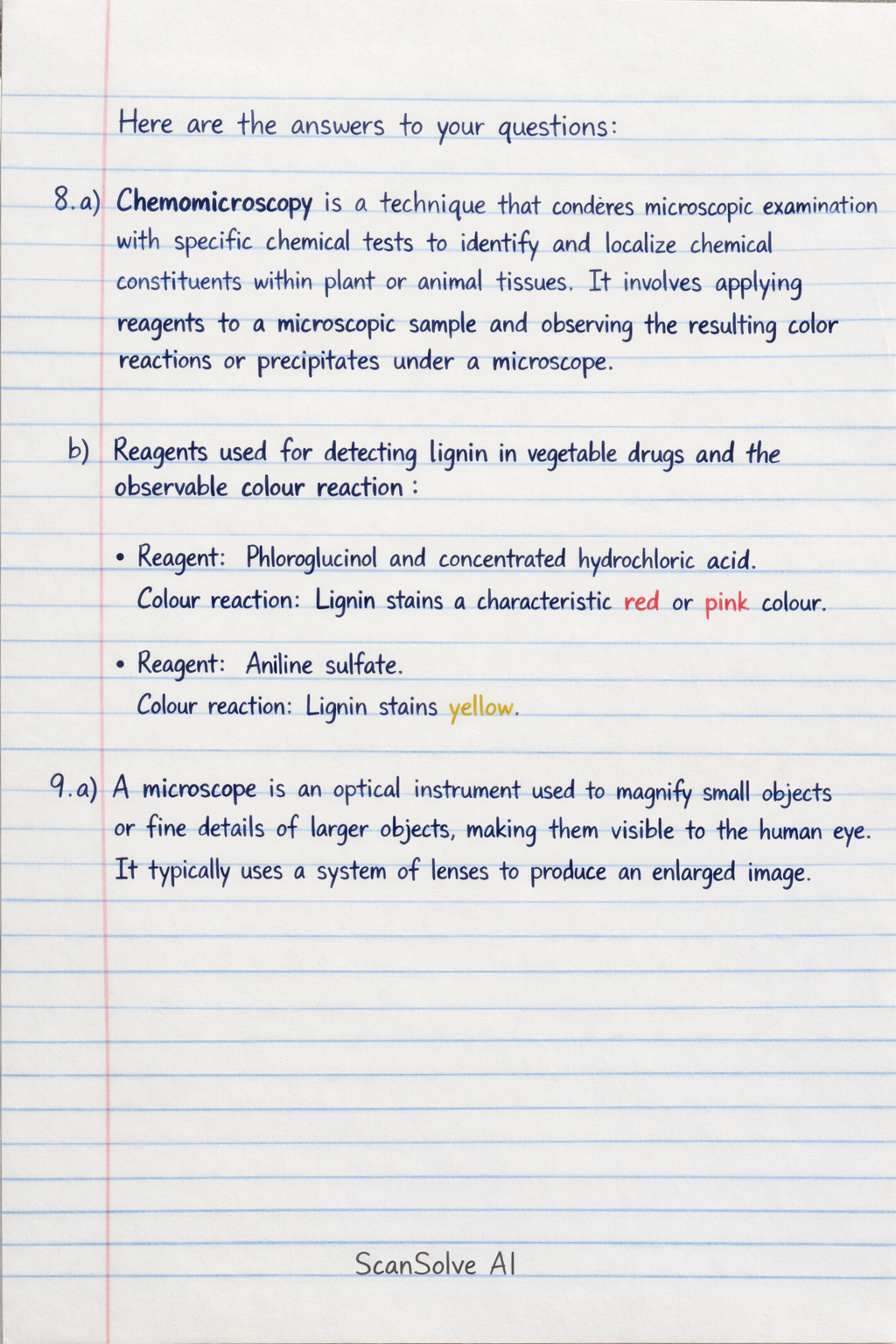
a) Chemomicroscopy is a technique that combines microscopic examination with specific chemical tests to identify and localize chemical constituents within plant or animal tissues. It involves applying reagents to a microscopic sample and observing the resulting color reactions or precipitates under a microscope.
b) Reagents used for detecting lignin in vegetable drugs and the observable colour reaction:
- Reagent: Phloroglucinol and concentrated hydrochloric acid. Colour reaction: Lignin stains a characteristic red or pink colour.
- Reagent: Aniline sulfate. Colour reaction: Lignin stains yellow.
-
a) A microscope is an optical instrument used to magnify small objects or fine details of larger objects, making them visible to the human eye. It typically uses a system of lenses to produce an enlarged image.
b) Four importances of microscopy in the study of crude vegetable drugs:
- Identification and Authentication: Microscopy helps in identifying the botanical origin of a crude drug by observing characteristic cellular structures, such as stomata, trichomes, starch grains, and crystal types, which are unique to specific plants.
- Detection of Adulteration: It is crucial for detecting adulterants or foreign matter in crude drugs. By examining the microscopic features, one can identify non-characteristic tissues, exhausted drugs, or other foreign materials added to the genuine drug.
- Quality Control: Microscopy allows for the assessment of the quality and purity of a crude drug by examining the integrity of its cellular structure, the presence of specific inclusions, and the absence of microbial contamination.
- Powdered Drug Analysis: For powdered crude drugs, where macroscopic features are lost, microscopy is indispensable for identification based on the characteristic microscopic elements present in the powder.
Still stuck on this one?
Ask a follow-up, and the answer starts from this question.
More Biology Questions
Handwritten Step-by-Step Solution
Get this as a handwritten image on WhatsApp — like a tutor wrote it for you.
Try on WhatsApp