
We read your photo as:
What are the benefits of microbes in food processing, the definition of enzymes, and methods/factors of fertilizer application?
ScanSolve AI Answer
Step-by-step solution
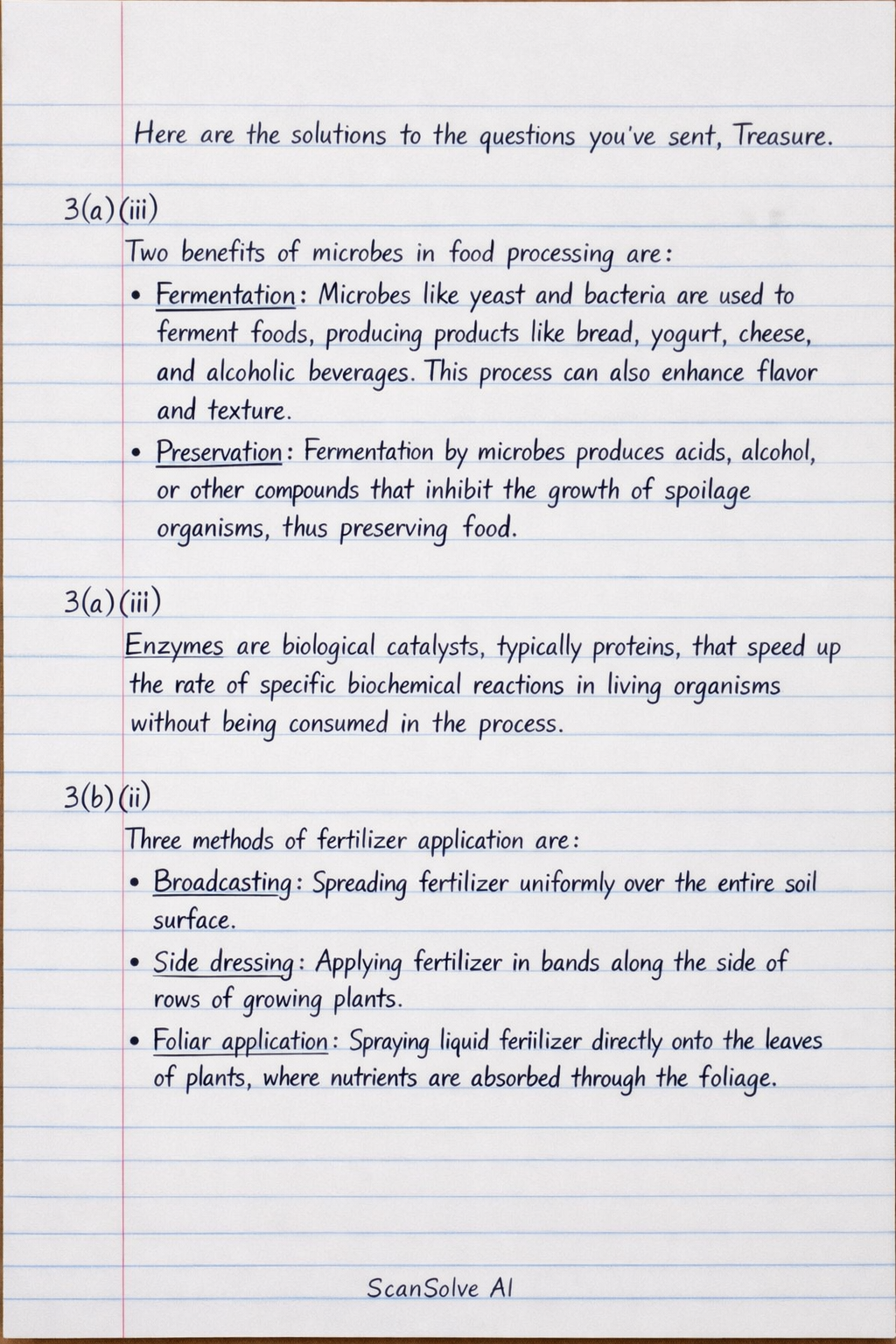
6 stepsHere are the solutions to the questions you've sent, Treasure.
3(a)(ii)
Two benefits of microbes in food processing are:
- Fermentation: Microbes like yeast and bacteria are used to ferment foods, producing products like bread, yogurt, cheese, and alcoholic beverages. This process can also enhance flavor and texture.
- Preservation: Fermentation by microbes produces acids, alcohol, or other compounds that inhibit the growth of spoilage organisms, thus preserving food.
3(a)(iii)
Enzymes are biological catalysts, typically proteins, that speed up the rate of specific biochemical reactions in living organisms without being consumed in the process.
3(b)(i)
Three methods of fertilizer application are:
- Broadcasting: Spreading fertilizer uniformly over the entire soil surface.
- Side dressing: Applying fertilizer in bands along the side of rows of growing plants.
- Foliar application: Spraying liquid fertilizer directly onto the leaves of plants, where nutrients are absorbed through the foliage.
3(b)(ii)
Two factors to be considered before the application of fertilizer to crops are:
- Soil test results: To determine existing nutrient levels and identify specific deficiencies, ensuring the correct type and amount of fertilizer is applied.
- Crop type and growth stage: Different crops have varying nutrient requirements, and the optimal time for fertilizer application depends on the crop's specific growth phase.
3(c)a
Alternative Current (AC) is an electric current that periodically reverses direction, while Direct Current (DC) is an electric current that flows in only one direction. AC is typically generated by alternators and is used for power transmission over long distances, whereas DC is produced by batteries and solar cells and is used in most electronic devices.
3(c)β(i)
A fuse is used as a safety device in electrical circuits to protect against overcurrent. It contains a wire that melts and breaks the circuit if the current exceeds a safe level, preventing damage to appliances and reducing the risk of fire.
3(c)β(ii)
Earthing (or grounding) is used as a safety measure in electrical systems to protect against electric shock. It provides a low-resistance path for fault current to flow directly to the earth, preventing dangerous voltage buildup on appliance casings.
3(d)a
The balanced chemical equation for calcium carbonate reacting with dilute hydrochloric acid is:
3(d)β(i)
To calculate the molar mass of :
Given atomic masses: C=12, H=1, O=16.
Molar mass =
Molar mass =
Molar mass =
3(d)β(ii)
To calculate the molar mass of :
Given atomic masses: N=14, O=16.
Molar mass =
Molar mass =
Molar mass =
4(a)(i)
Mirages occur due to the refraction of light as it passes through layers of air with different temperatures and densities. On a hot day, the air near the ground is much hotter and less dense than the cooler air above. Light rays from distant objects bend upwards as they travel from the denser, cooler air into the less dense, hotter air, creating an illusion of a reflection or a pool of water on the ground.
4(a)(ii)
Identify the given values.
Frequency () = 500 Hz
Wavelength () = 80 mUse the formula for the speed of a wave.
The speed of a wave () is given by the formula:
Substitute the values and calculate the speed.
4(b)α
Malnutrition is a condition that results from a diet in which nutrients are either not enough or are too much, such that the diet causes health problems. It can involve undernutrition (insufficient intake of energy and nutrients) or overnutrition (excessive intake).4(b)β(i)
One cause of Night blindness is Vitamin A deficiency.4(b)β(ii)
One cause of High Blood pressure is excessive sodium intake (e.g., from a high-salt diet).4(b)β(iii)
One cause of Kwashiorkor is protein deficiency.4(c)α(i)
An assay is an analytical procedure used to qualitatively assess or quantitatively measure the presence, amount, or functional activity of a target entity (e.g., a drug, hormone, or enzyme) in a sample.4(c)α(ii)
A standard solution is a solution of precisely known concentration, prepared by dissolving an accurately weighed amount of a primary standard substance in a known volume of solvent. It is used as a reference in titrations and other analytical procedures.4(c)α(iii)
A saturated solution is a solution that contains the maximum amount of solute that can be dissolved in a given amount of solvent at a specific temperature and pressure. Any additional solute added to a saturated solution will not dissolve and will remain as a solid.4(c)β
Calculate the molar mass of sodium chloride ().
Given atomic masses: Na=23, Cl=35.5.
Molar mass ofCalculate the number of moles of sodium chloride.
Mass of
Calculate the concentration of the solution.
Volume of solution = 2.0
4(d)(i)
Two examples of worms that infest farm animals are:- Roundworms (e.g., Ascaris suum in pigs, Haemonchus contortus in sheep/goats)
- Tapeworms (e.g., Taenia saginata larvae in cattle, Moniezia species in sheep/goats)
4(d)(ii)
Three precautions that could be adopted to reduce worm infestation in farm animals are:- Regular deworming: Administering anthelmintic drugs to animals at appropriate intervals to kill existing worms.
- Rotational grazing: Moving animals to different pastures periodically to break the life cycle of parasites and reduce the buildup of worm larvae on the land.
- Proper sanitation and hygiene: Regularly cleaning animal housing, disposing of manure properly, and ensuring access to clean feed and water to minimize exposure to worm eggs and larvae.
5(a)
The stages involved in large-scale treatment of water for public consumption are:- Screening: Raw water passes through screens to remove large debris like leaves, sticks, and trash.
- Coagulation and Flocculation: Chemicals (coagulants like alum or ferric chloride) are added to the water to neutralize the charge of suspended particles, causing them to clump together into larger, heavier particles called flocs.
- Sedimentation: The water flows into large tanks where the heavy flocs settle to the bottom due due to gravity, forming sludge.
- Filtration: The water passes through filters made of layers of sand, gravel, and sometimes activated carbon, which remove remaining suspended particles, pathogens, and some dissolved impurities.
- Disinfection: A disinfectant, typically chlorine, is added to kill any remaining bacteria, viruses, and other microorganisms.
- Fluoridation (Optional): In some areas, fluoride is added to help prevent tooth decay.
- Storage and Distribution: The treated water is stored in reservoirs or tanks and then distributed to consumers through a network of pipes.
Still stuck on this one?
Ask a follow-up, and the answer starts from this question.
More Biology Questions
Handwritten Step-by-Step Solution
Get this as a handwritten image on WhatsApp — like a tutor wrote it for you.
Try on WhatsApp