
We read your photo as:
What are two symptoms of Down syndrome, what is the risk of Down syndrome at maternal age 40, and how many times does the risk increase between age 35 and 40? Also, describe normal events of Meiosis.
ScanSolve AI Answer
Step-by-step solution
7 stepsHere's the breakdown of the Down syndrome questions:
Question 2.2.1
Based on the information provided, two symptoms of Down syndrome are:
- Learning delays
- Distinct physical features (or poor muscle development)
Question 2.2.2
Examine the "Down Syndrome Risk" column in the table for each maternal age.
- Age 25: 1 in 1250
- Age 31: 1 in 1000
- Age 35: 1 in 400
- Age 40: 1 in 100
Identify the age with the highest risk.
A risk of 1 in 100 means that for every 100 births, one child is expected to have Down syndrome, which is a higher probability than 1 in 400, 1 in 1000, or 1 in 1250.
The maternal age expected to have the greatest risk is 40.
Question 2.2.3
Identify the risk at age 35 and age 40 from the table.
- Risk at age 35 =
- Risk at age 40 =
Calculate how many times the risk increased by dividing the risk at age 40 by the risk at age 35.
The risk of Down syndrome increased 4 times between the age 35 and 40.
Question 2.2.4
Describe normal events of Meiosis II.
During anaphase II of normal meiosis, sister chromatids separate and move to opposite poles of the cell.
Describe nondisjunction in Meiosis II.
If nondisjunction occurs in meiosis II, the sister chromatids of a chromosome (e.g., chromosome 21) fail to separate. Both sister chromatids move to the same pole.
Explain the resulting gametes and Down syndrome.
This results in one gamete having an extra chromosome (n+1) and another gamete lacking that chromosome (n-1). If the gamete with the extra chromosome 21 (n+1) is fertilized by a normal gamete (n), the resulting zygote will have three copies of chromosome 21 (2n+1), leading to Down syndrome.
Still stuck on this one?
Ask a follow-up, and the answer starts from this question.
More Biology Questions
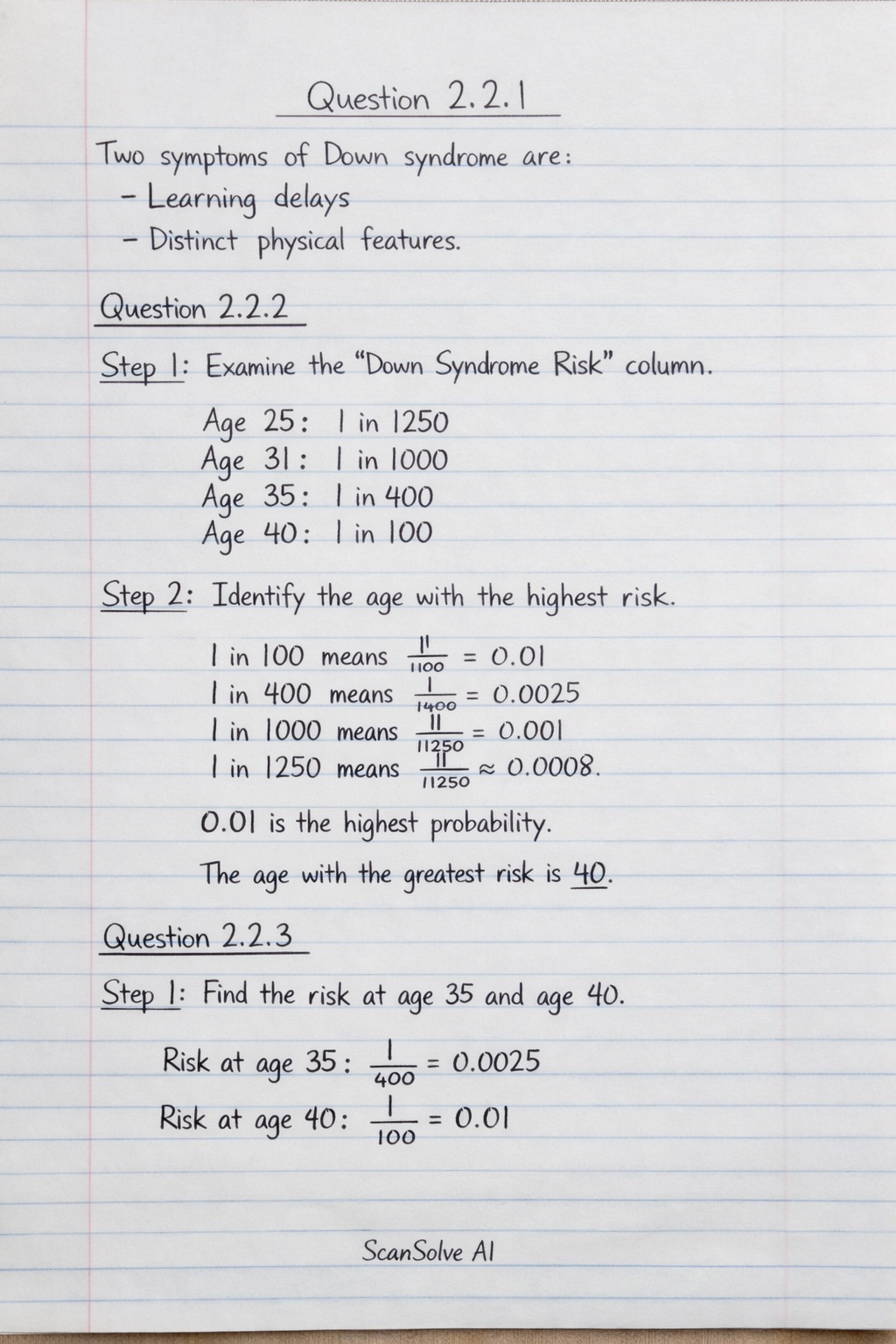
Handwritten Step-by-Step Solution
Get this as a handwritten image on WhatsApp — like a tutor wrote it for you.
Try on WhatsApp