

This business/management problem is solved step by step below, with detailed explanations to help you understand the method and arrive at the correct answer.
ScanSolve AI Answer
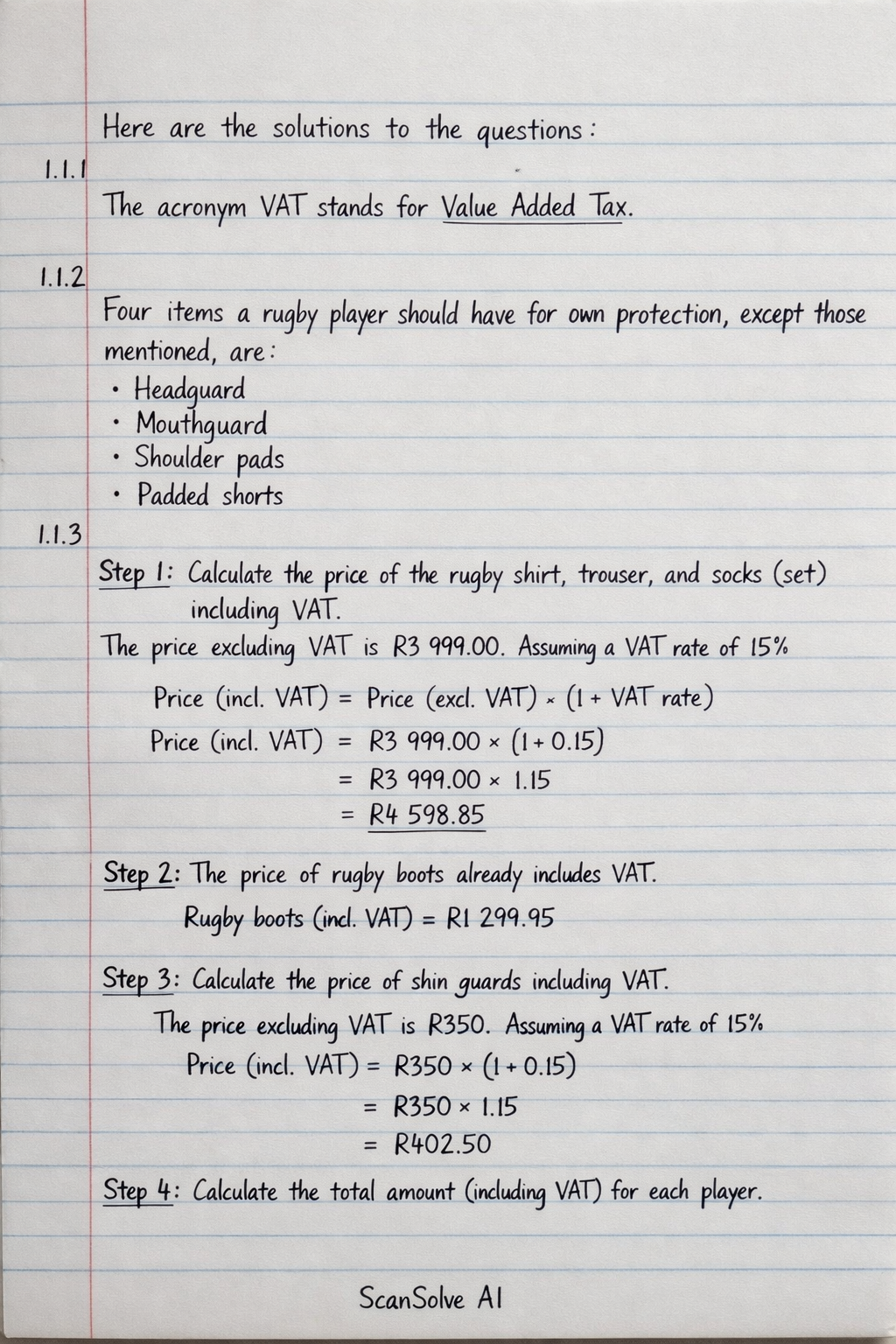
Here are the solutions to the questions: 1.1.1 The acronym VAT stands for Value Added Tax. 1.1.2 Four items a rugby player should have for own protection, except those mentioned, are: • Headguard • Mouthguard • Shoulder pads • Padded shorts 1.1.3 Step 1: Calculate the price of the rugby shirt, trouser, and socks (set) including VAT. The price excluding VAT is R3 999.00. Assuming a VAT rate of 15%. Price (incl. VAT) = Price (excl. VAT) × (1 + VAT rate) Price (incl. VAT) = R3\,999.00 × (1 + 0.15) = R3\,999.00 × 1.15 = R4\,598.85 Step 2: The price of rugby boots already includes VAT. Rugby boots (incl. VAT) = R1\,299.95 Step 3: Calculate the price of shin guards including VAT. The price excluding VAT is R350. Assuming a VAT rate of 15%. Price (incl. VAT) = R350 × (1 + 0.15) = R350 × 1.15 = R402.50 Step 4: Calculate the total amount (including VAT) for each player. Total per player = R4\,598.85 + R1\,299.95 + R402.50 = R6\,301.30 The total amount of money he would spend on each player is R6 301.30. 1.1.4 Step 1: Determine the total number of players. The team consists of in-field players and 5 out-field players. A standard rugby team has 15 in-field players. Total players = 15 (in-field) + 5 (out-field) = 20 players Step 2: Calculate the total cost for all players' kits. Using the cost per player from 1.1.3: Total cost = 20 × R6\,301.30 = R126\,026.00 Step 3: Compare the total cost with the budgeted amount. Budgeted amount = R139 999.00 Total cost = R126 026.00 Since R126 026.00 is less than R139 999.00, the budgeted money is sufficient. The assumption is correct. 1.1.5 Step 1: Identify the price of rugby boots including VAT. Price (incl. VAT) = R1\,299.95 Step 2: Calculate the price of rugby boots excluding VAT. Assuming a VAT rate of 15%, the price including VAT represents 115% of the original price. Price (excl. VAT) = Price (incl. VAT)1 + VAT rate = R1\,299.951.15 ≈ R1\,130.39 Step 3: Calculate the VAT amount. VAT amount = Price (incl. VAT) - Price (excl. VAT) VAT amount = R1\,299.95 - R1\,130.39 = R169.56 The VAT amount on the price of rugby boots is R169.56. 1.2.1 The acronym UIF stands for Unemployment Insurance Fund. 1.2.2 Step 1: Determine Sipho's annual UIF contribution. Sipho's gross annual salary is R114 000. The UIF contribution rate is 1% of gross remuneration. Annual UIF contribution = 1\% × R114\,000 = 0.01 × R114\,000 = R1\,140 Step 2: Calculate Sipho's monthly UIF contribution. Monthly UIF contribution = Annual UIF contribution12 = R1\,14012 = R95 Sipho's monthly UIF contribution is R95. 1.2.3 UIF is important for workers for the following two reasons: • It provides financial support to workers during periods of unemployment, maternity leave, adoption leave, or illness. • It helps to maintain a basic standard of living for workers and their families when they temporarily lose their income. That's 2 down. 3 left today — send the next one.