
We read your photo as:
One of the problems of soil management in a humid area is?
ScanSolve AI Answer
Answer
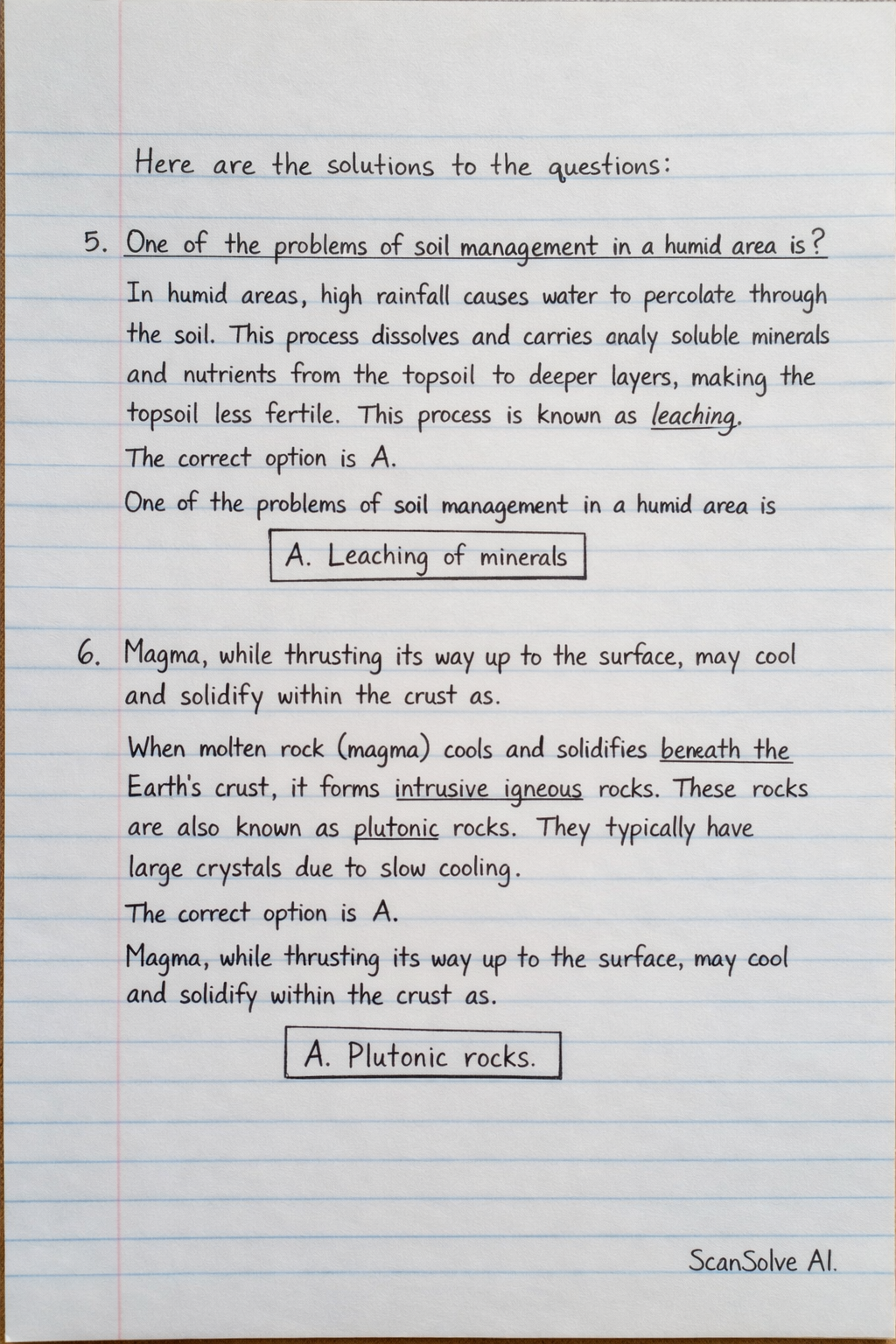
Here are the solutions to the questions:
5. One of the problems of soil management in a humid area is?
In humid areas, high rainfall causes water to percolate through the soil. This process dissolves and carries away soluble minerals and nutrients from the topsoil to deeper layers, making the topsoil less fertile. This process is known as leaching.
The correct option is A.
One of the problems of soil management in a humid area is .
6. Magma, while thrusting its way up to the surface, may cool and solidify within the crust as
When molten rock (magma) cools and solidifies beneath the Earth's surface (within the crust), it forms intrusive igneous rocks. These rocks are also known as plutonic rocks. They typically have large crystals due to slow cooling.
The correct option is A.
Magma, while thrusting its way up to the surface, may cool and solidify within the crust as .
7. The Nigerian towns which owed much of their growth in the 20th century to the development of the railway include
The development of railways in Nigeria during the 20th century significantly boosted the growth of several towns, particularly those that served as railway junctions, administrative centers, or collection points for agricultural and mineral resources.
- Enugu grew as a major coal mining center.
- Jos developed due to tin mining.
- Kaduna became an important administrative and railway junction.
- Minna was a key railway junction. These towns experienced substantial growth directly linked to the railway network. The correct option is C. The Nigerian towns which owed much of their growth in the 20th century to the development of the railway include .
8. Which of the following industries is likely to be located at or near the source of its major raw materials?
Industries that process heavy or bulky raw materials that lose significant weight or volume during manufacturing tend to locate near the raw material source to minimize transportation costs. This is known as a raw material-oriented industry.
- Cement manufacturing requires large quantities of heavy raw materials like limestone and clay. These materials are significantly reduced in weight and bulk during the production process (e.g., water is removed, and materials are ground and heated). Therefore, it is more economical to locate cement factories near the quarries where these raw materials are extracted. The correct option is D. The industry likely to be located at or near the source of its major raw materials is .
9. A manufacturing industry would tend to be market-oriented if the
A market-oriented industry is one that locates near its consumers or market. This is typically the case when the finished products are more expensive or difficult to transport than the raw materials, or if they are perishable.
- If finished products are highly perishable, they need to reach the market quickly to prevent spoilage. Locating the industry close to the market reduces transport time and costs associated with spoilage. The correct option is D. A manufacturing industry would tend to be market-oriented if the .
Try one yourself
A new problem that tests the same skill.
Still stuck on this one?
Ask a follow-up, and the answer starts from this question.
More Business/Management Questions
Handwritten Step-by-Step Solution
Get this as a handwritten image on WhatsApp — like a tutor wrote it for you.
Try on WhatsApp