
We read your photo as:
Briefly describe the six managerial competencies as discussed in your prescribed material.
ScanSolve AI Answer
Question 2
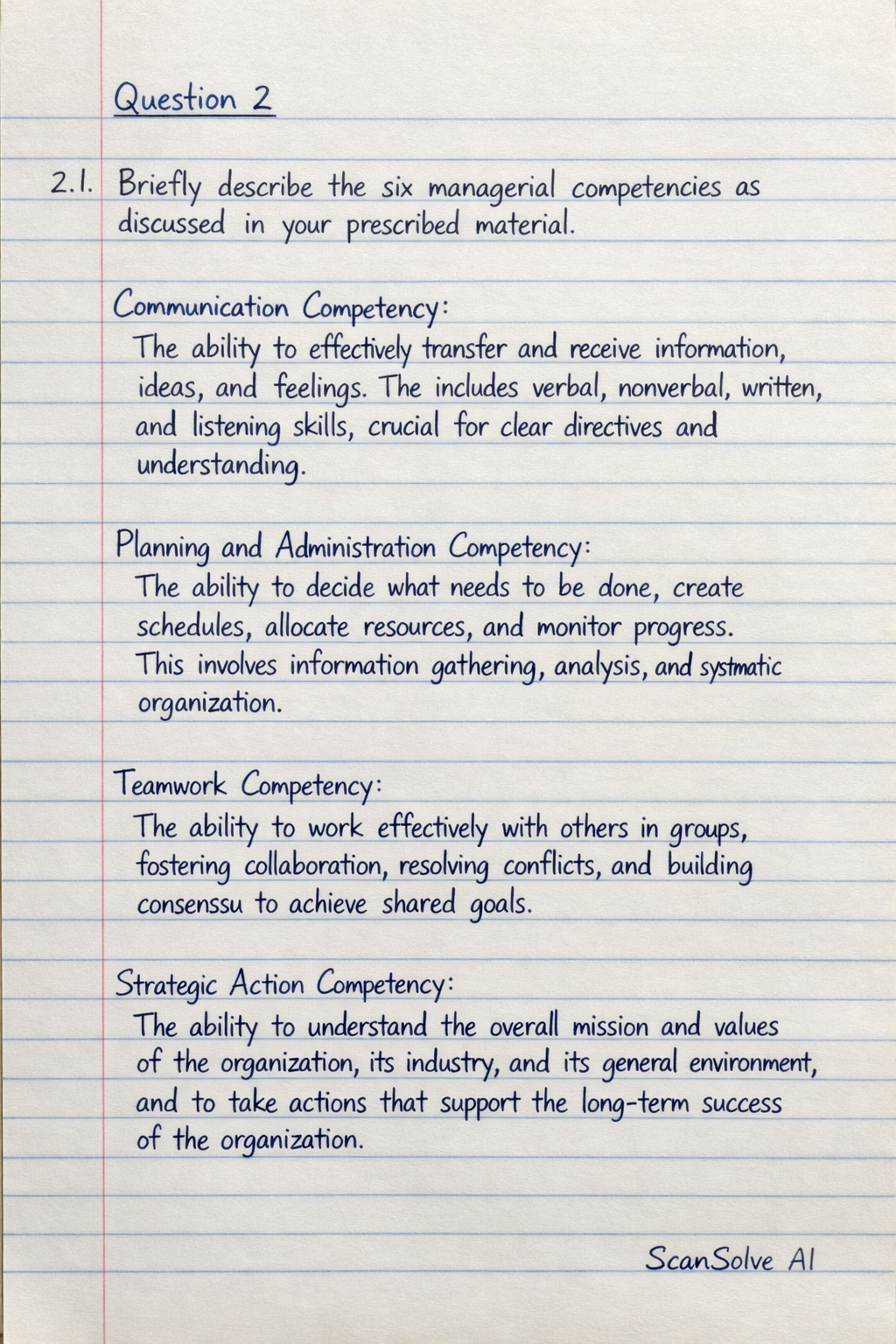
2.1 Briefly describe the six managerial competencies as discussed in your prescribed material.
- Communication Competency: The ability to effectively transfer and receive information, ideas, and feelings. This includes verbal, nonverbal, written, and listening skills, crucial for clear directives and understanding.
- Planning and Administration Competency: The ability to decide what needs to be done, create schedules, allocate resources, and monitor progress. This involves information gathering, analysis, and systematic organization.
- Teamwork Competency: The ability to work effectively with others in groups, fostering collaboration, resolving conflicts, and building consensus to achieve shared goals.
- Strategic Action Competency: The ability to understand the overall mission and values of the organization, its industry, and its general environment, and to take actions that support the long-term success of the organization.
- Self-Management Competency: The ability to take responsibility for one's own life and career, including setting personal goals, managing time, and adapting to change. It involves self-awareness and continuous learning.
- Global Awareness Competency: The ability to recognize and understand the impact of international events and cultural differences on the organization and its operations, adapting strategies accordingly.
2.2 Discuss the components of the strategic action competency with examples of how they are applied in the business context.
The strategic action competency involves four key components:
-
Understanding the Organization's Mission and Values: This component refers to a manager's ability to grasp the core purpose, guiding principles, and long-term objectives of their company.
- Example: A manager at a sustainable clothing brand understands that the company's mission is not just to sell clothes but to do so ethically and environmentally responsibly. When making sourcing decisions, they prioritize suppliers who meet fair labor standards and use eco-friendly materials, aligning with the company's values.
-
Understanding the Industry: This involves comprehending the competitive landscape, market trends, key players, and regulatory environment within which the organization operates.
- Example: A manager in the automotive industry monitors the rise of electric vehicles (EVs) and autonomous driving technology. They understand that these trends are reshaping consumer demand and manufacturing processes, influencing their department's R&D investments and production planning.
-
Understanding the General Environment: This component requires managers to analyze broader external factors such as economic conditions, political stability, social trends, technological advancements, and legal frameworks that can impact the organization.
- Example: A retail manager observes a shift in consumer spending habits due to an economic downturn. They adjust inventory levels, promote value-oriented products, and explore cost-saving measures to mitigate the impact of the broader economic environment on their store's profitability.
-
Taking Strategic Action: This is the ability to formulate and implement plans and decisions that align with the organization's mission, leverage industry insights, and respond effectively to the general environment, ensuring long-term success.
- Example: Based on an understanding of their tech company's mission to innovate, the competitive industry trend towards cloud computing, and the general environment's demand for remote work solutions, a product manager decides to pivot development efforts towards a new cloud-based collaboration tool, strategically positioning the company for future growth.
2.3 In relation to the above discussion, read the information in the excerpt below about the art and culture industry in a town in the Eastern Cape. Use the components of the strategic action competency as a basis for developing strategic actions that the residents of this town and relevant stakeholders should introduce to ensure the survival and prosperity of local businesses involved in art and culture in a small university town.
To ensure the survival and prosperity of local art and culture businesses in Makhanda (formerly Grahamstown), residents and stakeholders should implement strategic actions based on the components of strategic action competency:
-
Understanding Makhanda's Mission and Values (Art & Culture Identity):
- Strategic Action: Stakeholders should collaboratively define and promote Makhanda's unique identity as a vibrant arts and culture hub, leveraging its status as a university town and host of the National Arts Festival. This involves creating a shared vision that integrates the town's rich history, the academic environment of Rhodes University, and the cultural significance of its new name, Makhanda, to attract both local and international visitors.
-
Understanding the Art and Culture Industry in Makhanda:
- Strategic Action: Foster stronger collaboration between the National Arts Festival organizers, Rhodes University's arts departments, local galleries, museums, artists, and hospitality businesses (restaurants, pubs, accommodation). This could involve joint marketing initiatives, shared event calendars, and preferential support for local artists and cultural entrepreneurs to ensure year-round engagement beyond the festival period.
-
Understanding the General Environment (Makhanda's Context):
- Strategic Action: Develop a comprehensive tourism strategy that capitalizes on Makhanda's location off the N2 and its historical significance. This includes improving local infrastructure, enhancing visitor information services, and creating diverse cultural packages that appeal to different tourist segments. The strategy should also embrace the town's renaming to Makhanda, integrating Xhosa heritage and narratives into cultural offerings to provide a unique and authentic experience.
-
Taking Strategic Action (Overall Implementation):
- Strategic Action: Establish a dedicated "Makhanda Arts & Culture Development Forum" comprising representatives from the municipality, university, festival, local businesses, and community leaders. This forum would be responsible for developing a long-term strategic plan, securing funding (e.g., grants, sponsorships), and implementing initiatives such as skills development programs for local artists and cultural entrepreneurs, and creating a robust digital platform to showcase Makhanda's cultural assets and events to a wider audience.
Still stuck on this one?
Ask a follow-up, and the answer starts from this question.
More Business/Management Questions
Handwritten Step-by-Step Solution
Get this as a handwritten image on WhatsApp — like a tutor wrote it for you.
Try on WhatsApp