

This business/management problem is solved step by step below, with detailed explanations to help you understand the method and arrive at the correct answer.
ScanSolve AI Answer
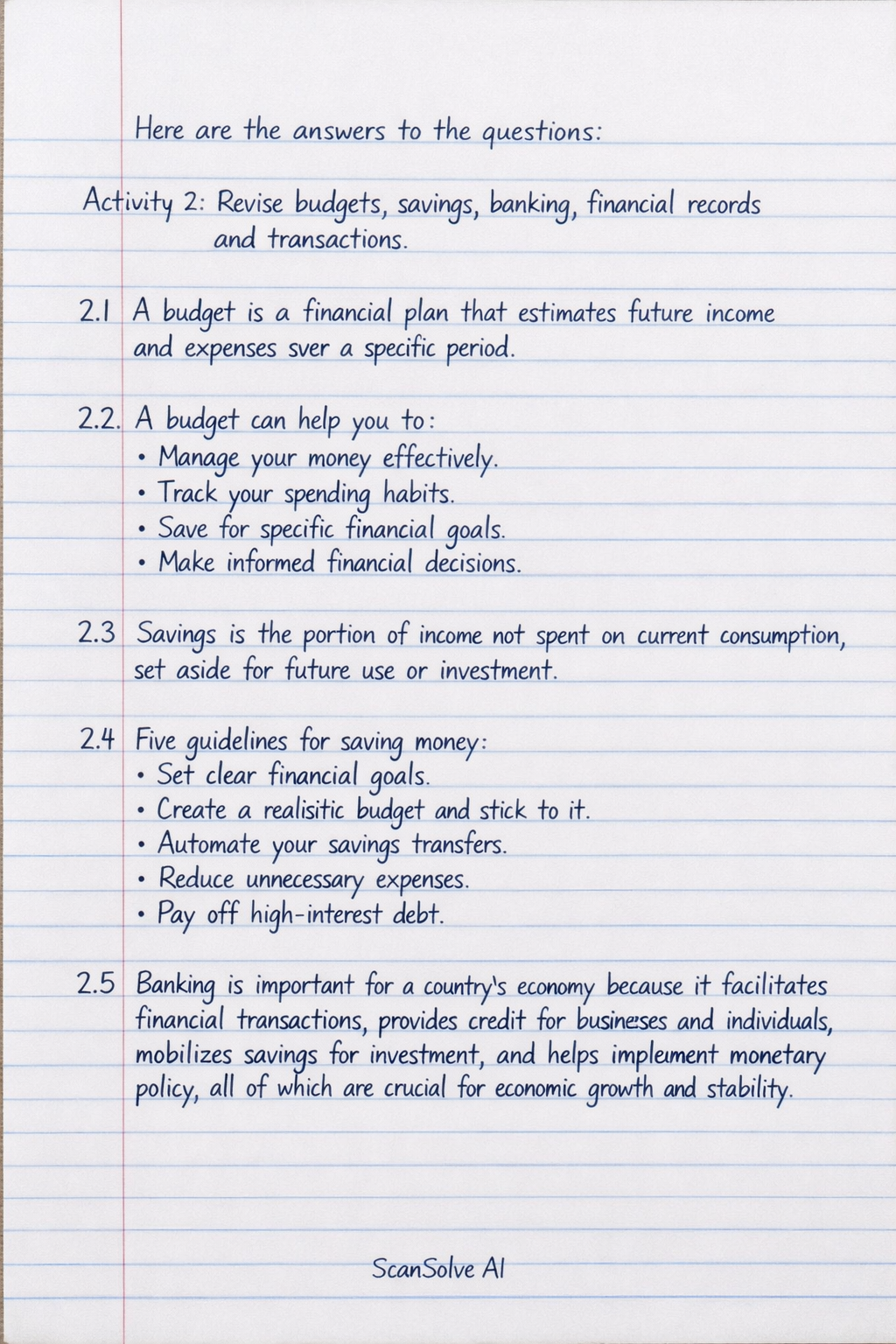
Here are the answers to the questions: Activity 2: Revise budgets, savings, banking, financial records and transactions 2.1 A budget is a financial plan that estimates future income and expenses over a specific period. 2.2 A budget can help you to: • Manage your money effectively. • Track your spending habits. • Save for specific financial goals. • Make informed financial decisions. 2.3 Savings is the portion of income not spent on current consumption, set aside for future use or investment. 2.4 Five guidelines for saving money: • Set clear financial goals. • Create a realistic budget and stick to it. • Automate your savings transfers. • Reduce unnecessary expenses. • Pay off high-interest debt. 2.5 Banking is important for a country's economy because it facilitates financial transactions, provides credit for businesses and individuals, mobilizes savings for investment, and helps implement monetary policy, all of which are crucial for economic growth and stability. 2.6 Four services that banks offer: • Savings accounts • Checking/current accounts • Loans and credit facilities • Investment services 2.7 A financial transaction is an economic event that affects the financial position of a business (e.g., buying goods). A financial record is the documented evidence of that transaction (e.g., an invoice or a ledger entry). 2.8 Businesses keep financial records to track performance, comply with tax regulations, make informed decisions, monitor cash flow, and report to stakeholders. Activity 3: Revise personal income and expenses 3.1 The three main sources of personal income: • Salaries/Wages (from employment) • Business profits (from self-employment or owning a business) • Investment income (e.g., interest, dividends, rent) 3.2 Four examples of personal expenses: • Rent/Mortgage payments • Groceries/Food • Transportation costs (fuel, public transport) • Utilities (electricity, water) 3.3 A personal Statement of Net Worth is a financial document that lists an individual's assets (what they own) and liabilities (what they owe) at a specific point in time, with the difference being their net worth. Activity 4: Revise the personal Statement of Net Worth 4.1 There are two types of assets: • Current Assets: Assets expected to be converted to cash, sold, or consumed within one year (e.g., cash, savings, short-term investments). • Non-current Assets (or Fixed Assets): Assets held for long-term use, not intended for sale within one year (e.g., property, vehicles, furniture). 4.2 A current liability is an obligation that is expected to be settled within one year or the operating cycle of the business, whichever is longer. 4.3 A long-term liability is an obligation that is not expected to be settled within one year or the operating cycle of the business. 4.4 The formula to calculate net worth is: Net Worth = Total Assets - Total Liabilities 4.5 Personal Statement of Net Worth for Luxolo: Assets: Cellphone: R450 Bank: R850 Clothing: R2,000 Scooter: R3,000 Computer: R950 Total Assets: R450 + R850 + R2,000 + R3,000 + R950 = R7,250 Liabilities: Owes mom: R250 Total Liabilities: R250 Net Worth: Net Worth = R7,250 - R250 = R7,000 Activity 5: Revise business income and expenses 5.1 Royalties are payments made to an owner for the right to use their property, such as intellectual property (patents, copyrights) or natural resources. 5.2 A shareholder is an individual or company that legally owns one or more shares of stock in a company, representing a partial ownership stake. 5.3 The South African Royalty Bill (Mineral and Petroleum Resources Royalty Act) applies to the extraction and sale of mineral and petroleum resources. 5.4 A dividend is a distribution of a portion of a company's earnings, decided by the board of directors, to its shareholders. 5.5 Three examples of business income sources: • Sales revenue (from selling goods or services) • Interest income (from investments or loans given) • Rental income (from property leased out) 3 done, 2 left today. You're making progress.