
We read your photo as:
Discuss briefly any three questions of the following: Explain various methods and criteria for evaluating library staff performance. Elaboration on the financial Management practices and budget planni
ScanSolve AI Answer
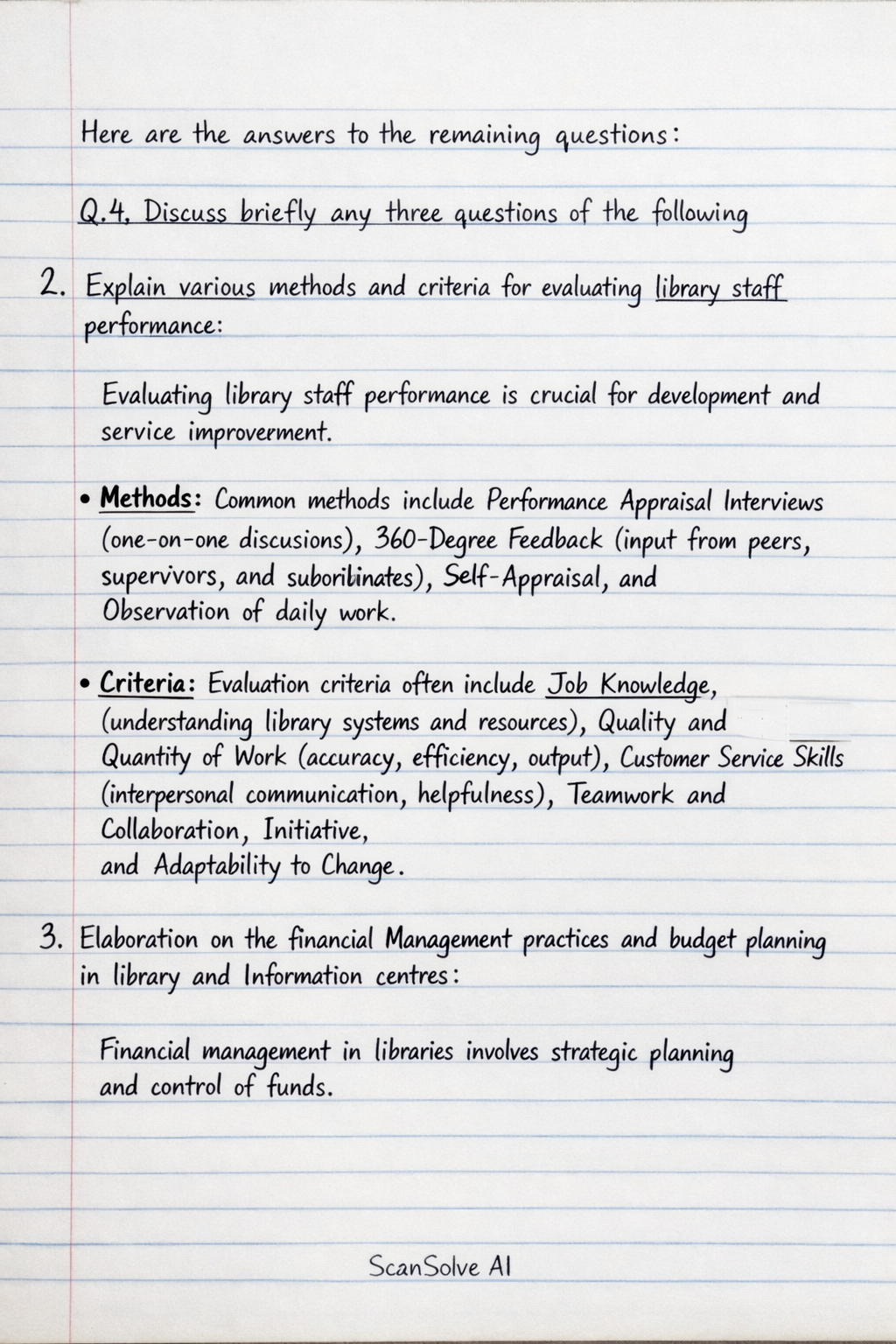
Here are the answers to the remaining questions:
Q.4 Discuss briefly any three questions of the following
- Explain various methods and criteria for evaluating library staff performance:
Evaluating library staff performance is crucial for development and service improvement.
- Methods: Common methods include Performance Appraisal Interviews (one-on-one discussions), 360-Degree Feedback (input from peers, supervisors, and subordinates), Self-Appraisal, and Observation of daily work.
- Criteria: Evaluation criteria often include Job Knowledge (understanding library systems and resources), Quality and Quantity of Work (accuracy, efficiency, output), Customer Service Skills (interpersonal communication, helpfulness), Teamwork and Collaboration, Initiative, and Adaptability to Change.
- Elaboration on the financial Management practices and budget planning in library and Information centres:
Financial management in libraries involves strategic planning and control of funds.
- Practices: Key practices include Fundraising (seeking grants, donations), Cost-Benefit Analysis for new services, Internal Controls to prevent fraud, and Financial Reporting to stakeholders.
- Budget Planning: This involves forecasting expenses (salaries, acquisitions, technology) and revenue (fines, fees, institutional allocations). Common budgeting approaches include Line-Item Budgeting (allocating funds to specific categories), Program Budgeting (linking funds to specific services), and Zero-Based Budgeting (justifying all expenditures from scratch each cycle).
- Describe in Details about organizational structure (organizational structure):
An organizational structure defines how activities are directed to achieve an organization's objectives. In libraries, it typically outlines roles, responsibilities, and reporting relationships.
- Hierarchical Structure: Most common, with a clear chain of command from the Library Director down through department heads (e.g., Acquisitions, Cataloging, Circulation, Reference) to frontline staff. This provides clear lines of authority and communication.
- Functional Structure: Organizes staff based on specialized functions, such as technical services, public services, or digital services. This promotes expertise within specific areas.
- Matrix Structure: Less common in traditional libraries, but might be used for specific projects, where staff report to both a functional manager and a project manager.
- The structure impacts efficiency, communication flow, decision-making, and staff morale, aiming to optimize resource allocation and service delivery.
Q.5 Write an essay on Management techniques.
Management techniques are systematic approaches and tools used by managers to achieve organizational goals effectively and efficiently. These techniques help in planning, organizing, leading, and controlling resources and activities.
One fundamental technique is Management by Objectives (MBO), where managers and employees collaboratively set specific, measurable, achievable, relevant, and time-bound (SMART) goals. This fosters employee engagement and aligns individual efforts with organizational objectives. Another crucial technique is Strategic Planning, which involves defining the organization's long-term vision, mission, and goals, and then formulating strategies to achieve them. This provides a roadmap for future direction and resource allocation.
Total Quality Management (TQM) is a technique focused on continuous improvement of processes and products/services to meet customer satisfaction. It emphasizes employee involvement, data-driven decision-making, and a commitment to excellence across all levels. Benchmarking is another valuable technique where an organization compares its performance, processes, and services against industry best practices or leading competitors to identify areas for improvement. Furthermore, Delegation is a key management technique that involves assigning authority and responsibility for specific tasks to subordinates, empowering them and freeing up managers for higher-level strategic work. Effective delegation enhances productivity, develops staff skills, and improves decision-making speed.
In the modern context, Change Management techniques are vital for guiding organizations through transitions, ensuring smooth adoption of new processes or technologies. This involves clear communication, training, and addressing resistance to change. Similarly, Risk Management techniques are employed to identify, assess, and mitigate potential threats to an organization's operations and objectives. By applying a combination of these techniques, managers can navigate complex environments, optimize performance, and ensure the sustained success of their organizations.
Still stuck on this one?
Ask a follow-up, and the answer starts from this question.
More Business/Management Questions
Handwritten Step-by-Step Solution
Get this as a handwritten image on WhatsApp — like a tutor wrote it for you.
Try on WhatsApp