
We read your photo as:
Please answer the following multiple-choice questions about public finance and budgeting:
ScanSolve AI Answer
Answer
Government budgets differentiate between
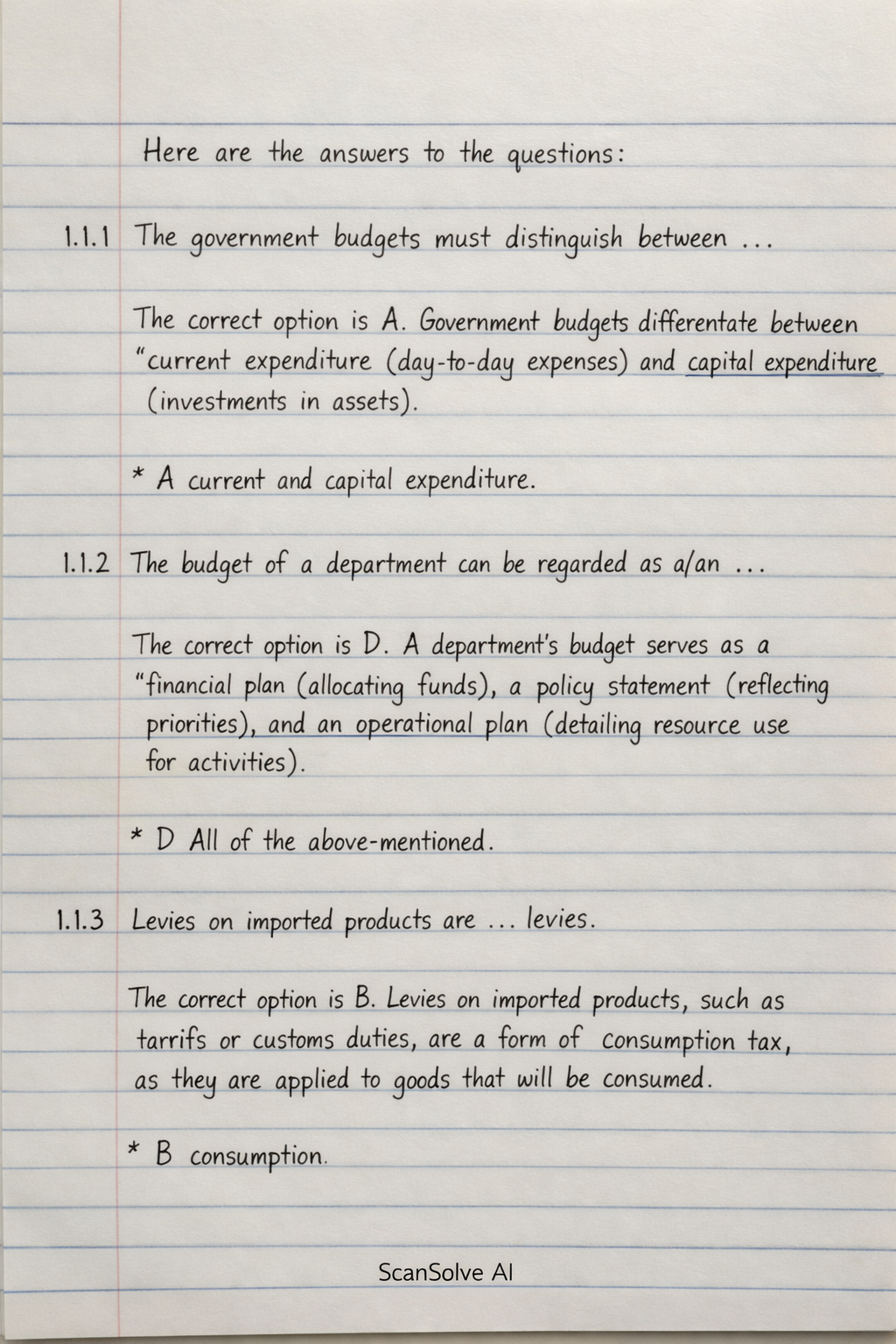
Here are the answers to the questions:
1.1.1 The government budgets must distinguish between ...
The correct option is A. Government budgets differentiate between current expenditure (day-to-day expenses) and capital expenditure (investments in assets).
- A current and capital expenditure.
1.1.2 The budget of a department can be regarded as a/an ...
The correct option is D. A department's budget serves as a financial plan (allocating funds), a policy statement (reflecting priorities), and an operational plan (detailing resource use for activities).
- D All of the above-mentioned.
1.1.3 Levies on imported products are ... levies.
The correct option is B. Levies on imported products, such as tariffs or customs duties, are a form of consumption tax, as they are applied to goods that will be consumed.
- B consumption
1.1.4 Absence of the 'quid pro quo' principle means ...
The correct option is B. "Quid pro quo" is a Latin phrase meaning "something for something." Therefore, its absence means there is no direct exchange of something for something.
- B something for something.
1.1.5 Mining rights and licences of various kinds are classified under ...
The correct option is A. Payments for mining rights and licenses are considered user charges because they are fees paid for the right to use a specific resource or engage in a particular activity.
- A user charge.
1.1.6 What to look out for in the budget speech ...
The correct option is D. A budget speech typically addresses the government's debt, potential tax hikes or cuts, and funding for major policy initiatives like NHI.
- D All of the above-mentioned.
Try one yourself
A new problem that tests the same skill.
Still stuck on this one?
Ask a follow-up, and the answer starts from this question.
More Economics Questions
Handwritten Step-by-Step Solution
Get this as a handwritten image on WhatsApp — like a tutor wrote it for you.
Try on WhatsApp