
We read your photo as:
Explain the difference between the Monetary Policy and Fiscal Policy. Identify the different source of taxes and list them under direct or indirect tax.
ScanSolve AI Answer
Answer
Step-by-step solution
5 stepsPart 3
Monetary Policy involves actions taken by a central bank to influence the money supply and credit conditions, primarily through adjusting interest rates and quantitative easing/tightening. Fiscal Policy refers to the government's use of government spending and taxation to influence the economy. The key difference is the authority: monetary policy is controlled by the central bank, while fiscal policy is controlled by the government.
Part 4
Here are different sources of taxes, categorized as direct or indirect:
- Direct Taxes:
- Income Tax: Tax levied on an individual's or company's income.
- Corporate Tax: Tax on the profits of companies.
- Property Tax: Tax on real estate or property ownership.
- Inheritance Tax: Tax on inherited wealth.
- Indirect Taxes:
- Value Added Tax (VAT) / Sales Tax: Tax on the sale of goods and services.
- Excise Duty: Tax on specific goods like tobacco, alcohol, or fuel.
- Customs Duty (Tariffs): Tax on imported goods.
ASSIGNMENT 3: INFLATION
Part 1
The steps involved in calculating the Consumer Price Index (CPI) are:
- Fix the basket: Determine the typical goods and services consumed by households.
- Find the prices: Collect price data for all items in the basket for the current period and the base period.
- Calculate the basket's cost: Multiply the quantity of each item in the fixed basket by its price for both the base year and the current year, then sum these expenditures for each year.
- Choose a base year and calculate the index: Select a base year and calculate the CPI using the formula:
- Calculate the inflation rate: Determine the percentage change in the CPI from one period to another.
Part 2
Here is the completed table and the Consumer Price Index calculation:
| Regimen | Weight (Kg) | Year 1 (Base year) | Year 2 (Current year) | ||
|---|---|---|---|---|---|
| Price | Expenditure | Price | Expenditure | ||
| Meat | 10 | 50.00 | 500.00 | 55.00 | 550.00 |
| Potatoe | 5 | 20.00 | 100.00 | 25.00 | 125.00 |
| Milk | 15 | 10.00 | 150.00 | 15.00 | 225.00 |
| Bread | 6 | 5.00 | 30.00 | 10.00 | 60.00 |
| Tea | 1 | 2.00 | 2.00 | 5.00 | 5.00 |
| Total Expenditure | 782.00 | 965.00 | |||
| Consumer Price Index | 100.00 | 123.40 |
Calculate Expenditure for Year 1 (Base year)
For each item, multiply its weight by its Year 1 price.
- Meat:
- Potatoe:
- Milk:
- Bread:
- Tea:
Calculate Total Expenditure for Year 1
Sum the expenditures for all items in Year 1.
Calculate Expenditure for Year 2 (Current year)
For each item, multiply its weight by its Year 2 price.
- Meat:
- Potatoe:
- Milk:
- Bread:
- Tea:
Calculate Total Expenditure for Year 2
Sum the expenditures for all items in Year 2.
Calculate Consumer Price Index (CPI) for Year 2
Using the formula for CPI:
Try one yourself
A new problem that tests the same skill.
Still stuck on this one?
Ask a follow-up, and the answer starts from this question.
More Economics Questions
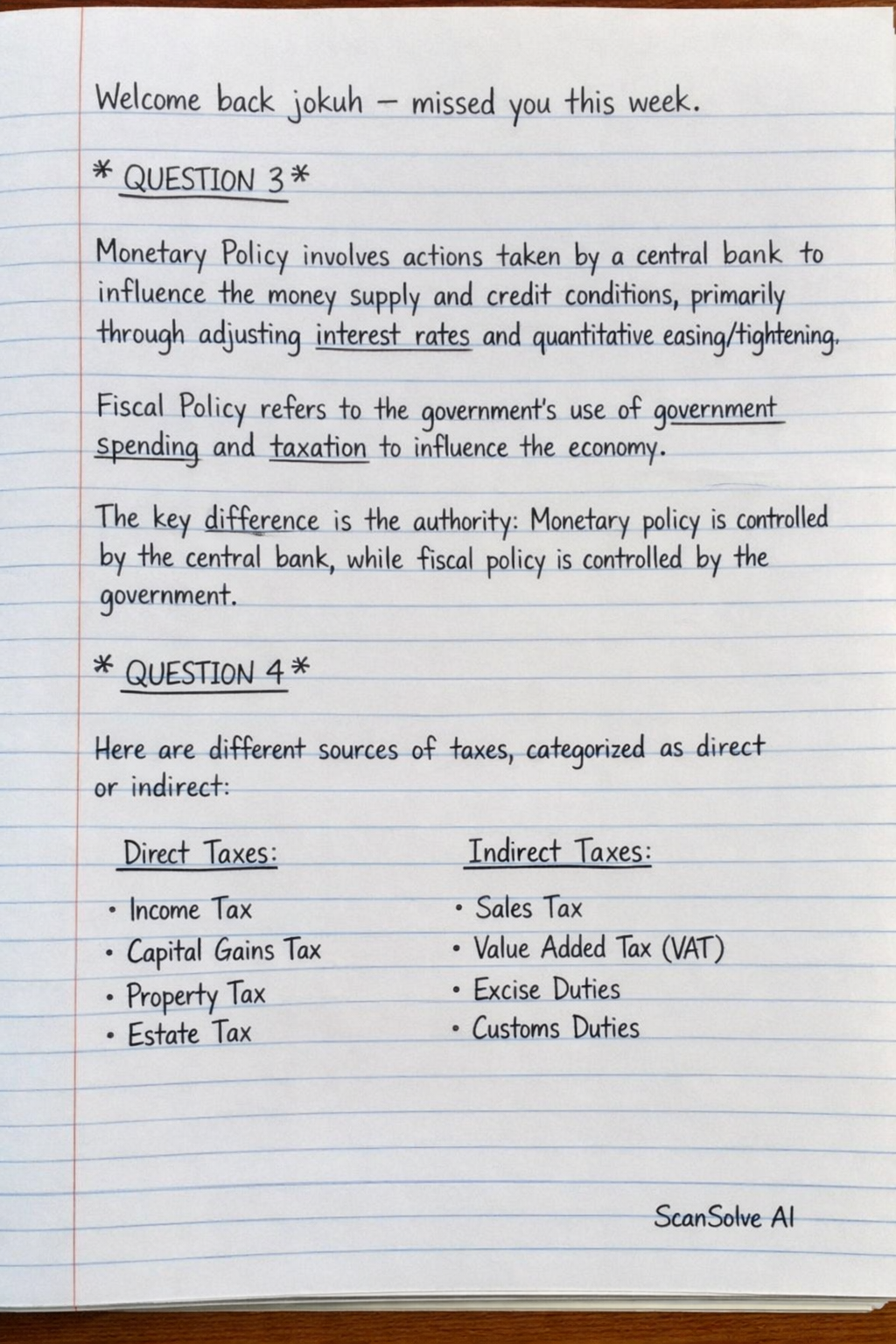
Handwritten Step-by-Step Solution
Get this as a handwritten image on WhatsApp — like a tutor wrote it for you.
Try on WhatsApp