
We read your photo as:
What are the main components of the public sector and examples of indirect taxes, and why does the government intervene in the economy?
ScanSolve AI Answer
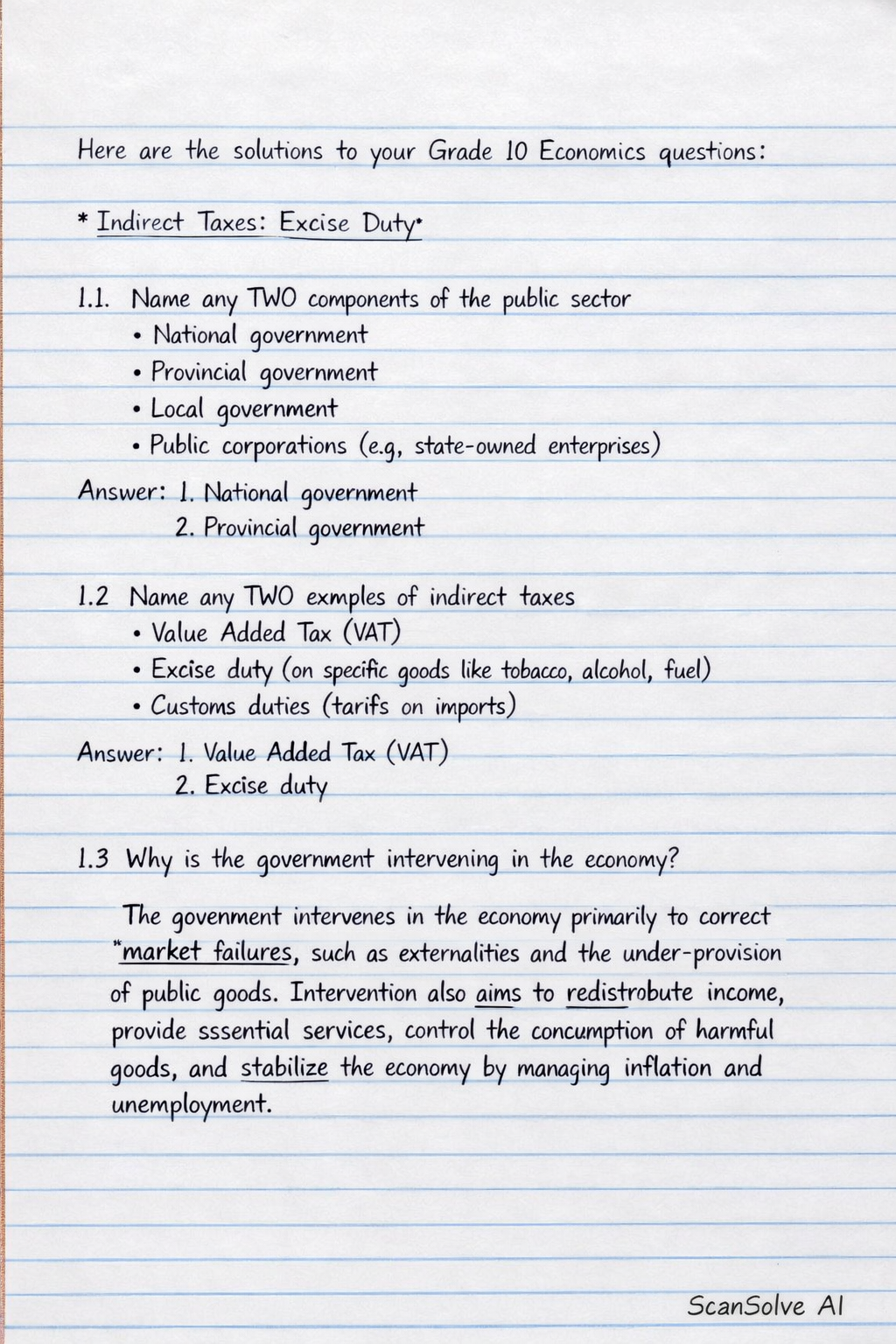
Here are the solutions to your Grade 10 Economics questions:
Indirect Taxes: Excise Duty
1.1 Name any TWO components of the public sector
- National government
- Provincial government
- Local government
- Public corporations (e.g., state-owned enterprises)
Choose any two from the above.
Answer:
- National government
- Provincial government
1.2 Name any TWO examples of indirect taxes
- Value Added Tax (VAT)
- Excise duty (on specific goods like tobacco, alcohol, fuel)
- Customs duties (tariffs on imports)
Choose any two from the above.
Answer:
- Value Added Tax (VAT)
- Excise duty
1.3 Why is the government intervening in the economy?
The government intervenes in the economy primarily to correct market failures, such as externalities and the under-provision of public goods. Intervention also aims to redistribute income, provide essential services, control the consumption of harmful goods, and stabilize the economy by managing inflation and unemployment.
2.1 Identify the original supply curve for the product
The original supply curve for the product is S. The excise tax causes the supply curve to shift from S to S1.
Answer:
S
2.2 Name ONE example of harmful products (demerit goods)
Harmful products, also known as demerit goods, are goods whose consumption is considered socially undesirable.
Answer:
Cigarettes (or alcohol)
2.3 Briefly describe the term indirect taxes
Indirect taxes are taxes levied on goods and services rather than directly on income or profits. They are paid by consumers when they purchase products, but are collected by businesses and then remitted to the government.
2.4 Why does the government charge excise taxes on harmful products?
The government charges excise taxes on harmful products for two main reasons:
- To discourage consumption of demerit goods like tobacco and alcohol, which have negative impacts on public health and society.
- To raise revenue for the government, which can then be used to fund public services or mitigate the social costs associated with these products.
2.5 Explain how the excise tax affected the market for the product in the graph
The excise tax affects the market for the product as follows:
- Supply decreases: The tax increases the cost of production for suppliers, causing the supply curve to shift to the left, from S to S1.
- Price increases: The new equilibrium point () shows that the market price for the product rises from P to P1.
- Quantity decreases: Due to the higher price, the quantity demanded and supplied falls from Q to Q1.
3. Draw and explain the indirect taxes graph as a method of government involvement
A graph illustrating indirect taxes (like an excise tax) would show:
- A downward-sloping demand curve (D) and an upward-sloping original supply curve (S).
- An initial equilibrium point () where D and S intersect, determining the original price (P) and quantity (Q).
- When an indirect tax is imposed, it increases the cost of production, causing the supply curve to shift upwards and to the left, from S to S1.
- The new equilibrium point () is where D intersects S1. This results in a higher equilibrium price (P1) and a lower equilibrium quantity (Q1).
- The vertical distance between S and S1 at the new quantity Q1 represents the per-unit tax. The total tax revenue collected by the government is the area of the rectangle formed by the tax per unit and the new quantity Q1. This intervention aims to reduce consumption of certain goods and generate government revenue.
4. Name any TWO kinds of subsidies
- Production subsidies: Financial assistance given to producers to reduce their costs and encourage production.
- Consumption subsidies: Financial assistance given to consumers to reduce the price they pay for certain goods or services.
Still stuck on this one?
Ask a follow-up, and the answer starts from this question.
More Economics Questions
Handwritten Step-by-Step Solution
Get this as a handwritten image on WhatsApp — like a tutor wrote it for you.
Try on WhatsApp